Oakland is a home for creative and technological innovation. Logistics, transportation, and emerging tech are some of the important industries that see continual innovation each day. When you create something innovative in these or other key fields, you need to protect it. An Oakland, CA, utility patent attorney can help you file to protect the function of your innovation, potentially securing an essential market advantage.
The attorneys at Bold Patents have decades of experience in utility patent laws and how those laws affect innovators in Oakland in many different industries. When you have a bold idea, you need to protect it, especially in the competitive industries that are essential to growth and innovation in Oakland. Our attorneys and our network of patent litigators can help you protect your rights and your invention, whether you are an independent inventor or part of an existing small business.
There are three types of patents: utility patents, design patents, and plant patents. These patents protect different aspects or types of new and innovative inventions. A utility patent is the most commonly used type of patent. It applies to your invention’s function, and is meant to protect:
The invention needs to be new, or an inventive improvement on an existing invention, and it also has to be useful. The invention must also meet the other requirements of a patent, including being non-theoretical and non-obvious. There must also be a description of your invention and how it is made and used.
If you get patent protection, your invention is protected for up to 20 years, as long as you pay the maintenance fees to the USPTO. This protection allows you to take legal action against others who make, sell, use, offer to sell, or import your invention to the United States
Innovators often find their inventions impacted by the key industries that change technological landscapes and other aspects of innovation. When you are an innovator in these industries, being aware of these changes is especially important. Some of the key industries include:
Each of these industries has several supporting elements that help push new ideas and innovation, such as:
Some key resources for innovators to help them refine and develop their inventions and secure patent protection include:
It’s important to get targeted patent guidance for your specific industry. Find your industry below to discover specialized patent requirements, strategic approaches, and how our attorneys can transform your ideas into protected intellectual property and assets.
A: Patents and trademarks apply to different types of intellectual property (IP) and serve different purposes, so which is better will depend on what you want to safeguard and your business intentions.
A patent is for an invention that is new or innovative, such as a new process or design of something manufactured, and patent protection gives you certain legal rights. A trademark is a word, phrase, or symbol associated with your business, which you can register with the USPTO.
A: The average cost of a utility patent depends on whether you qualify for a reduced fee or not. Small entities and micro entities can request fee reductions of 60% to 80%. There are several fees to consider. There is an application fee of between $70 and $350, depending on entity status. There is also a patent search fee of $154 to $770, an examination fee of $176 to $880, and an issue fee of $258 to $1,290.
A: Some things can’t be patented by requirement of the USPTO, like a law of nature, a physical phenomenon, an idea or suggestion, or something abstract. You also cannot get a patent for an invention that is only related to things used in an atomic weapon, like nuclear material or atomic energy. More generally, you can’t patent an invention that someone else has patented or publicly disclosed, because the invention needs to be innovative.
A: On average, the USPTO states that it takes between 27.6 and 44.5 months for a final response on your patent application, or over two to nearly four years, as of January 2026. This range accounts for the use of requests for continued examination (RCEs). Applications with no RCEs took an average of 27.6 months, while applications that only include those with at least one RCE took an average of 44.5 months.
At Bold Patents, we help you protect your financial future. Reach out to our team to hire a utility patent attorney today.
Principal Patent Attorney, Bold Patents
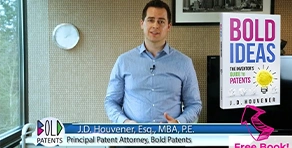




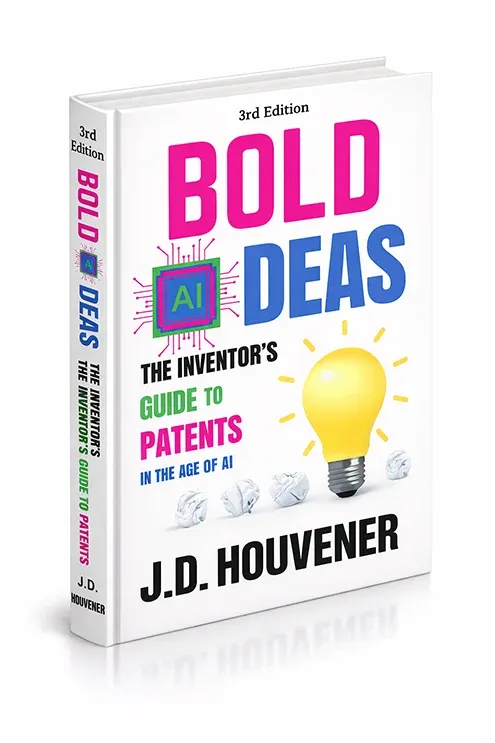
Written by Patent Attorney J.D. Houvener, this updated edition provides inventors, entrepreneurs, and startups with practical guidance for protecting ideas, avoiding costly mistakes, and navigating the patent process with confidence.
Whether you’re exploring a new invention, building a startup, or preparing to file a patent application, our team is here to help you move forward with confidence. Get personalized guidance from experienced patent professionals who understand the challenges inventors face.






We are a full-service patent and trademark prosecution firm. We help inventors and entrepreneurs research, protect, and monetize their intellectual property in the marketplace.
Schedule a Discovery Call 601-298-8425
Copyright © 2026 - Bold Patents• All Rights Reserved. Digital Marketing By: