
The internet is full of patent information.
Some of it is excellent.
Some of it is outdated.
Some of it is simply wrong.
Early in the invention process, Alex made the mistake of bookmarking dozens of websites, blogs, search tools, and databases.
Instead of saving time, the growing list created confusion.
Eventually, Alex adopted a different philosophy.
Rather than collecting resources, Alex built a small toolkit of reliable references that answered nearly every patent question.
Most came directly from official patent offices.
Others were carefully selected tools that made searching, filing, and managing patents easier.
This chapter shares that toolkit.
Not because you need every resource today.
But because you’ll know exactly where to go when you need it.
Reading Time: 10 minutes
Video: 8 minutes
By the time Alex had filed several patent applications, responded to Office Actions, explored international filings, and negotiated licensing discussions, one thing became obvious.
There was no shortage of patent information.
The challenge was knowing which information to trust.
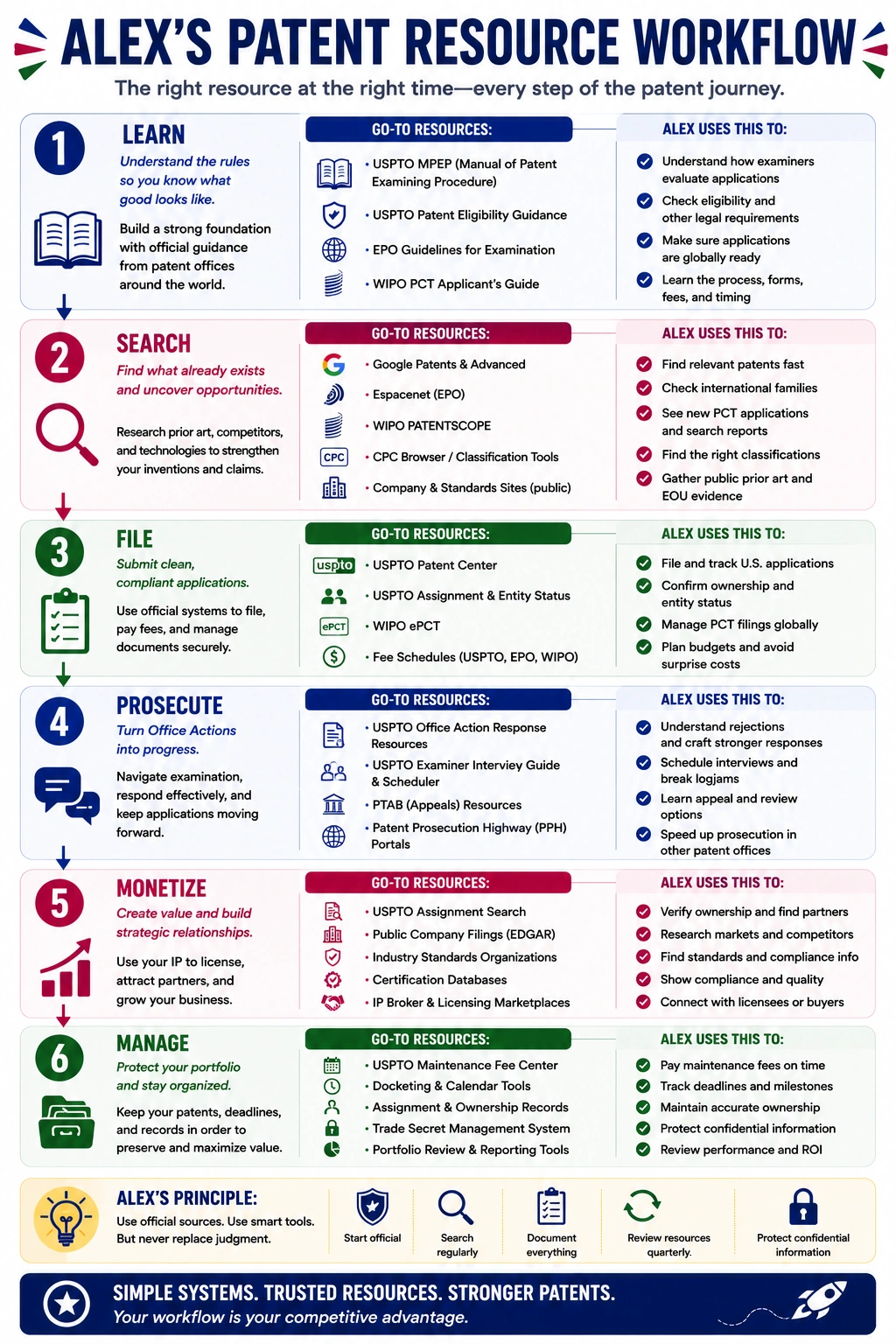
Alex eventually organized every resource into six simple categories:
Instead of searching the internet every time a question arose, Alex always knew where to start.
That simple system saved countless hours.
Every inventor should understand the basic rules before filing a patent application.
Alex relied on official resources whenever possible because they explained how patent offices actually evaluate applications.
Some of the most valuable references included:
Rather than memorizing every rule, Alex learned where to find reliable answers quickly.
Patent searching became one of Alex’s regular habits.
The goal wasn’t simply to see if an invention already existed.
Searching helped Alex:
Alex frequently used:
Excellent for keyword searching and reviewing published patents.
Useful for international patent families and machine translations.
Helpful for published international (PCT) applications and international search reports.
One of Alex’s biggest productivity improvements came from learning the Cooperative Patent Classification (CPC) system.
Searching by classification often uncovered relevant patents that keyword searches completely missed.
As Alex’s portfolio grew, filing became more organized.
Important tools included:
Instead of guessing deadlines or filing requirements, Alex relied on official systems.
Good organization reduced mistakes.
Receiving an Office Action no longer felt overwhelming.
Alex developed a routine.
Review:
Preparation made prosecution more productive.
Once patents began creating business opportunities, Alex expanded the toolkit.
Useful resources included:
These tools helped identify potential partners, estimate market opportunities, and prepare for licensing discussions.
When patent disputes arose, Alex added another category.
Resources included:
Rather than relying on rumors or internet commentary, Alex looked directly at primary sources whenever possible.
Perhaps the most important lesson came after the first patent issued.
Managing patents became just as important as obtaining them.
Alex maintained:
Organization protected the value of the portfolio.

AI can dramatically improve how inventors manage information.
Alex used AI to:
But Alex followed one important rule.
Public AI tools only received public information.
Confidential inventions, unpublished patent applications, source code, and trade secrets stayed inside secure systems.
AI became an organizational assistant—not a replacement for judgment.
As the toolkit matured, Alex returned to the same resources again and again.
Rather than constantly searching for new tools, Alex focused on mastering these core resources.
Depth proved more valuable than endless bookmarks.
Every inventor’s business is different.
Some portfolios emphasize software.
Others focus on medical devices, manufacturing, consumer products, or licensing.
Alex regularly adjusted the toolkit based on changing business needs.
The important lesson wasn’t using identical resources.
It was creating a small, trusted system that remained organized and easy to maintain.
Avoid these common pitfalls:
❌ Collecting hundreds of bookmarks
❌ Relying solely on blogs instead of official sources
❌ Ignoring patent classifications
❌ Missing filing deadlines
❌ Forgetting maintenance fees
❌ Uploading confidential information into public AI platforms
❌ Never reviewing your resource list
One of the biggest productivity improvements I see is surprisingly simple.
Stop searching for more resources.
Start mastering the right ones.
Patent law can seem overwhelming because there’s an endless amount of information available.
But most inventors don’t need dozens of websites.
They need a reliable system.
That’s why I recommend building a personal toolkit using trusted, primary sources and revisiting those resources consistently. A disciplined workflow will almost always outperform a scattered collection of bookmarks.
Google Patents is an excellent starting point for most inventors because it’s easy to use and covers a broad range of published patent documents.
Espacenet is especially useful for researching international patent families and reviewing foreign patent documents.
Official resources reflect the rules and procedures actually used during patent examination, making them more reliable than many secondary sources.
Not necessarily. Many inventors can manage an early-stage portfolio effectively using official patent office tools and a well-organized internal tracking system.
No. AI can help organize and summarize information, but it should complement—not replace—careful legal and technical analysis.
✔ Build a small, trusted toolkit instead of collecting endless resources.
✔ Start with official patent office guidance whenever possible.
✔ Learn the major search tools and classification systems.
✔ Keep your filing, prosecution, and maintenance systems organized.
✔ Use AI to improve organization—not as a substitute for judgment.
✔ A disciplined workflow saves more time than another bookmarked website.
🎥 Video: The Patent Resources Every Inventor Should Know
Learn which patent resources matter most, how to organize your own patent toolkit, and why a disciplined workflow can save time, reduce mistakes, and strengthen your intellectual property strategy.
The right resources are only valuable if you know how to use them.
During a Discovery Call, we’ll help you evaluate your invention, identify the tools that fit your business, and build a practical patent strategy designed to support your long-term innovation goals.
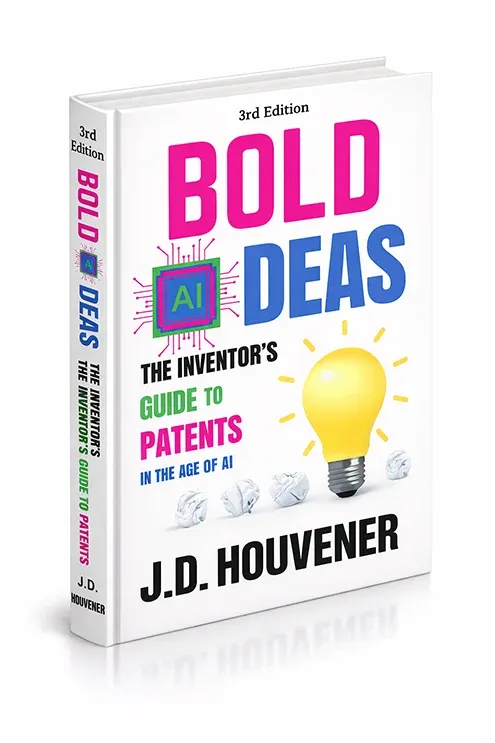
Written by Patent Attorney J.D. Houvener, this updated edition provides inventors, entrepreneurs, and startups with practical guidance for protecting ideas, avoiding costly mistakes, and navigating the patent process with confidence.
Whether you’re exploring a new invention, building a startup, or preparing to file a patent application, our team is here to help you move forward with confidence. Get personalized guidance from experienced patent professionals who understand the challenges inventors face.






We are a full-service patent and trademark prosecution firm. We help inventors and entrepreneurs research, protect, and monetize their intellectual property in the marketplace.
Schedule a Discovery Call 601-298-8425
Copyright © 2026 - Bold Patents• All Rights Reserved. Digital Marketing By: 