
Meet Alex.
Late one evening, Alex sat at his workbench staring at a light bulb that kept failing long before it should.
Instead of accepting the problem, he started asking questions.
Why does this happen?
Could the electronics be redesigned?
Could heat be managed more efficiently?
Within hours, sketches covered his notebook. A new driver architecture and cooling system began taking shape. Alex wasn’t just solving a problem—he was creating something genuinely different.
Then came the question every serious inventor eventually asks:
“Do I need a patent?”
It’s a simple question, but it often reveals a deeper misunderstanding.
Many people think patents are government approvals, business licenses, or certificates proving they invented something first.
They’re none of those.
Understanding what a patent actually is will shape every decision you make from this point forward. As I often tell clients, it’s the keel of the ship. If your understanding of patents is crooked, every decision that follows—filing, investing, licensing, fundraising, and enforcement—will lean in the wrong direction.
At its core, a patent is a legal agreement between an inventor and society.
You agree to publicly teach the world how your invention works.
In exchange, the government gives you a limited right to prevent others from making, using, selling, offering for sale, or importing the invention described by your patent claims.
Think of it like this:
Without patents:
With patents:

The single biggest misconception I hear is this: “A patent gives me the right to make my invention.”
Actually…a patent gives you the right to exclude.
That’s a huge difference.
Imagine your invention is a new electric vehicle battery.
You might own a patent covering your improved cooling system.
Someone else may own an earlier patent covering another essential battery component.
You can own your improvement while still needing permission to practice technology covered by someone else’s patent.
Owning property doesn’t automatically give you access to neighboring property.
Patents work similarly.
A patent creates options.
It can help you:
Notice what isn’t on that list. Guaranteed success.
Patents don’t create demand.
They don’t manufacture products.
They don’t market inventions.
They don’t build businesses. They give you leverage.
Artificial Intelligence has dramatically lowered the barriers to innovation.
Today you can use AI to:
That’s incredible.
But it also means competitors can move faster than ever.
AI accelerates invention. It also accelerates imitation.
That’s one reason patents are becoming increasingly valuable—not less.
The more quickly ideas spread, the more important it becomes to clearly define what belongs to you.
A modern patent generally contains:
Most first-time inventors focus on the description.
Patent attorneys focus on the claims. Why?
Because the claims define the legal boundaries of your invention. The description teaches the invention; the claims define the property line.
Imagine buying ten acres of land.
Your deed defines the property boundary.
The fence tells everyone where your rights begin and end.
Patent claims work exactly the same way.
The broader the claims…
The larger your fence.
The stronger the supporting description…
The harder that fence is to challenge.
Alex initially believed his beautifully written explanation was the valuable part.
It wasn’t.
The real value came from carefully defining exactly what made his invention different—and ensuring those differences appeared in the patent claims.
That realization changed everything.
Instead of describing his invention like a marketing brochure, Alex began documenting it like an inventor.
A patent is NOT:
❌ A business license
❌ Government approval
❌ Proof your invention will succeed
❌ Freedom to operate
❌ A guarantee no one will sue you
❌ A substitute for building a great product
Understanding these limitations helps inventors make smarter business decisions.
Before filing, ask yourself:
If you answered “yes” to most of these questions, you’re already thinking strategically—not just legally. That aligns with the practical checklist Alex develops as he prepares to file.
🎥 Video: What Is a Patent? The One Concept Every Inventor Must Understand
Understanding patents is the first step.
The next question is whether your invention is actually patentable—and what the smartest strategy looks like.
Every inventor’s situation is different. During a Discovery Call, we’ll discuss your invention, your business goals, and whether pursuing patent protection makes sense for you.
→ Schedule Your Discovery Call Today
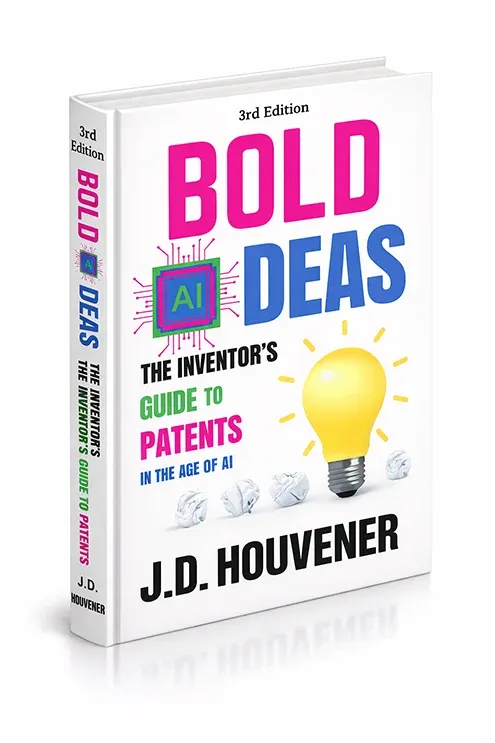
Written by Patent Attorney J.D. Houvener, this updated edition provides inventors, entrepreneurs, and startups with practical guidance for protecting ideas, avoiding costly mistakes, and navigating the patent process with confidence.
Whether you’re exploring a new invention, building a startup, or preparing to file a patent application, our team is here to help you move forward with confidence. Get personalized guidance from experienced patent professionals who understand the challenges inventors face.




We are a full-service patent and trademark prosecution firm. We help inventors and entrepreneurs research, protect, and monetize their intellectual property in the marketplace.
Schedule a Discovery Call 601-298-8425
Copyright © 2026 - Bold Patents• All Rights Reserved. Digital Marketing By: 