
One of the most common questions inventors ask is:
“How long does my patent last?”
The answer depends on the type of patent you own, when it was filed, and how your application moves through the patent process.
A patent’s lifespan isn’t measured the same way for every patent, and certain events can shorten—or occasionally extend—that protection.
Knowing your expiration dates helps you plan product development, licensing opportunities, investor discussions, and future patent filings.
As Alex learned, a patent isn’t just a legal document—it’s a business asset with a timeline.
Reading Time: 13 minutes
Video: 11 minutes
After receiving the patent, Alex proudly framed the certificate.
Then an investor asked a simple question.
“How many years of protection do you have left?”
Alex hesitated.
The answer wasn’t simply “twenty years.”
The patent attorney explained that different patents measure time differently.
Some begin counting from filing.
Others begin counting from grant.
Some can receive additional time.
Others can lose valuable time if mistakes are made.
For the first time, Alex realized the patent portfolio wasn’t just about obtaining patents.
It was about managing their lifespan strategically.
Many inventors assume a patent begins protecting them the day they file.
That’s not exactly how it works.
There are two separate concepts:
How long the patent lasts.
When the patent becomes enforceable.
You generally cannot enforce a patent until it has actually been issued by the USPTO.
Understanding the difference helps avoid confusion when discussing “patent pending” status versus enforceable rights.
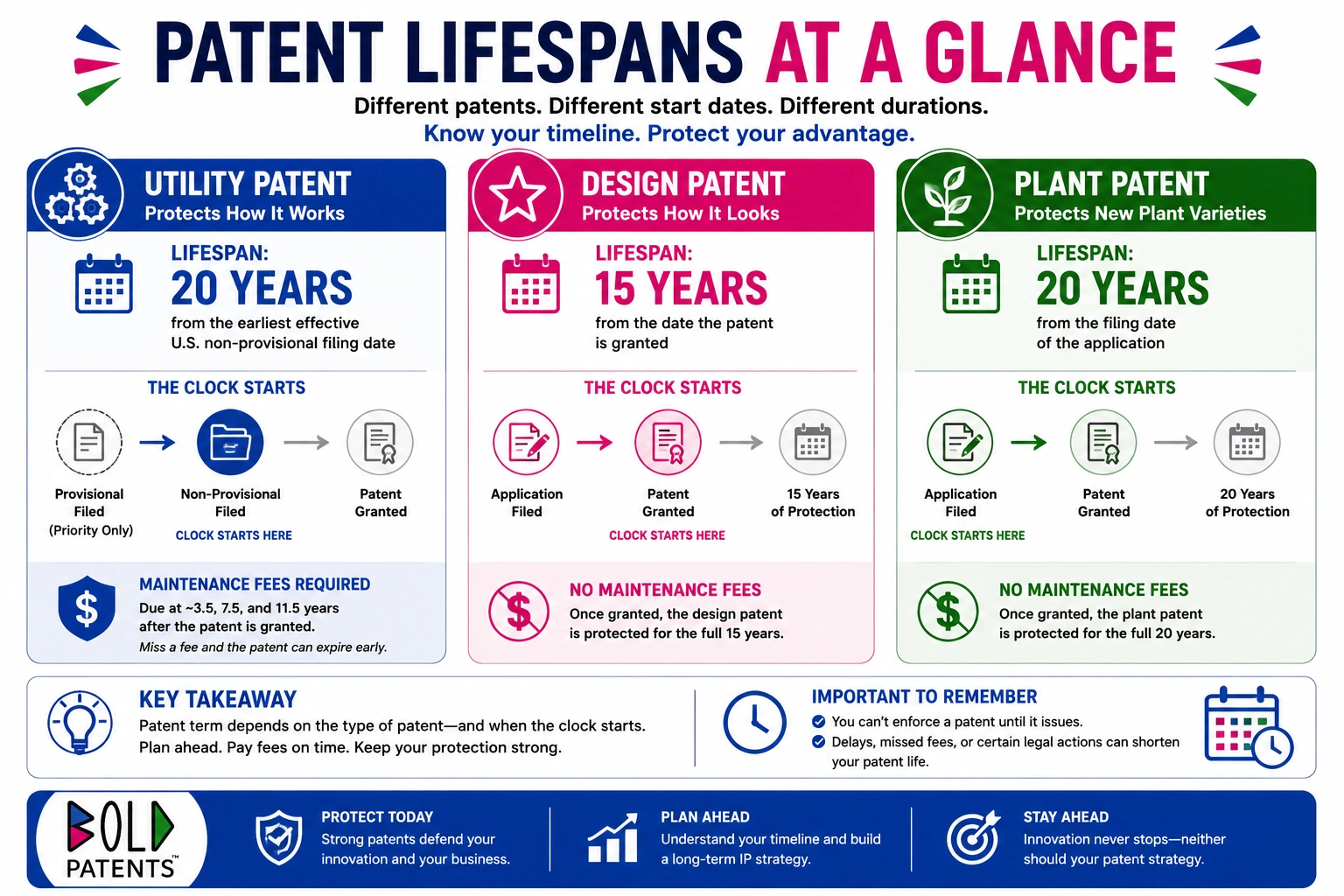
For most modern U.S. utility patents:
This surprises many first-time inventors because patents often issue several years after filing.
The time spent waiting for examination usually counts toward the overall patent term.
Many inventors mistakenly believe filing a provisional application gives them an extra year of patent protection.
It doesn’t.
A provisional application establishes an early priority date, but the 20-year patent term generally begins with the later non-provisional application.
Think of the provisional as reserving your place in line—not extending the life of the patent.
Design patents follow a different rule.
For most modern U.S. design patents:
Because the term begins at issuance, design patents often provide a predictable period of protection for product appearance.
Unlike utility patents, U.S. design patents do not require maintenance fees.
Plant patents generally provide:
Like design patents, plant patents do not require maintenance fees.
Although relatively uncommon outside agriculture and horticulture, they follow their own unique rules.
Sometimes.
Certain utility patents may receive additional time because of delays that occurred during examination.
This is known as a Patent Term Adjustment (PTA).
PTA is intended to compensate applicants when the USPTO exceeds certain examination timelines.
However, applicants can reduce or lose some of that additional time by causing unnecessary delays themselves.
Prompt responses during prosecution help preserve valuable patent term.
These two concepts sound similar, but they’re very different.
Compensates for delays caused by the USPTO during examination.
Typically applies only to utility patents.
Available only in limited industries, such as pharmaceuticals and certain medical products, where regulatory review delays commercialization.
Most inventors will never use Patent Term Extension.
Understanding the difference prevents confusion during patent planning.
Several factors can reduce the practical life of a patent.
Examples include:
Good patent management helps preserve the maximum available protection.
Different filing strategies affect patent timing in different ways.
Establish priority.
Do not start the patent term.
Allow additional claim strategies.
Do not create a new 20-year patent term.
Separate inventions when required.
Still share the original filing date for patent term purposes.
Can be useful in limited situations but require careful planning because they may affect long-term patent strategy.
Choosing the right filing approach depends on both legal and business considerations.
AI can be extremely useful for portfolio management by helping track:
AI can organize information efficiently.
However, determining the legal patent term and evaluating filing strategy still require experienced legal judgment.
Think of AI as your portfolio manager—not your patent attorney.
Smart companies don’t wait until patents expire to think about the future.
Instead, they continuously evaluate:
By filing new innovations as products evolve, businesses can maintain a healthy portfolio with overlapping patent protection.
Alex realized that the goal wasn’t making one patent last forever.
It was creating a pipeline of innovation that kept the business protected for years to come.
Avoid these common myths:
❌ A provisional application gives you 21 years of protection.
❌ Every continuation creates a new 20-year patent.
❌ Patent Pending means enforceable rights.
❌ All patents expire the same way.
❌ Patent term always begins when the patent issues.
Understanding these distinctions helps inventors make smarter long-term decisions.
One of the most valuable things a patent portfolio gives a business isn’t simply protection.
It’s predictability.
Investors want to know how long exclusivity will last.
Business partners want to know how long competitive advantages remain protected.
Competitors want to know when those protections expire.
Understanding patent timelines allows you to make better business decisions long before the expiration date arrives.
The strongest patent portfolios aren’t built around a single filing.
They’re built around a long-term innovation strategy that keeps new intellectual property entering the portfolio as older patents mature.
For most modern U.S. utility patents, approximately 20 years from the earliest qualifying non-provisional filing date.
No. It establishes priority but generally does not start the 20-year patent term.
Most modern U.S. design patents last 15 years from the date they are granted.
Sometimes. Certain utility patents may receive Patent Term Adjustment because of USPTO delays, while limited industries may qualify for Patent Term Extension.
Yes. Missing maintenance fees or certain legal circumstances can shorten the practical life of a patent.
✔ Utility patents generally last 20 years from the qualifying non-provisional filing date.
✔ Design patents generally last 15 years from grant.
✔ Plant patents generally last 20 years from filing.
✔ Patent Term Adjustment and Patent Term Extension are different concepts.
✔ Strong patent portfolios are built through continuous innovation—not a single filing.
🎥 Video: How Long Does a Patent Last? Understanding Patent Expiration Dates
Learn how patent terms are calculated, what affects expiration dates, and how strategic planning can maximize the long-term value of your intellectual property.
A patent isn’t just about protecting today’s invention—it’s about planning tomorrow’s opportunities.
During a Discovery Call, we’ll review your patent timeline, discuss filing strategies, identify future opportunities, and help you build a portfolio that supports long-term business growth.
Written by Patent Attorney J.D. Houvener, this updated edition provides inventors, entrepreneurs, and startups with practical guidance for protecting ideas, avoiding costly mistakes, and navigating the patent process with confidence.
Whether you’re exploring a new invention, building a startup, or preparing to file a patent application, our team is here to help you move forward with confidence. Get personalized guidance from experienced patent professionals who understand the challenges inventors face.







We are a full-service patent and trademark prosecution firm. We help inventors and entrepreneurs research, protect, and monetize their intellectual property in the marketplace.
Schedule a Discovery Call 601-298-8425
Copyright © 2026 - Bold Patents• All Rights Reserved. Digital Marketing By: 