
Many inventors assume every innovation should become a patent.
Others believe keeping everything secret is the safest approach.
Neither strategy is correct.
Some innovations should absolutely be patented.
Others are far more valuable if they remain confidential.
The challenge is knowing which approach creates the greatest long-term competitive advantage.
Alex discovered that patents and trade secrets aren’t competing strategies.
They’re complementary tools that work best together.
The strongest companies don’t choose one or the other.
They intentionally use both.
Reading Time: 16 minutes
Video: 13 minutes
As Alex’s patent portfolio continued to grow, another question emerged.
“Should we patent this too?”
Sometimes the answer was yes.
Sometimes the answer was absolutely not.
One afternoon, Alex spread dozens of engineering documents across a conference table.
Some described inventions customers could easily reverse engineer.
Others contained manufacturing techniques no customer would ever see.
The patent attorney smiled.
“You’re looking at two completely different kinds of competitive advantage.”
That conversation changed the way Alex thought about intellectual property.
Not everything valuable belongs in a patent application.
Some of the company’s greatest assets would never appear in a USPTO filing.
Instead, they would stay locked inside the company.
A patent gives you the right to prevent others from making, using, selling, offering to sell, or importing your claimed invention for a limited period of time.
In exchange, you publicly disclose how the invention works.
A trade secret works differently.
Rather than disclosing information, you protect it by keeping it confidential.
As long as the information remains secret—and reasonable efforts are taken to protect it—it may continue providing competitive value indefinitely.
The tradeoff is simple.
Patents require disclosure.
Trade secrets require secrecy.
Neither is inherently better.
The best choice depends on the nature of the innovation.
Alex stopped making decisions based on instinct.
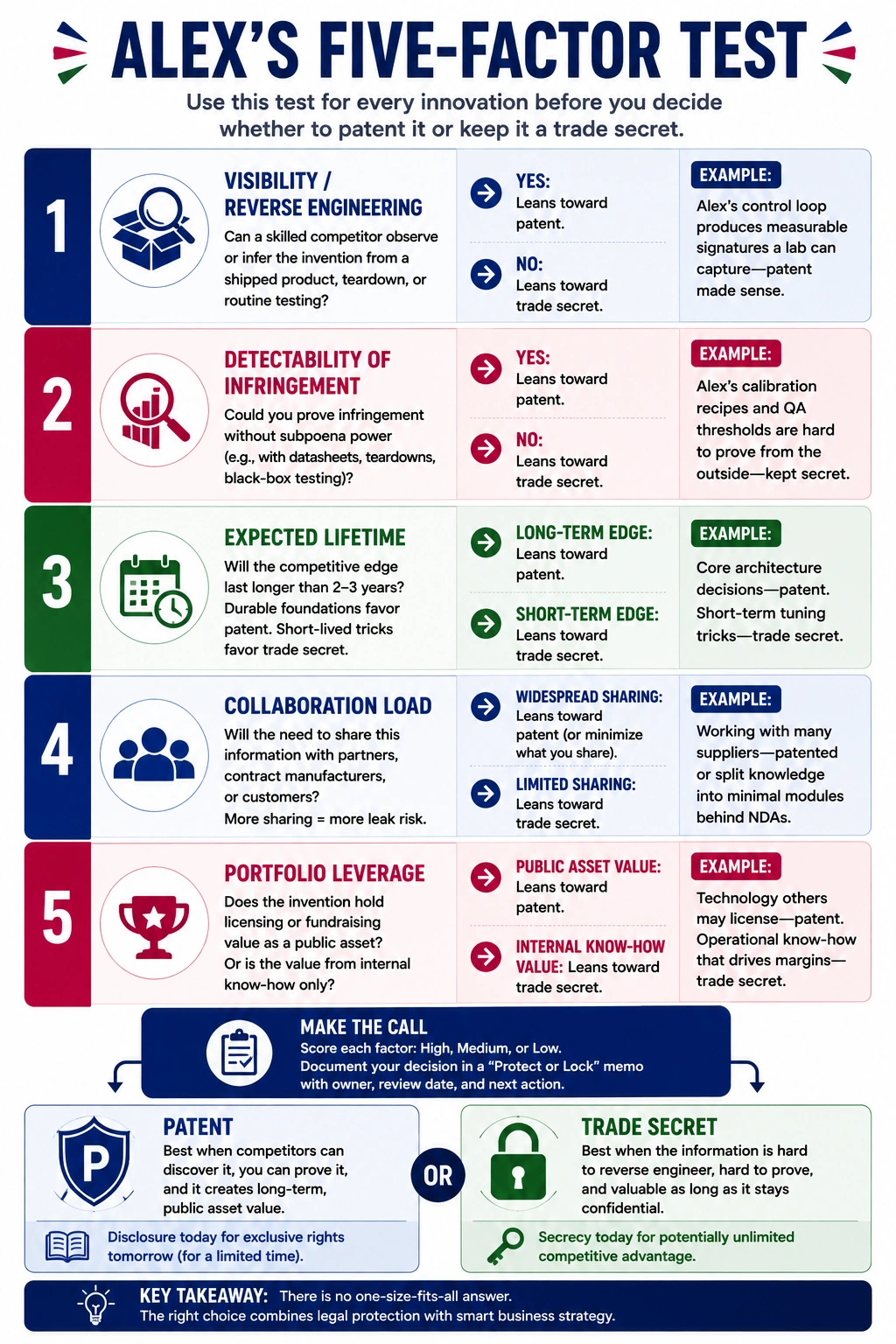
Instead, every potential innovation passed through five simple questions.
If someone can learn how your invention works simply by buying your product, patent protection often makes more sense.
If they can’t reasonably discover the information, trade secret protection may provide greater value.
Some inventions are visible.
Others exist only inside manufacturing processes or internal software.
If infringement would be nearly impossible to detect, a trade secret may provide stronger protection.
A manufacturing shortcut that becomes obsolete next year may not justify a patent.
A foundational technology expected to remain valuable for decades may.
The more partners, suppliers, contractors, and employees who require access, the greater the risk that confidential information eventually leaks.
Broad collaboration sometimes favors patent protection.
Some innovations increase company valuation because they become public intellectual property assets.
Others create value only through operational know-how.
Those often belong in the trade secret category.
Alex rarely chose only one form of protection.
Instead, the company divided technology into two categories.
Anything competitors could likely observe, measure, or reverse engineer.
Examples included:
Knowledge that remained inside the company.
Examples included:
Together, the two forms of protection created a much stronger competitive advantage than either could alone.
Many companies claim to have trade secrets.
Few actually protect them.
Alex built a structured program that included:
Trade secrets remain valuable only if reasonable efforts are taken to protect them.
Artificial intelligence has changed how companies handle confidential information.
Alex established several simple rules.
Never upload:
into public AI systems.
AI became an excellent assistant.
It never became a vault.
One lesson surprised Alex.
A patent application must enable the invention.
It does not require revealing every internal business process.
Strong patent drafting teaches someone how to make and use the invention.
It does not require donating every manufacturing shortcut, quality-control process, or calibration technique that creates competitive advantage.
The best patent applications disclose enough to satisfy the law while preserving valuable know-how as trade secrets.
Many inventors assume once information becomes a trade secret, the decision is permanent.
Alex treated it differently.
Every six to twelve months, the team reviewed important trade secrets.
Questions included:
Sometimes yesterday’s trade secret became tomorrow’s patent application.
Intellectual property strategy evolves with the business.
AI can help organize internal knowledge, summarize public documents, and improve workflows.
However, Alex followed three non-negotiable rules:
✔ Never upload confidential information into public AI systems.
✔ Use enterprise AI tools whenever sensitive information is involved.
✔ Human review remains mandatory before anything leaves the company.
The fastest way to lose a trade secret is to accidentally make it public.
Avoid these frequent errors:
❌ Patenting everything
❌ Keeping everything secret
❌ Sharing confidential information too broadly
❌ Forgetting employee agreements
❌ Assuming NDAs alone create trade secret protection
❌ Uploading proprietary information into public AI platforms
❌ Never revisiting earlier protection decisions
One of the biggest misconceptions I see is that patents and trade secrets compete with one another.
They don’t.
The strongest intellectual property strategies use both.
Patents protect what competitors can eventually discover.
Trade secrets protect what they never should.
The art isn’t choosing one.
It’s understanding where each creates the greatest long-term value.
That’s how real competitive moats are built.
No. Some innovations create greater value when they remain confidential.
Absolutely. Many successful products combine patented technology with confidential manufacturing methods, software, calibration processes, or business know-how.
Potentially forever—as long as it remains secret and reasonable measures are taken to protect it.
Public disclosure, poor security practices, uncontrolled sharing, or failure to maintain confidentiality.
Potentially. Uploading confidential information into public AI platforms may jeopardize secrecy depending on the circumstances and platform.
✔ Patents and trade secrets solve different business problems.
✔ Alex’s Five-Factor Test creates better protection decisions.
✔ Many businesses benefit from using both forms of protection.
✔ Strong trade secret programs require active management.
✔ Patent applications should disclose enough—but not more than necessary.
✔ Intellectual property strategy should evolve as your business grows.
🎥 Video: Patent vs. Trade Secret: Which Protection Is Right for Your Innovation?
Learn how to decide whether an invention should be patented or protected as a trade secret, understand Alex’s Five-Factor Test, and discover how successful companies combine both strategies to build lasting competitive advantages.
Every innovation deserves the right type of protection—not simply the most familiar one.
During a Discovery Call, we’ll evaluate your technology, identify what should be patented, determine what should remain confidential, and build an intellectual property strategy that supports your long-term business goals.
Written by Patent Attorney J.D. Houvener, this updated edition provides inventors, entrepreneurs, and startups with practical guidance for protecting ideas, avoiding costly mistakes, and navigating the patent process with confidence.
Whether you’re exploring a new invention, building a startup, or preparing to file a patent application, our team is here to help you move forward with confidence. Get personalized guidance from experienced patent professionals who understand the challenges inventors face.






We are a full-service patent and trademark prosecution firm. We help inventors and entrepreneurs research, protect, and monetize their intellectual property in the marketplace.
Schedule a Discovery Call 601-298-8425
Copyright © 2026 - Bold Patents• All Rights Reserved. Digital Marketing By: 