Having a great product doesn’t automatically mean you can get a patent.
The U.S. Patent Office evaluates every invention using specific legal requirements. Understanding these standards before you file can save time, money, and frustration.
In this chapter, you’ll learn the three fundamental questions every patent examiner asks—and how they determine whether your invention deserves patent protection.
Reading Time: 11 minutes
Video: 3 minutes
Alex had done everything right.
He built the prototype.
Tested it.
Improved it.
Friends loved it.
Potential customers loved it.
Confidently, Alex declared,
“I’m ready to patent my invention.”
His patent attorney smiled.
“Maybe.”
Alex looked confused.
“What do you mean, maybe?”
The attorney asked three simple questions.
“Has anyone done this before?”
“Does it actually solve a useful problem?”
“And would this improvement have been obvious to another engineer?”
Alex suddenly realized…
Inventing something useful isn’t enough.
You also have to satisfy the legal requirements for patentability.
Think of these as three gates.
Your invention must successfully pass all three before a patent can be granted.
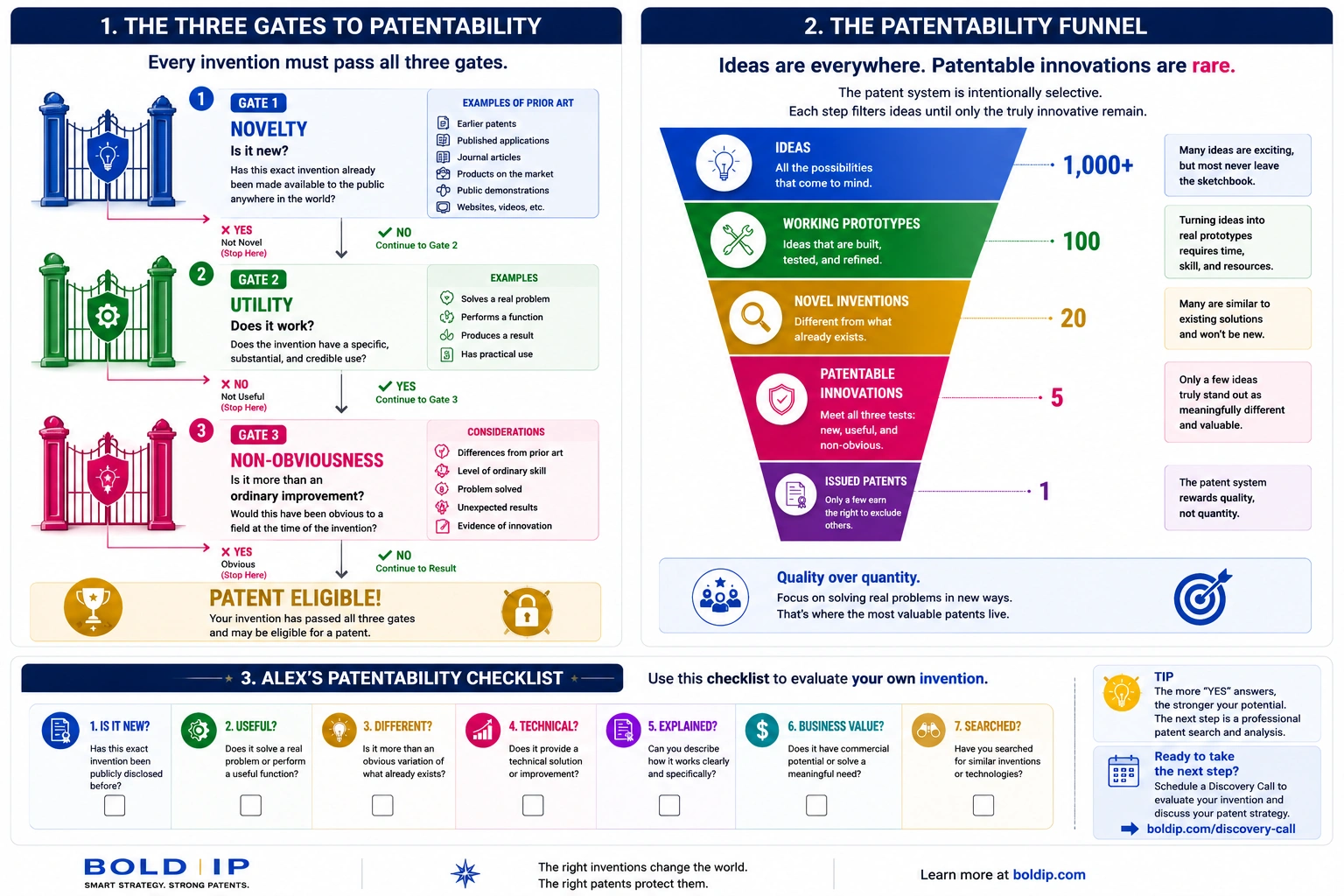
Your invention must be new.
That sounds simple…
But “new” has a very specific legal meaning.
If someone else has already publicly disclosed the same invention before your filing date, it’s no longer novel.
That prior disclosure could be:
Novelty asks one question:
Has this exact invention already been made available to the public?
Your invention must have a useful purpose.
Fortunately…
This requirement is usually easy to satisfy.
If your invention performs a real function or solves a genuine problem, utility is rarely the obstacle.
Examples:
✔ Medical device
✔ Software
✔ Manufacturing tool
✔ Consumer product
✔ AI-assisted process
Patent law rewards inventions that produce practical results.
This is where many patent applications succeed—or fail.
Your invention cannot simply be an obvious variation of existing technology.
Imagine this.
Suppose someone invented:
A blue hammer.
You invent…
A red hammer.
Probably obvious.
But…
Suppose your redesign cuts vibration by 60%.
Reduces fatigue.
Improves safety.
Extends tool life.
Now we’re asking a different question.
Not:
“What color is it?”
Instead:
“What technical problem did you solve?”
Non-obviousness is about meaningful innovation—not cosmetic change.
One of the biggest surprises for inventors is that patent examiners compare your invention against everything that already exists.
This existing body of knowledge is called prior art.
Prior art includes:
If it’s publicly available…
It may count.
Alex originally thought his invention was “a better light bulb.”
His attorney disagreed.
After reviewing prior art, they discovered dozens of similar bulbs already existed.
But…
None used Alex’s unique thermal feedback algorithm.
That became the innovation.
Instead of trying to patent the entire product…
They patented the improvement that truly mattered.
That’s exactly how many successful patent strategies are built.
Today’s inventors have access to extraordinary research tools.
AI can help:
That’s incredibly valuable.
But AI isn’t a substitute for a professional patentability search.
Large language models don’t have perfect visibility into patent databases, and they can’t provide legal opinions.
Think of AI as an incredibly fast research assistant—not the final decision-maker.
Before your Discovery Call, ask your favorite AI assistant:
“What existing technologies solve the same problem my invention solves?”
You may discover opportunities to differentiate your invention before filing.
“I’ve never seen this before.”
That doesn’t mean it’s new.
Someone may have patented it twenty years ago.
“It works better.”
How much better?
Can you measure it?
Better patents often begin with measurable improvements.
“It’s just one small improvement.”
Some of history’s most valuable patents protected improvements rather than entirely new products.
Small innovations often create enormous competitive advantages.
Consider the smartphone.
Thousands of patents protect:
Very few companies invented the smartphone.
Many invented important improvements.
Innovation is cumulative.
Patents reward meaningful contributions along the way.
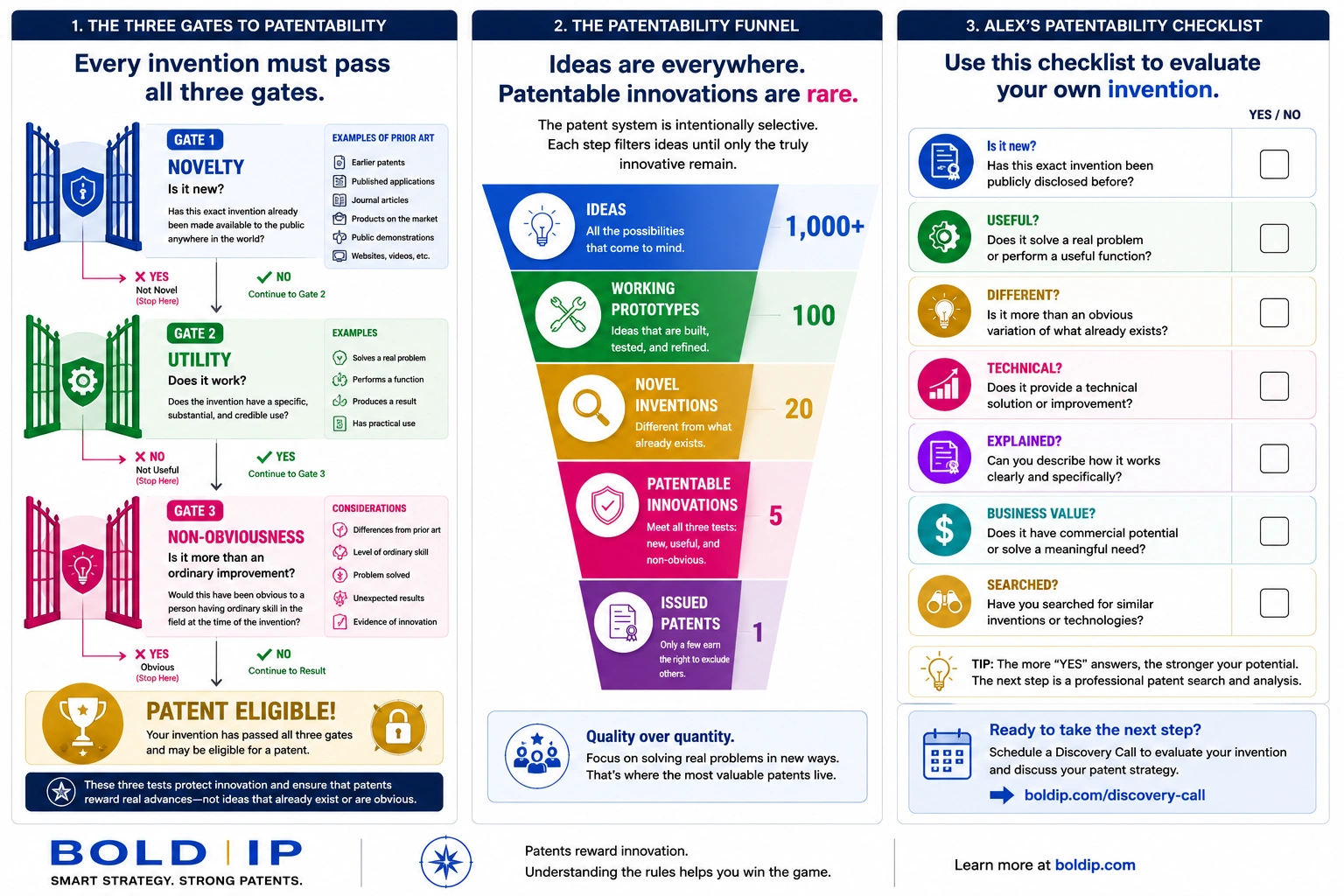
Ask yourself:
✓ What makes my invention different?
✓ Can I explain that difference in one sentence?
✓ Does it solve a technical problem?
✓ Could I measure the improvement?
✓ Have I searched for similar solutions?
If not…
Now is the perfect time.
A patentable invention is generally:
✅ New
✅ Useful
✅ Non-obvious
Most successful patents aren’t revolutionary.
They’re meaningful improvements that solve real technical problems in ways others hadn’t previously recognized.
That’s encouraging news for inventors.
You don’t have to reinvent the world.
You simply have to make it better.
AI is helping inventors generate ideas faster than at any point in history. That’s exciting—but it also means more people may arrive at similar solutions around the same time.
The inventors who stand out won’t necessarily be those with the most ideas. They’ll be the ones who can clearly demonstrate what makes their solution technically different, why that difference matters, and how it creates measurable value.
In the Age of AI, clarity may be just as important as creativity.
🎥 Video: The Three Tests Every Invention Must Pass to Get a Patent
The fastest way to understand your patent potential is to discuss your invention with an experienced patent attorney.
During your Discovery Call, we’ll evaluate your innovation, identify potential patent opportunities, discuss prior art considerations, and help you determine the smartest path forward.
→ Book Your Discovery Call
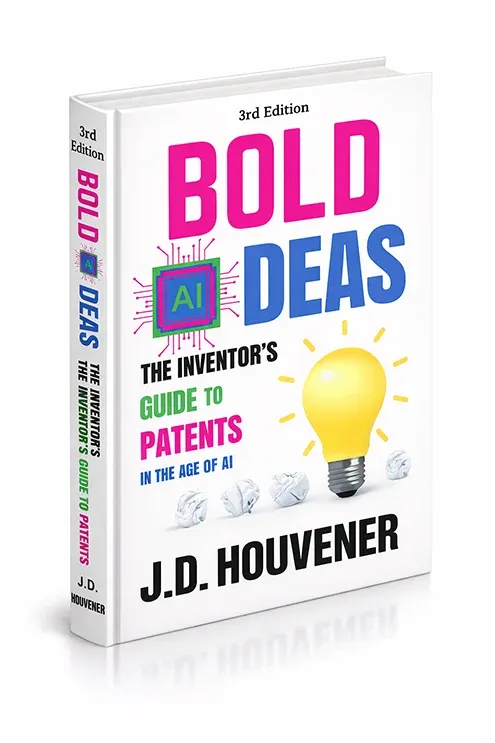
Written by Patent Attorney J.D. Houvener, this updated edition provides inventors, entrepreneurs, and startups with practical guidance for protecting ideas, avoiding costly mistakes, and navigating the patent process with confidence.
Whether you’re exploring a new invention, building a startup, or preparing to file a patent application, our team is here to help you move forward with confidence. Get personalized guidance from experienced patent professionals who understand the challenges inventors face.




We are a full-service patent and trademark prosecution firm. We help inventors and entrepreneurs research, protect, and monetize their intellectual property in the marketplace.
Schedule a Discovery Call 601-298-8425
Copyright © 2026 - Bold Patents• All Rights Reserved. Digital Marketing By: 