
Many inventors think patent enforcement begins with a cease-and-desist letter or a lawsuit.
In reality, successful enforcement starts long before any dispute arises.
It begins with good recordkeeping, market awareness, strong evidence, and a clear business strategy.
The goal isn’t to sue everyone who resembles your product.
The goal is to protect your competitive advantage while resolving conflicts as efficiently and commercially as possible.
Alex discovered that the strongest enforcement strategy wasn’t built on aggression—it was built on preparation. A clean patent file, credible evidence, and thoughtful business discussions often accomplished more than threats ever could.
Reading Time: 15 minutes
Video: 12 minutes
Several months after launching the product, Alex noticed something familiar at an industry trade show.
Across the aisle sat a competing product that looked remarkably similar.
At first, frustration took over.
“They’re copying us.”
The patent attorney offered different advice.
“Let’s not assume. Let’s investigate.”
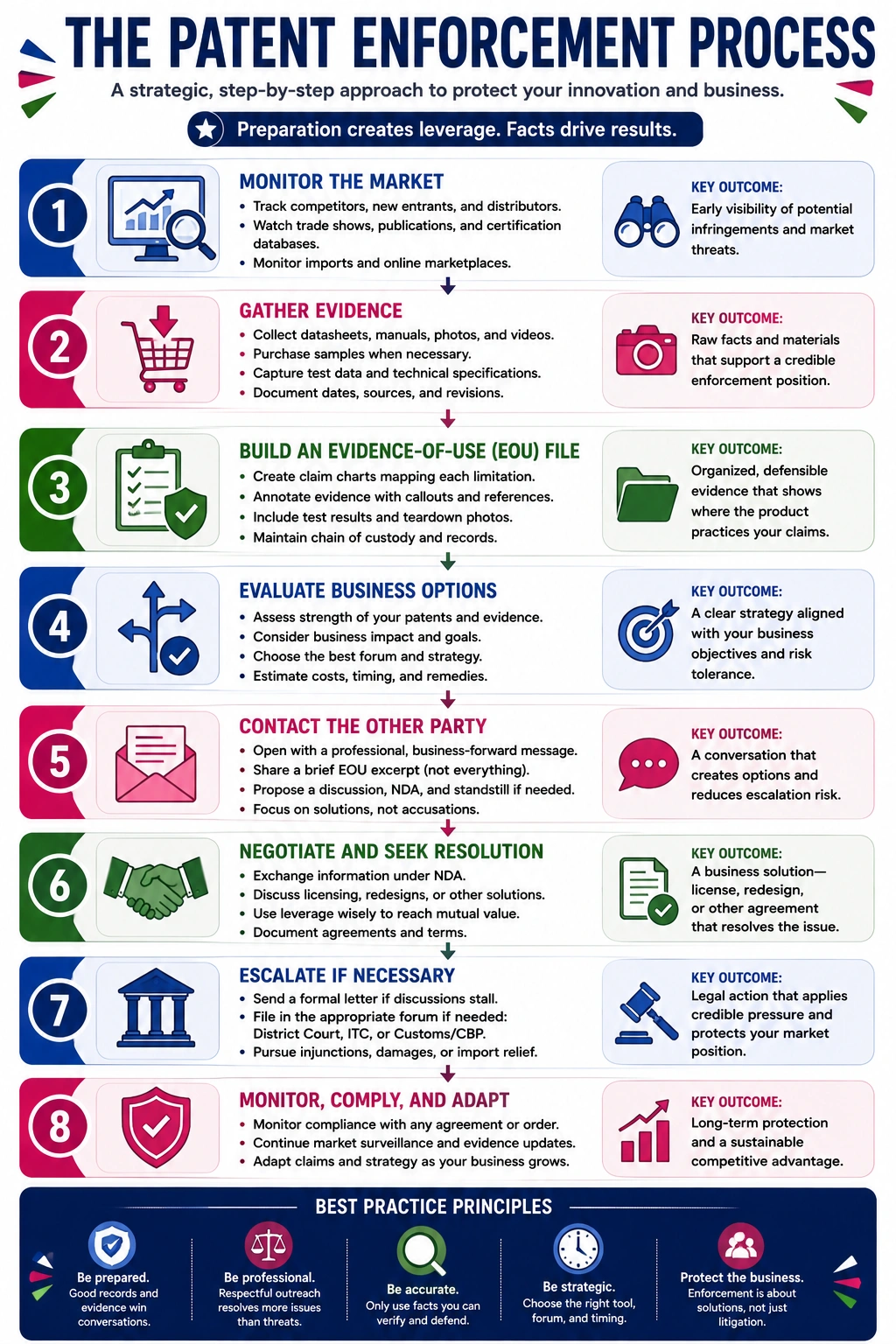
Instead of sending an angry letter, Alex’s team quietly gathered information.
They collected product literature.
Downloaded technical manuals.
Purchased a sample.
Photographed the product.
Compared each feature to the patent claims.
Only after the facts were organized did they discuss next steps.
That discipline transformed emotion into strategy.
You cannot protect what you don’t monitor.
Rather than trying to watch every company in the industry, Alex created focused watch lists.
These included:
The objective wasn’t constant surveillance.
It was staying informed about meaningful developments that could affect the business.
One of the biggest mistakes inventors make is assuming a competing product infringes simply because it looks similar.
Patent enforcement requires evidence.
Alex created an Evidence-of-Use (EOU) file for each potential issue.
The file typically included:
Every important fact could be traced back to objective evidence.
The goal was simple:
Replace “We think.”
With “Here’s where.”
An Evidence-of-Use (EOU) chart compares the patent claims to a product.
Typically, the chart includes:
Each limitation from the patent claim.
Evidence showing where the product appears to satisfy that limitation.
Possible sources include:
Well-prepared EOU charts create credibility during licensing discussions and, if necessary, litigation.
Alex treated evidence carefully.
The team:
Good evidence today may become important years later.
Not every situation requires the same response.
Alex evaluated several options.
Often the first and least expensive approach.
A professional conversation may resolve the issue through licensing, redesign, or other commercial solutions.
District courts may provide:
These cases often require substantial time and resources.
When infringing products are imported into the United States, the ITC may offer powerful remedies.
Instead of awarding money damages, the ITC can exclude products from entering the country.
For imported products, this may create significant business pressure.
For certain forms of intellectual property, including many design-related rights, U.S. Customs may assist in identifying infringing imports.
Border enforcement can become an effective complement to traditional litigation.
One of Alex’s biggest lessons was this:
The first letter should open a conversation—not start a war.
Instead of making accusations, Alex focused on:
The objective was to encourage dialogue while preserving legal options.
Sometimes a calm approach produces better results than an aggressive one.
If litigation becomes necessary, several remedies may be available.
An injunction may prohibit continued infringement under appropriate circumstances.
This can be especially important when market share, reputation, or customer relationships are at stake.
Successful patent owners may recover damages based on several legal theories, depending on the facts.
Examples may include:
The available recovery depends heavily on the evidence and the circumstances of the case.
Enforcement rarely proceeds without resistance.
Competitors may:
Alex prepared for these possibilities before beginning enforcement discussions.
Preparation reduced surprises.
Design patents often provide unique enforcement advantages.
Because they protect appearance, infringement may sometimes be easier to explain visually.
Alex used design patents strategically against products that closely copied the product’s distinctive appearance while preserving utility patent claims for broader technology protection.
Sometimes appearance created the quickest path toward resolution.
AI can help monitor:
AI can also assist with:
However, Alex followed several important rules.
AI accelerates preparation.
Human judgment remains essential.
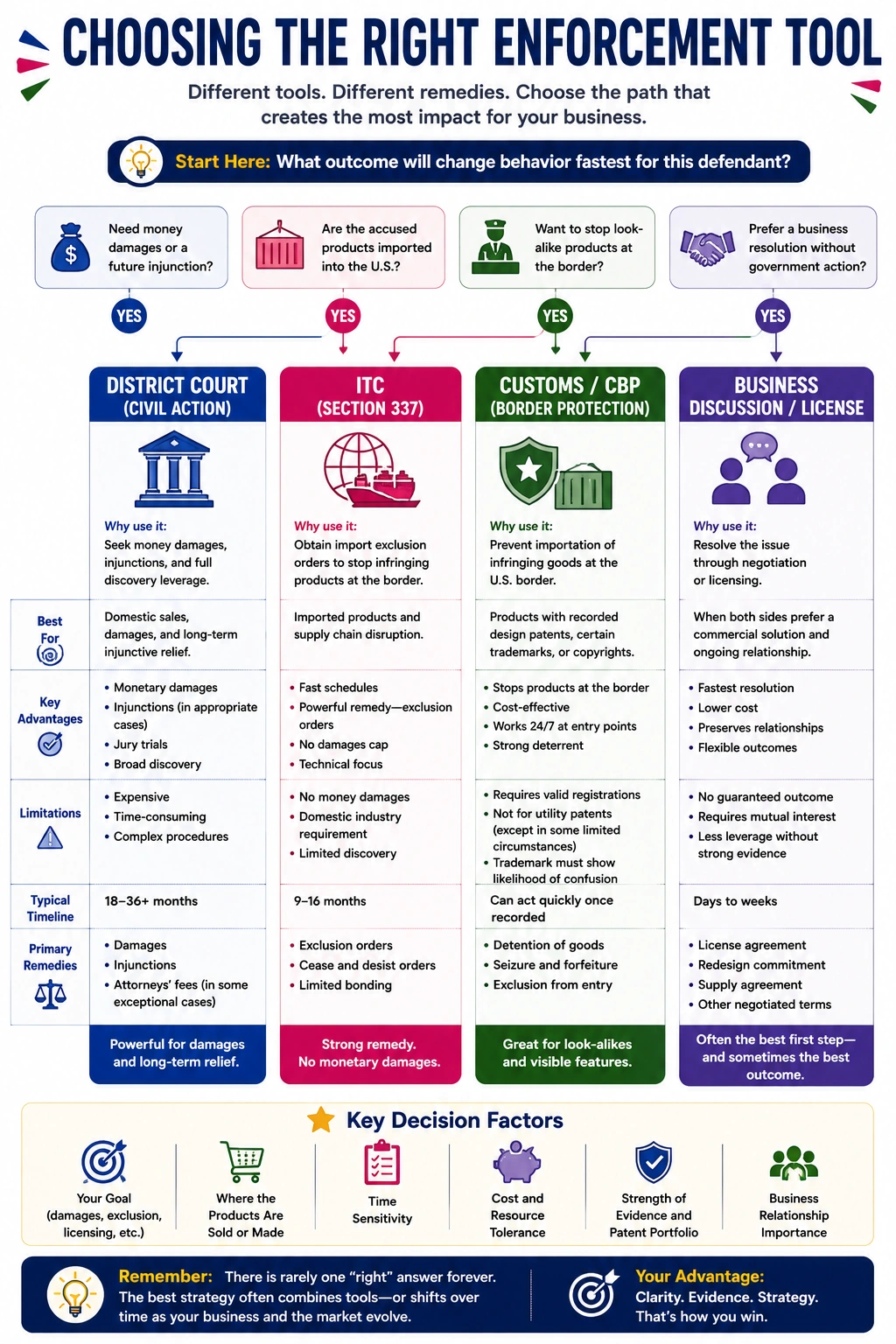
Alex followed a deliberate process.
Quietly monitor the market.
↓
Prepare internal evidence.
↓
Evaluate business options.
↓
Begin professional outreach.
↓
Exchange information under appropriate confidentiality protections.
↓
Send a carefully prepared letter if necessary.
↓
Consider litigation or administrative remedies.
↓
Continue pursuing settlement whenever appropriate.
The objective remained the same throughout:
Protect the business while resolving disputes efficiently.
Patent litigation can be valuable.
It can also be expensive.
Alex evaluated:
Each major stage became a decision point.
Rather than committing to years of litigation from the beginning, Alex continuously reassessed whether the expected value justified continued investment.
Avoid these common pitfalls:
❌ Assuming similarity equals infringement
❌ Sending aggressive letters without evidence
❌ Ignoring documentation and recordkeeping
❌ Failing to monitor competitors
❌ Uploading confidential information into public AI tools
❌ Treating litigation as the first option instead of the last
❌ Forgetting that enforcement should support business goals
One of the biggest misconceptions about patent enforcement is that it’s primarily about lawsuits.
In my experience, it’s really about preparation.
The companies that achieve the best outcomes are rarely the loudest.
They’re the most organized.
They know their patent.
They understand the market.
They’ve gathered evidence.
They’ve considered business solutions before legal ones.
And when litigation becomes necessary, they’re ready because they’ve been preparing all along.
Good enforcement creates leverage.
Great preparation creates options.
No. Many disputes are resolved through licensing discussions, business negotiations, redesigns, or other commercial agreements.
An Evidence-of-Use chart compares each limitation of a patent claim with publicly available evidence from a product to evaluate whether the claim may be practiced.
Usually not. Gather facts first, evaluate your patent, and discuss strategy with experienced patent counsel before making accusations.
No. AI may help organize information or identify similarities, but infringement analysis requires careful legal and technical evaluation.
Proper marking may affect available remedies and demonstrates good intellectual property management.
✔ Successful enforcement begins with preparation.
✔ Good evidence creates stronger business conversations.
✔ Evidence-of-Use charts organize facts—not assumptions.
✔ Different enforcement forums provide different remedies.
✔ Professional communication often produces better outcomes than aggressive tactics.
✔ Litigation should support business strategy—not replace it.
🎥 Video: Patent Enforcement Basics: Protecting Your Intellectual Property
Learn how to monitor competitors, gather evidence, evaluate enforcement options, and use patents strategically to protect your innovation while supporting your long-term business goals.
Owning a patent is only the beginning. Knowing how—and when—to enforce it is what preserves its value.
During a Discovery Call, we’ll review your patent portfolio, discuss potential enforcement strategies, evaluate competitive risks, and help you build a practical plan that aligns with your business objectives.
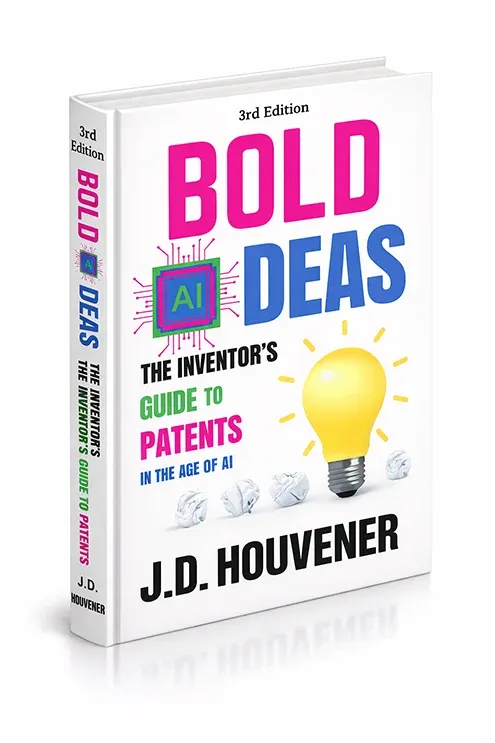
Written by Patent Attorney J.D. Houvener, this updated edition provides inventors, entrepreneurs, and startups with practical guidance for protecting ideas, avoiding costly mistakes, and navigating the patent process with confidence.
Whether you’re exploring a new invention, building a startup, or preparing to file a patent application, our team is here to help you move forward with confidence. Get personalized guidance from experienced patent professionals who understand the challenges inventors face.



We are a full-service patent and trademark prosecution firm. We help inventors and entrepreneurs research, protect, and monetize their intellectual property in the marketplace.
Schedule a Discovery Call 601-298-8425
Copyright © 2026 - Bold Patents• All Rights Reserved. Digital Marketing By: 