Passing the eligibility gate doesn’t guarantee you’ll receive a patent.
Now your invention faces three of the most important questions in patent law:
Understanding these three tests won’t just help you obtain a patent—it will help you become a better inventor.
Reading Time: 12 minutes Video: 10 minutes
Alex felt relieved.
His invention had cleared the first hurdle.
It was patent-eligible.
Now the real examination began.
His patent attorney leaned back and said,
“Now we’re going to think like an examiner.”
Alex looked puzzled.
“I thought we already proved it was patentable.”
The attorney smiled.
“Not yet.”
“Now we have to prove three things.”
It works.
It’s new.
And it isn’t simply an obvious variation of what already exists.
Those three questions would shape everything that followed.
Many inventors ask:
“Is my invention good enough?”
Patent examiners ask something different.
“Does this invention satisfy the legal requirements for patentability?”
Every patent application is evaluated through three lenses:
⚙️ Utility
🆕 Novelty
💡 Non-Obviousness
Miss one…
The application may be rejected.
Pass all three…
You’re well on your way toward meaningful patent protection.
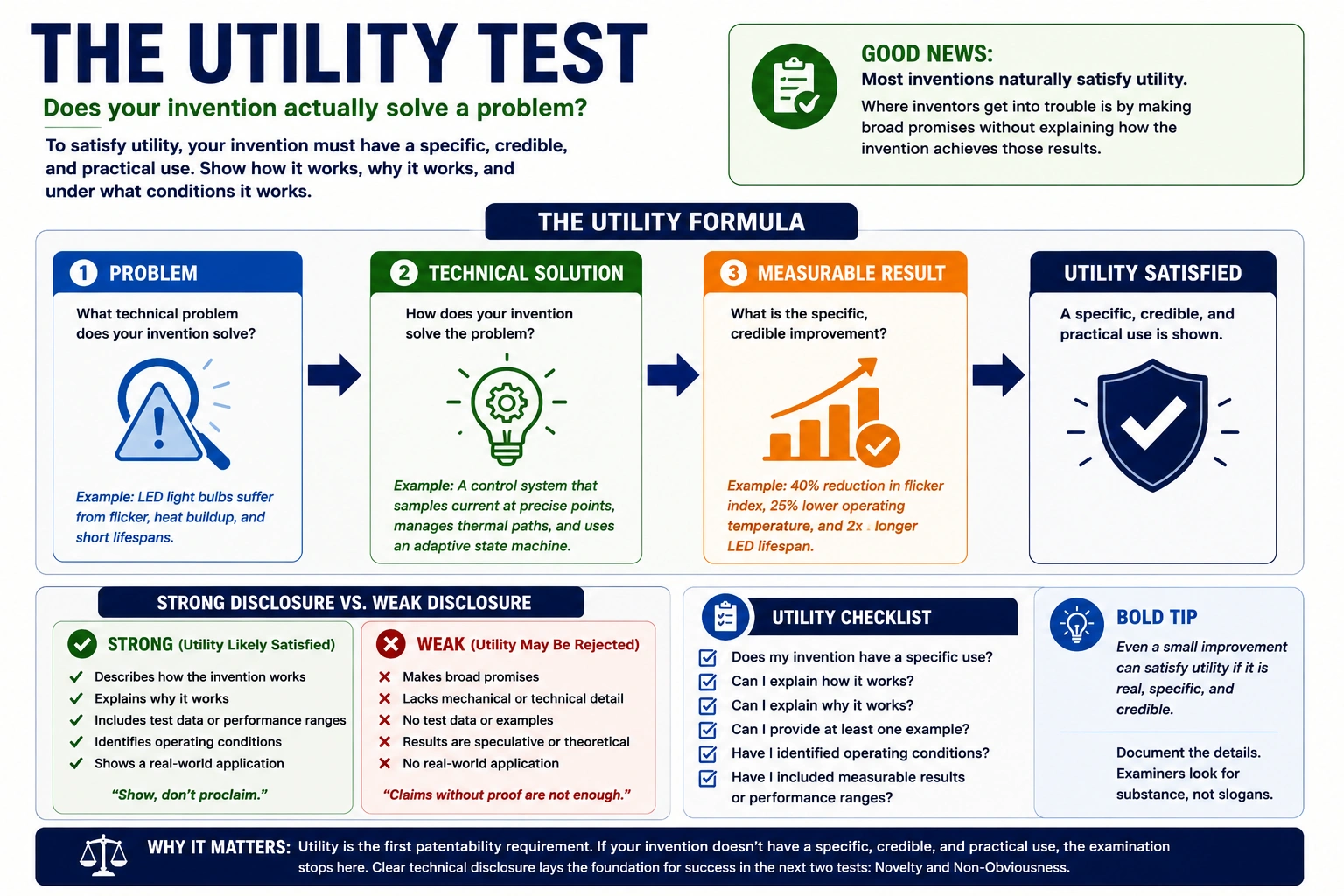
Fortunately, this is often the easiest requirement to satisfy.
Your invention must have a specific, credible, and practical use.
Most inventions naturally clear this hurdle.
Where inventors get into trouble is by making broad promises without explaining how the invention achieves those results.
As your manuscript explains, utility problems arise when inventors promise miracles without operational detail. Alex strengthened his application by describing where signals were sampled, how the controller transitioned between states, and what measurable performance improvements resulted.
Instead of saying:
“This invention dramatically improves battery life.”
Explain:
Show. Don’t proclaim.
Evidence beats adjectives every time.
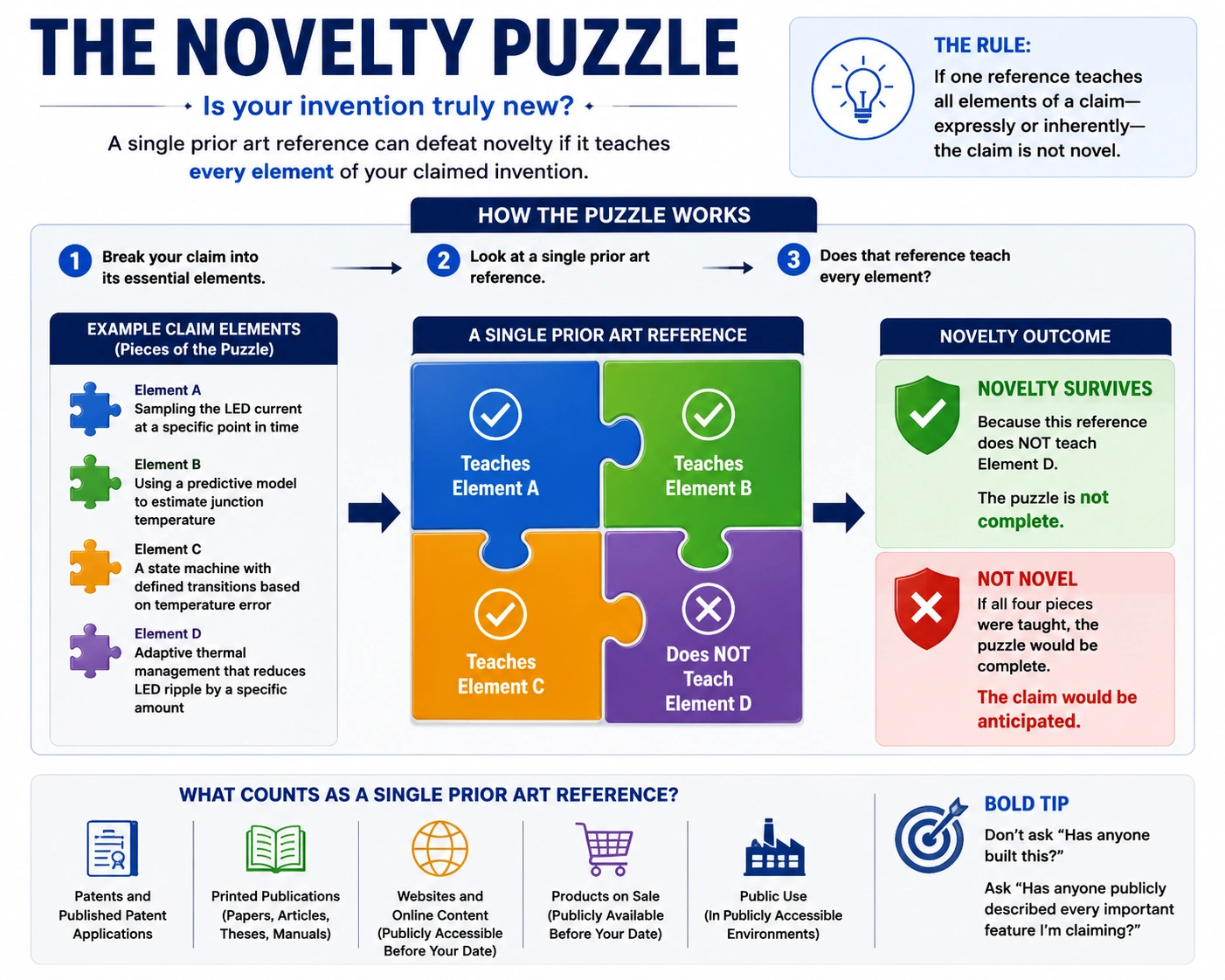
Novelty is often described as an “all-or-nothing” test.
If a single prior art reference already teaches every element of your claimed invention, the claim is anticipated.
Game over.
But if even one meaningful claim element is missing…
The novelty inquiry continues.
Alex learned to think about novelty like a puzzle.
Could an examiner place one patent beside Claim 1 and check every box?
If yes…
The claim needed to change.
If no…
There was still hope.
Your manuscript’s “jigsaw puzzle” analogy is excellent, and I’d preserve it because it’s memorable and intuitive.
Prior art includes:
If it’s publicly available before your effective filing date…
Assume the examiner can find it.
Don’t ask:
“Has anyone built this?”
Ask:
“Has anyone publicly described every important feature I’m claiming?”
This is where many patent applications succeed—or fail.
An invention doesn’t need to be revolutionary.
But it must represent more than what an ordinary engineer would naturally combine based on existing knowledge.
The question isn’t:
“Is it different?”
It’s:
“Would this difference have been obvious?”
As your manuscript emphasizes, the strongest non-obviousness arguments explain why a skilled person wouldn’t naturally combine the prior art—perhaps because of technical constraints, teachings away, or unexpected interactions between components.
Imagine someone invents:
A flashlight with a blue handle.
That’s probably obvious.
Now imagine:
A flashlight with a redesigned thermal management system that doubles LED life while reducing manufacturing cost.
That’s a very different conversation.
Meaningful technical improvements—not cosmetic differences—are what the patent system rewards.
One of my favorite concepts from your manuscript is that strong patents often arise from the cooperation of elements rather than a collection of individual parts.
Alex’s invention wasn’t simply:
It was the way those systems worked together to solve a technical problem.
That cooperation became the invention.
AI can help identify prior art.
AI can summarize patents.
AI can compare technical disclosures.
But AI cannot reliably answer:
“Would this be obvious to a person having ordinary skill in the art?”
That’s still a legal judgment requiring technical understanding and strategic analysis.
❌ Describing results instead of mechanisms.
❌ Assuming “I’ve never seen this before” means it’s novel.
❌ Focusing on cosmetic differences instead of technical improvements.
❌ Ignoring measurable performance data.
❌ Believing AI patent searches replace professional patentability opinions.
One lesson I’ve learned over the years is that patentability isn’t about making your invention sound impressive.
It’s about making your invention understandable.
The strongest patent applications explain exactly why the invention works, why it’s different, and why that difference matters.
Patent examiners appreciate clarity far more than cleverness.
Before filing, ask yourself:
✅ Can I explain how my invention works?
✅ What measurable problem does it solve?
✅ Which claim elements are truly new?
✅ Why wouldn’t another engineer naturally combine these features?
✅ Have I documented objective evidence supporting those differences?
If you’re struggling to answer these questions, don’t panic.
They’re exactly the kinds of issues a patent attorney can help you refine before filing.
Every patent application must satisfy three fundamental requirements:
✔ Utility — It works.
✔ Novelty — It’s new.
✔ Non-Obviousness — It’s more than an expected improvement.
Understanding these principles helps you do more than obtain patents.
It helps you design stronger inventions from the very beginning.
🎥 Video: Utility, Novelty & Non-Obviousness: The Three Tests Every Patent Must Pass
Not every invention meets all three patentability requirements—but many inventors are surprised to learn that small, meaningful technical improvements can qualify for protection.
During a Discovery Call, we’ll evaluate your invention through the same framework patent examiners use and help you determine the strongest strategy moving forward.
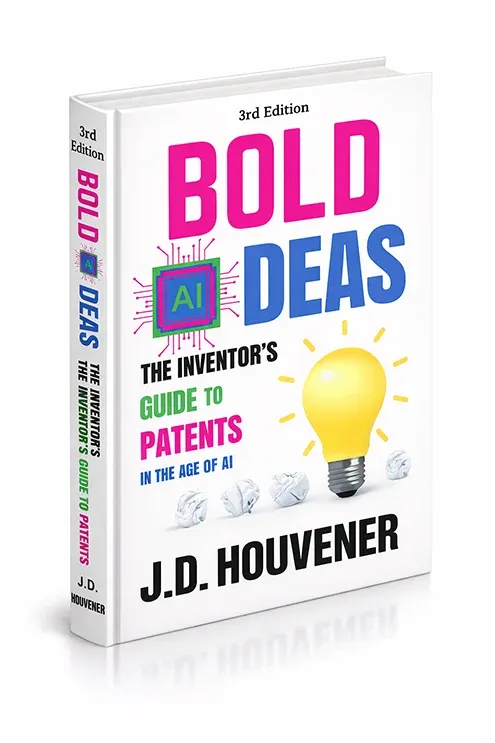
Written by Patent Attorney J.D. Houvener, this updated edition provides inventors, entrepreneurs, and startups with practical guidance for protecting ideas, avoiding costly mistakes, and navigating the patent process with confidence.
Whether you’re exploring a new invention, building a startup, or preparing to file a patent application, our team is here to help you move forward with confidence. Get personalized guidance from experienced patent professionals who understand the challenges inventors face.
We are a full-service patent and trademark prosecution firm. We help inventors and entrepreneurs research, protect, and monetize their intellectual property in the marketplace.
Schedule a Discovery Call 601-298-8425
Copyright © 2026 - Bold Patents• All Rights Reserved. Digital Marketing By: 