
“Has someone already invented this?”
A patent search isn’t about finding reasons to quit.
It’s about finding the best path forward.
The strongest patents are rarely written in isolation—they’re written with a clear understanding of the existing technology landscape.
In this chapter, you’ll learn why a professional patent search is one of the smartest investments an inventor can make and how it helps build stronger patent applications from day one. This is exactly how Alex approaches Step One in your manuscript.
Reading Time: 11 minutes
Video: 9 minutes
Alex was excited.
His lightbulb prototype worked.
The thermal management system stabilized the output exactly as intended.
He was ready to file.
Then his patent attorney asked:
“What have you found so far?”
Alex proudly replied,
“I searched Google.”
His attorney smiled.
Google was a good start.
But Google wasn’t the Patent Office.
And it certainly wasn’t a patentability opinion.
That conversation changed Alex’s entire approach.
Instead of asking,
“Does someone already have my invention?”
Alex learned to ask,
“What can I learn from everything that’s already been invented?”
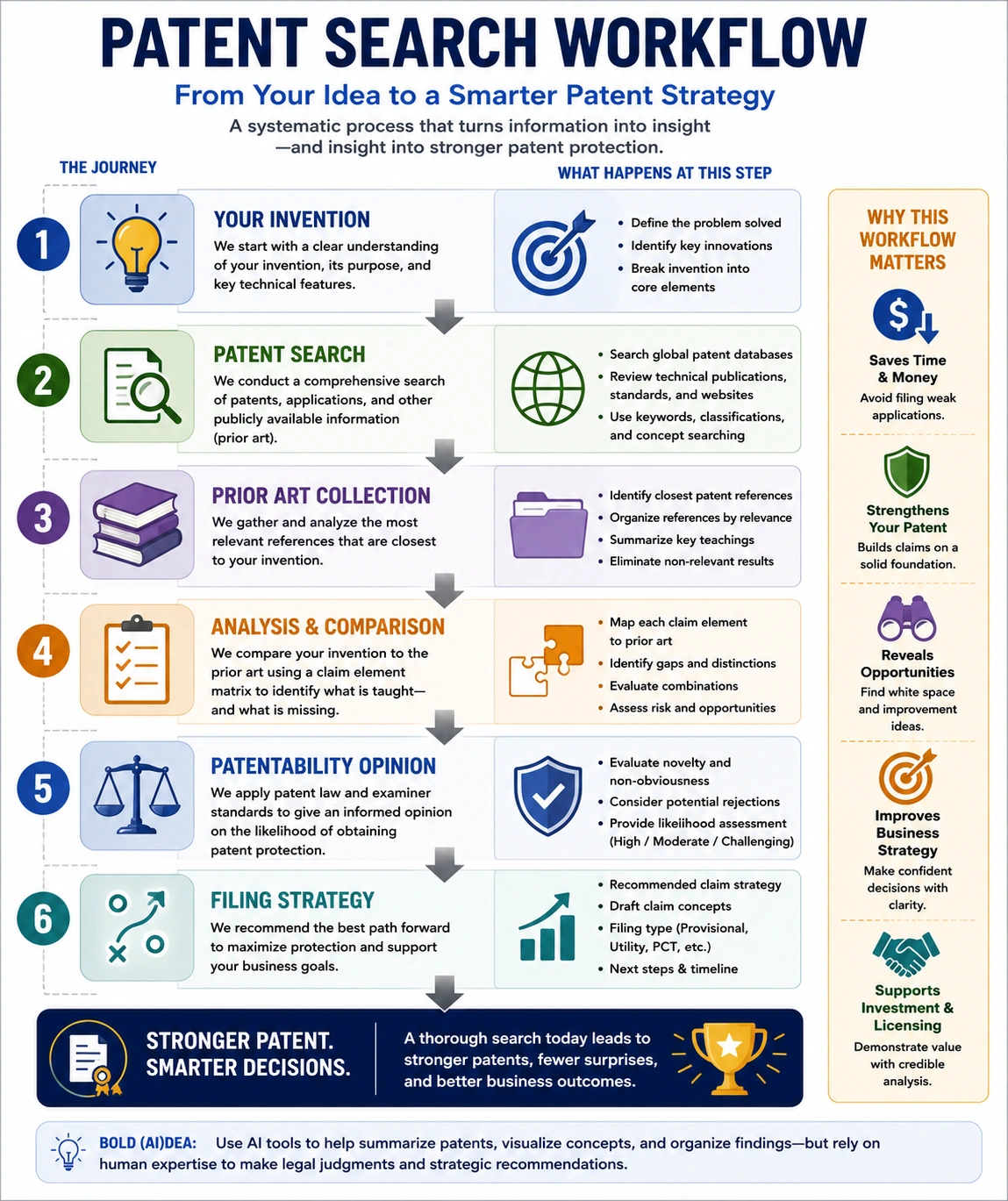
A patent search is a systematic review of existing patents, published patent applications, technical publications, and other publicly available information—collectively known as prior art.
The purpose isn’t simply to determine whether your invention already exists.
It’s to understand:
Think of it as reconnaissance before beginning your journey.
Many inventors use these terms interchangeably.
They’re not the same thing.
Answers:
What prior art exists?
Answers:
Given the prior art…
How likely is this invention to receive patent protection?
The search gathers information.
The opinion interprets it.
That’s where legal experience becomes invaluable.
Many inventors worry that a search will discourage them.
In reality…
The opposite is usually true.
A good search helps you:
✔ Avoid wasting money on weak applications.
✔ Identify what makes your invention unique.
✔ Draft stronger claims.
✔ Anticipate examiner rejections.
✔ Discover additional innovations you hadn’t considered.
Your manuscript emphasizes that Alex’s search didn’t kill the patent—it made the patent by forcing better choices about claims, disclosure, and design-arounds.
A thorough search often reviews:
Patent attorneys also search by:
Finding the closest references is only the beginning.
Understanding them is where value is created.
One of my favorite concepts from your manuscript.
Instead of simply reading patents…
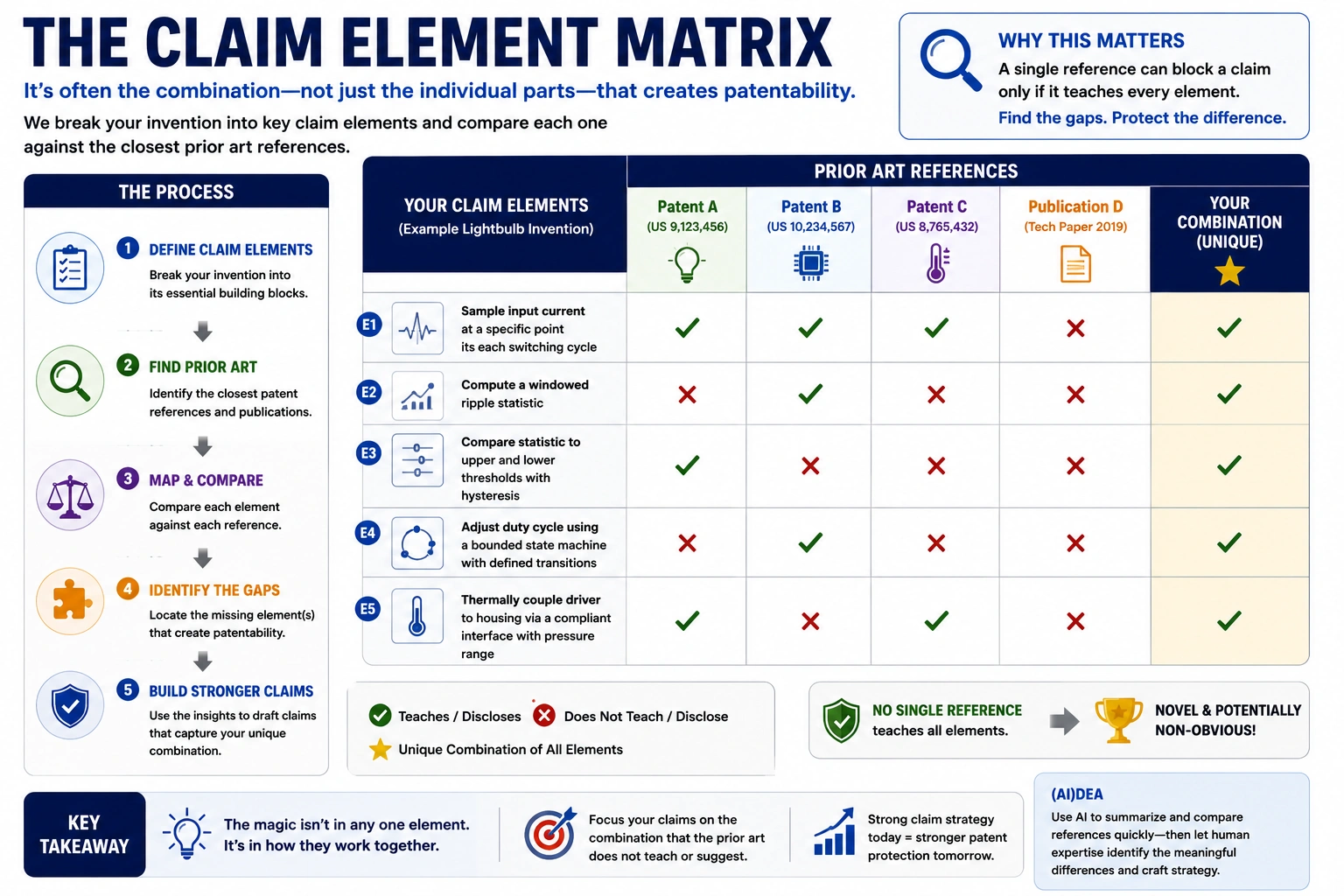
Break your invention into individual claim elements.
Then compare each element against the closest references.
Think of it as building a comparison matrix.
Some references teach:
✔ Element A
✔ Element B
✔ Element C
But…
None teach all of them working together.
That’s often where patentability begins.
If you’re paying for a professional patentability search, don’t settle for a simple list of patents.
Your manuscript lays out an excellent checklist. Ask for:
Those deliverables become the foundation for the patent application itself.
AI has dramatically improved the speed of technical research.
It can help you:
But AI also has limitations.
It may:
Use AI as a research assistant—not your patent attorney.
Ask AI:
“What technical problems are other inventors trying to solve in this field?”
That’s often a better starting point than asking:
“Has anyone patented my idea?”
Another valuable lesson from your manuscript.
If you discover material prior art, don’t hide it.
Disclose it.
Submitting an Information Disclosure Statement (IDS) demonstrates candor with the USPTO and allows you to explain how your invention differs from the closest references.
Transparency often strengthens credibility.
At first, Alex viewed the patent search as a hurdle.
By the end…
He realized it was a blueprint.
The search didn’t tell him to abandon the invention.
It showed him exactly where the innovation lived.
That insight made the patent stronger.
❌ Searching only Google.
❌ Assuming no search results means no prior art.
❌ Reading patent titles instead of claims.
❌ Ignoring international patents.
❌ Filing before understanding the competitive landscape.
One of the biggest misconceptions I encounter is that inventors think a patent search is about finding a reason not to file.
I’ve found the opposite to be true.
The best searches don’t discourage inventors—they sharpen their thinking. They help us identify what is truly innovative, draft stronger claims, and avoid expensive surprises during prosecution.
A patent search isn’t a roadblock.
It’s the beginning of a smarter patent strategy.
Before filing, ask yourself:
✔ Have I searched for similar technologies?
✔ Do I understand what makes my invention different?
✔ Have I reviewed the closest patents?
✔ Can I identify the unique claim elements?
✔ Have I separated patentability from freedom to operate?
If you answered “no” to several of these questions…
A professional search may be your smartest next step.
A patent search isn’t about proving your invention is unique.
It’s about understanding the landscape.
A professional patentability opinion transforms search results into strategy.
The stronger your understanding of prior art…
The stronger your patent application is likely to become.
🎥 Video: Patent Searches Explained: Why Every Inventor Should Start Here
A thoughtful patent search can save time, money, and frustration while helping build a stronger patent portfolio.
During a Discovery Call, we’ll discuss your invention, determine whether a professional patentability search makes sense, and outline the best strategy for protecting your innovation.
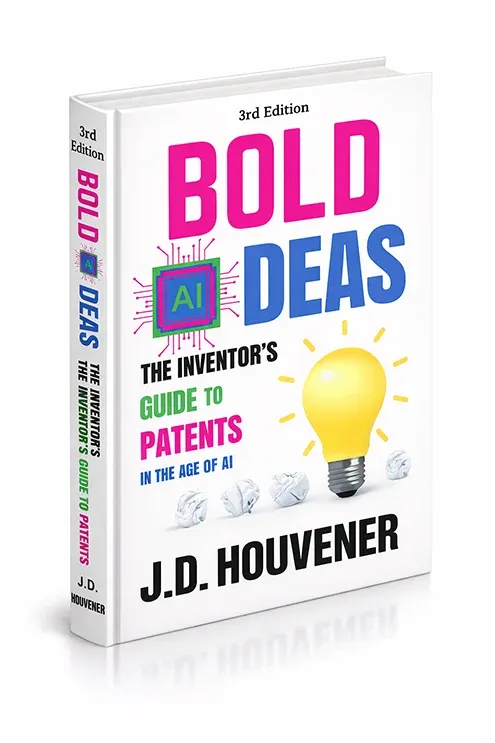
Written by Patent Attorney J.D. Houvener, this updated edition provides inventors, entrepreneurs, and startups with practical guidance for protecting ideas, avoiding costly mistakes, and navigating the patent process with confidence.
Whether you’re exploring a new invention, building a startup, or preparing to file a patent application, our team is here to help you move forward with confidence. Get personalized guidance from experienced patent professionals who understand the challenges inventors face.



We are a full-service patent and trademark prosecution firm. We help inventors and entrepreneurs research, protect, and monetize their intellectual property in the marketplace.
Schedule a Discovery Call 601-298-8425
Copyright © 2026 - Bold Patents• All Rights Reserved. Digital Marketing By: 