That’s the story.
Everything in this chapter revolves around one metaphor.
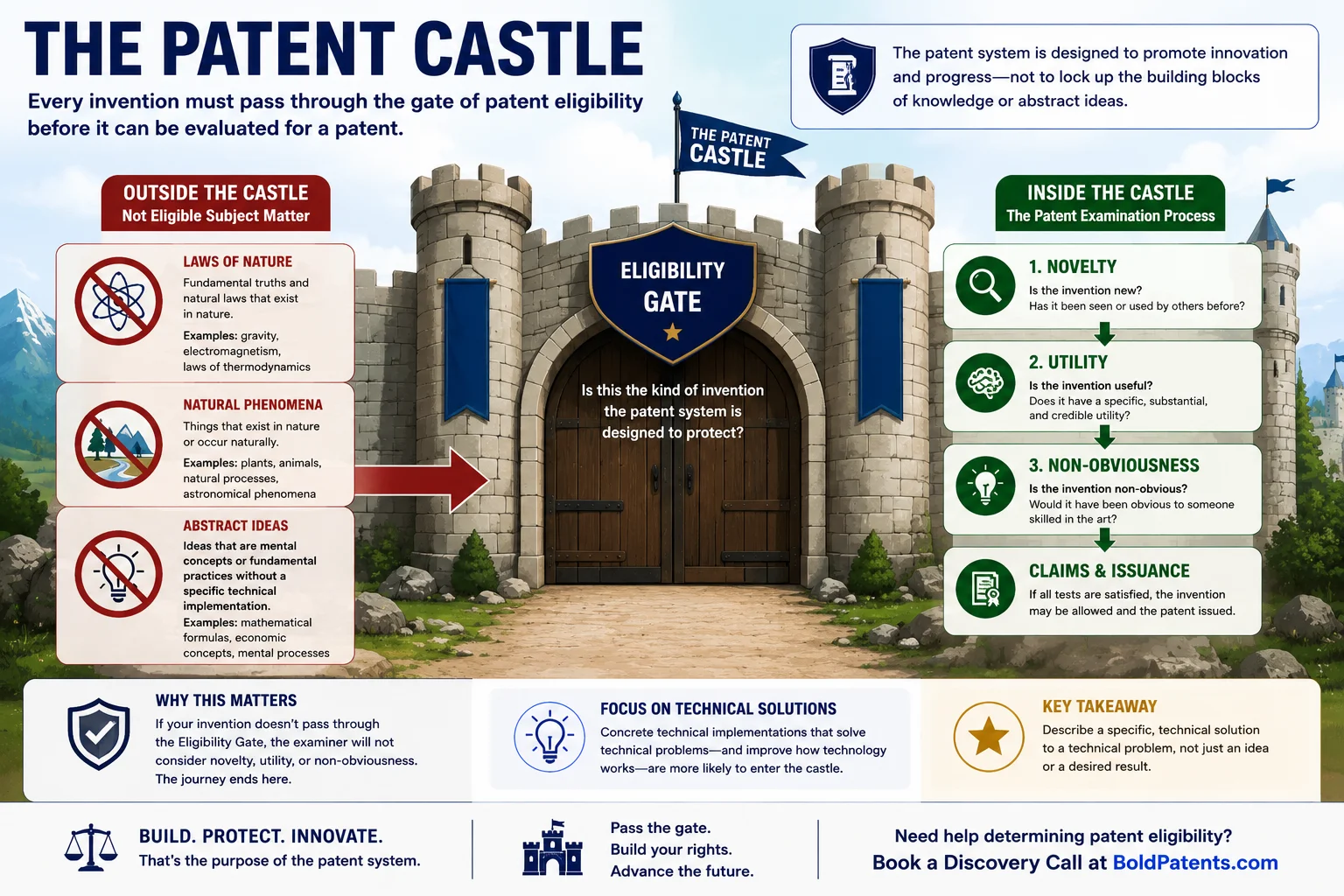
Imagine the USPTO as a castle.
Before anyone asks:
…your invention first arrives at the front gate.
The examiner asks only one question:
“Is this even the kind of thing the patent system is allowed to protect?”
If the answer is no…
You never enter the castle.
Novelty doesn’t matter.
Non-obviousness doesn’t matter.
Your invention never gets evaluated.
I think this visual alone will make this chapter memorable.
…it has to pass through the front gate.
Many inventors spend months worrying about whether their invention is new enough.
But patent examiners ask an even more fundamental question first:
Is this the kind of invention the patent system is designed to protect?
If the answer is no, the journey ends before it begins.
Understanding this “gate” is one of the most important concepts in modern patent law—especially for software, AI, and computer-implemented inventions. Your manuscript makes this exact distinction, emphasizing that eligibility comes before novelty and non-obviousness.
Alex believed he was ready.
The prototype worked.
Customers loved it.
His patent attorney agreed the invention was novel.
It solved a real problem.
It wasn’t obvious.
Everything looked promising.
Then the attorney asked one more question.
“What exactly are we asking the Patent Office to protect?”
Alex answered confidently.
“My idea.”
The attorney smiled.
“Ideas aren’t enough.”
That conversation completely changed how Alex viewed patents.
Patent eligibility answers one simple question:
Can this type of innovation even qualify for patent protection?
It’s different from asking:
Instead…
Patent eligibility asks whether your invention belongs inside the patent system at all.
Think of it as the admission ticket before the real examination begins.
For mechanical inventions…
Eligibility is usually straightforward.
For software…
Artificial Intelligence…
Machine learning…
Business methods…
Medical diagnostics…
The question becomes much more complicated.
That’s why understanding eligibility early can save inventors enormous amounts of time and money.
Patent law intentionally excludes certain categories because they belong to everyone.
These include:
No one can patent gravity.
Or electromagnetism.
Or the laws of thermodynamics.
These belong to humanity.
You can’t patent something that already exists in nature simply because you discovered it.
However…
Human-created applications of natural discoveries may qualify.
This category causes the most confusion.
Abstract ideas include things like:
The key distinction is implementation.
The patent system rewards practical innovation—not abstract thought.
These are the three judicial exceptions your manuscript walks through before explaining how concrete technical implementations can still qualify.
This chapter becomes incredibly timely because of AI.
People often ask:
“Can I patent something ChatGPT created?”
That’s usually the wrong question.
A better question is:
What technical innovation did I create using AI?
AI may help you:
but patent eligibility still depends on whether the claimed invention describes a concrete technical solution—not merely the use of AI itself. As your manuscript notes, software and AI inventions are strongest when tied to specific architectures, data transformations, hardware constraints, and measurable technical effects.
Don’t try to patent AI.
Patent what AI helped you invent.
Originally…
Alex described his invention like this:
“A smarter light bulb.”
Eventually…
He learned to explain:
and most importantly…
how those parts worked together to solve a technical problem.
That shift—from describing a result to teaching a mechanism—is exactly what strengthened his eligibility position throughout the chapter.
Imagine you’re the patent examiner.
You’re not asking:
“Is this exciting?”
You’re asking:
Is this a technological solution to a technological problem?
If yes…
Now we can begin discussing novelty.
If no…
The analysis stops.
Understanding that mindset changes how inventors write about their inventions.
❌ Describing goals instead of mechanisms.
❌ Using marketing language instead of engineering language.
❌ Claiming broad concepts instead of technical implementations.
❌ Assuming AI-generated language sounds technical enough.
One of the biggest mindset shifts I see is when inventors stop describing what they hope their invention accomplishes and start describing how it actually accomplishes it.
Patent eligibility isn’t about clever wording.
It’s about clearly communicating a technical solution.
That change alone often transforms an application from difficult to understand into compelling.
Ask yourself:
✓ Am I describing a real technical solution?
✓ Could another engineer understand how it works?
✓ Am I claiming a mechanism rather than an aspiration?
✓ Have I identified the specific technical improvement?
✓ Would my explanation make sense even if all the marketing language disappeared?
If you answered “yes,” you’re already thinking more like both an inventor and a patent examiner.
Patent eligibility is the first gate—not the final destination.
Before an examiner considers whether your invention is new or non-obvious, they first determine whether it belongs within the kinds of subject matter the patent system is designed to protect.
When you focus on concrete technical solutions, specific implementations, and measurable improvements, you’re far more likely to clear that gate and move on to the next stage of examination.
🎥 Video: The Heart of Patent Eligibility: Why Some Great Ideas Never Become Patents
If you’re unsure whether your invention is likely to satisfy the patent eligibility requirements, a Discovery Call is the best place to start.
We’ll discuss your technology, identify the core technical innovation, and help you determine whether it belongs inside the patent system—and, if so, how to present it effectively.
Written by Patent Attorney J.D. Houvener, this updated edition provides inventors, entrepreneurs, and startups with practical guidance for protecting ideas, avoiding costly mistakes, and navigating the patent process with confidence.
Whether you’re exploring a new invention, building a startup, or preparing to file a patent application, our team is here to help you move forward with confidence. Get personalized guidance from experienced patent professionals who understand the challenges inventors face.

We are a full-service patent and trademark prosecution firm. We help inventors and entrepreneurs research, protect, and monetize their intellectual property in the marketplace.
Schedule a Discovery Call 601-298-8425
Copyright © 2026 - Bold Patents• All Rights Reserved. Digital Marketing By: 