
It’s defined by its claims.
If you’ve ever wondered what makes one patent broad, another narrow, or why competitors sometimes “design around” a patent…
The answer almost always starts with the claims.
This chapter will help you understand why claims are the most valuable part of a patent application—and how thoughtful claim strategy can create long-term competitive advantage.
Reading Time: 12 minutes
Video: 10 minutes
Alex’s invention was finally coming together.
The electronics worked.
The firmware stabilized the light output.
The thermal design solved the overheating problem.
He proudly handed his patent attorney a beautifully written 25-page technical description.
The attorney smiled.
Then flipped to the back.
“Where are the claims?”
Alex pointed to the description.
“Everything is in there.”
The attorney nodded.
“But the description teaches the invention.”
Then he picked up a pen.
“The claims decide what you own.”
That moment completely changed how Alex thought about patents.
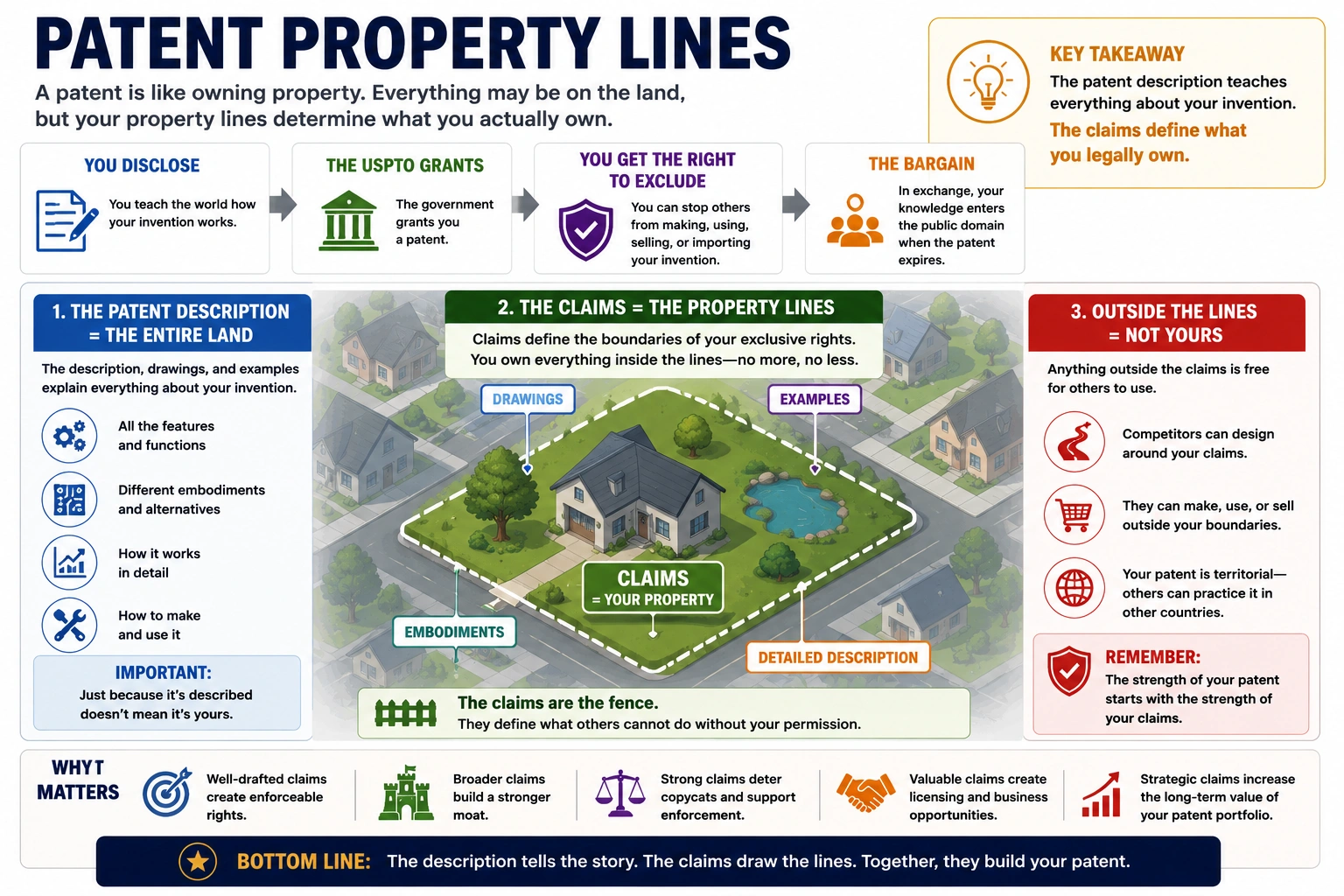
Think of your patent application like purchasing land.
The description explains everything that’s on the property.
The drawings show what it looks like.
But…
The property lines determine what you actually own.
Patent claims work exactly the same way.
Claims define the legal boundaries of your invention—no more and no less. Courts, investors, competitors, and potential licensees will read them first because they determine the scope of protection.
Imagine you invented a revolutionary smart light bulb.
Your patent describes:
But your claims only cover the housing.
A competitor copies everything except the housing.
Have they infringed?
Maybe not.
If a feature never appears in a claim, you generally don’t own exclusive rights to that feature through that patent.
That’s why claim drafting is so important.
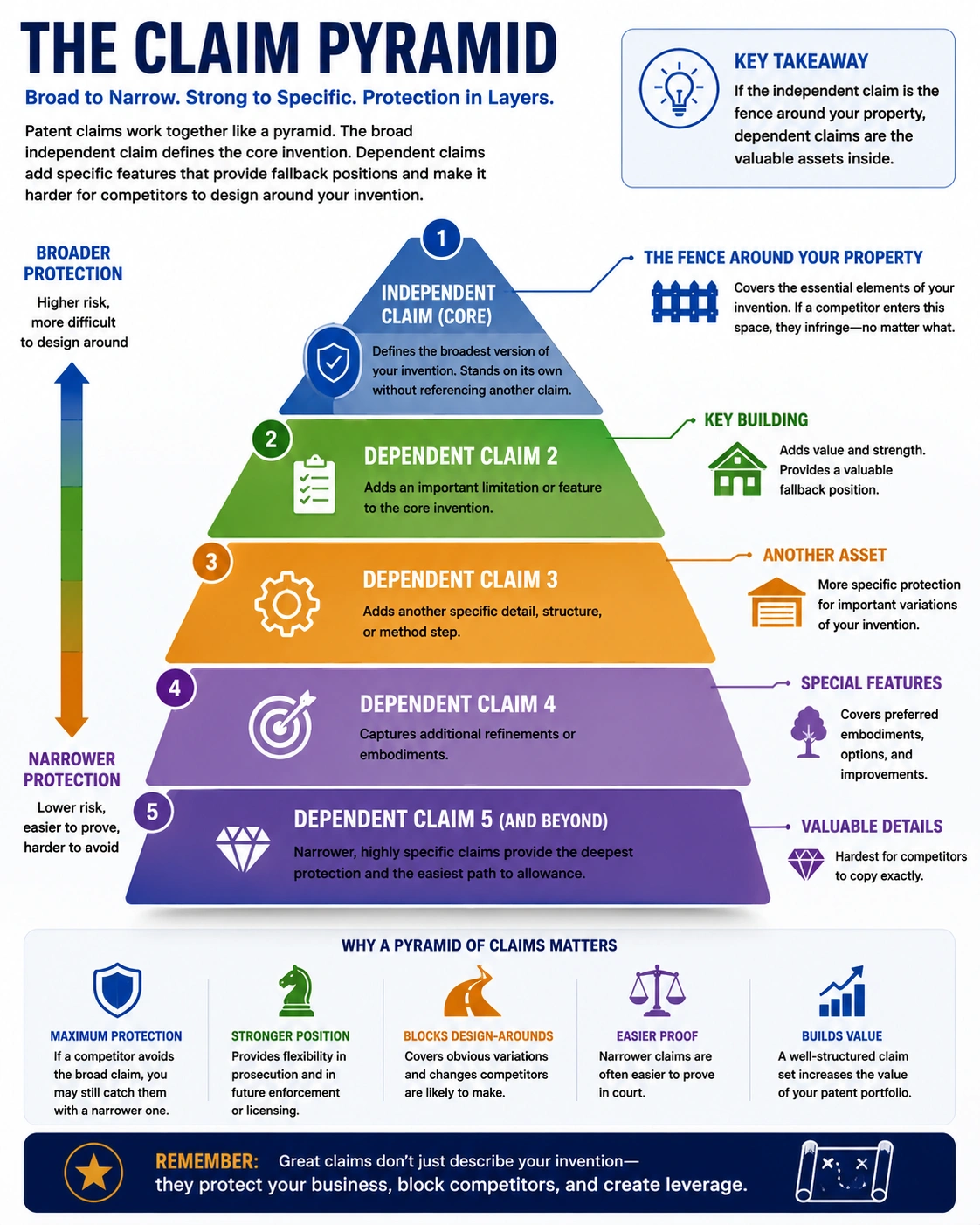
Patent claims work together.
These define the broad invention.
Think:
The fence around your entire property.
These add additional limitations.
Think:
Buildings.
Driveways.
Pools.
Gardens.
They’re still protected…
But they’re nested inside the larger property.
Your manuscript’s “rings” concept is excellent:
Ring 1 → Core invention
Ring 2 → Best commercial embodiment
Ring 3 → Competitor design-arounds
Ring 4 → Future premium products and continuation opportunities.
Alex initially thought:
“My invention is the light bulb.”
His attorney disagreed.
Instead…
They asked:
Who will copy it?
What will they copy?
How can they change one feature and avoid infringement?
Suddenly the claims became a business strategy—not just legal language.
Alex built:
✔ System claims
✔ Method claims
✔ Computer-readable medium claims
Why?
Because different competitors infringe in different ways.
Manufacturers.
Software developers.
Importers.
Distributors.
Each may interact with different aspects of the technology, which is why Alex’s filing deliberately combined system, method, and computer-readable medium claims.
One of my favorite concepts from your manuscript.
Weak claim:
“A system configured to optimize lighting.”
Strong claim:
“A controller configured to sample an input signal, compute a windowed statistic, compare the statistic to defined thresholds, and adjust duty cycle based on a bounded state machine.”
See the difference?
One promises a result.
The other explains the mechanism.
Patent examiners reward mechanisms.
AI can generate draft claims.
It cannot determine:
Use AI to brainstorm.
Use human expertise to protect.
❌ Claiming results instead of mechanisms.
❌ Being unnecessarily narrow.
❌ Being unrealistically broad.
❌ Forgetting competitor design-arounds.
❌ Writing claims that don’t match the business.
Here’s a useful exercise.
Imagine your biggest competitor receives your patent tomorrow.
Ask:
“How would they try to avoid infringement?”
Now write dependent claims covering those likely detours.
That’s exactly why Alex drafted claims in expanding “rings.”
One of the biggest mistakes I see is inventors assuming the patent application protects everything they describe.
It doesn’t.
Your claims are your legal property lines.
The description gives those claims strength.
But the claims determine what others are legally prohibited from doing.
That’s why I often spend more time refining claims than writing any other part of the application.
Ask yourself:
✔ Can I explain my invention in one sentence?
✔ What absolutely must competitors copy?
✔ Which features create commercial value?
✔ What obvious design-arounds exist?
✔ Do my claims protect the business—not just the engineering?
Patent claims:
✔ Define ownership.
✔ Create enforceable rights.
✔ Shape licensing opportunities.
✔ Influence valuation.
✔ Determine competitive advantage.
Everything else in the patent supports the claims.
The claims determine what you actually protect.
🎥 Video: Patent Claims Explained: Why Every Word Matters
Great patents begin with great claim strategy.
During your Discovery Call, we’ll help identify the core innovation behind your invention, discuss how competitors might attempt to design around it, and begin developing a claim strategy that aligns with your technology and business goals.
Written by Patent Attorney J.D. Houvener, this updated edition provides inventors, entrepreneurs, and startups with practical guidance for protecting ideas, avoiding costly mistakes, and navigating the patent process with confidence.
Whether you’re exploring a new invention, building a startup, or preparing to file a patent application, our team is here to help you move forward with confidence. Get personalized guidance from experienced patent professionals who understand the challenges inventors face.





We are a full-service patent and trademark prosecution firm. We help inventors and entrepreneurs research, protect, and monetize their intellectual property in the marketplace.
Schedule a Discovery Call 601-298-8425
Copyright © 2026 - Bold Patents• All Rights Reserved. Digital Marketing By: 