
One of the first questions nearly every inventor asks is:
“How much does a patent cost?”
The honest answer is that it depends.
Every invention is different. A simple mechanical device requires a different level of work than an AI-powered software platform, a medical device, or a complex manufacturing process. Patent costs also occur over time—not all at once.
Understanding where those costs come from will help you budget more effectively, make informed decisions, and avoid surprises throughout the patent process.
In this chapter, you’ll learn what contributes to patent costs, why pricing varies from invention to invention, and how to think about protecting your intellectual property as a long-term business investment rather than simply another expense.
After completing the patent search and selecting a registered patent attorney, Alex finally asked the question that had been sitting in the back of his mind.
“How much is this going to cost?”
His attorney smiled.
“It’s a fair question—but it’s a little like asking how much it costs to build a house.”
A starter home.
A custom home.
A skyscraper.
All are buildings.
None cost the same.
Patent applications work exactly the same way.
The answer depends on the complexity of the invention, the amount of technical detail required, the filing strategy, and the long-term business goals.
Alex quickly realized he wasn’t simply paying for paperwork.
He was investing in an asset that could protect his business for decades.
There is no fixed price for obtaining a patent.
Instead, costs are influenced by factors such as:
Just as every invention is unique, every patent strategy is unique.
One-size-fits-all pricing rarely produces one-size-fits-all results.
One of the biggest misconceptions is that inventors pay one fee and receive a patent.
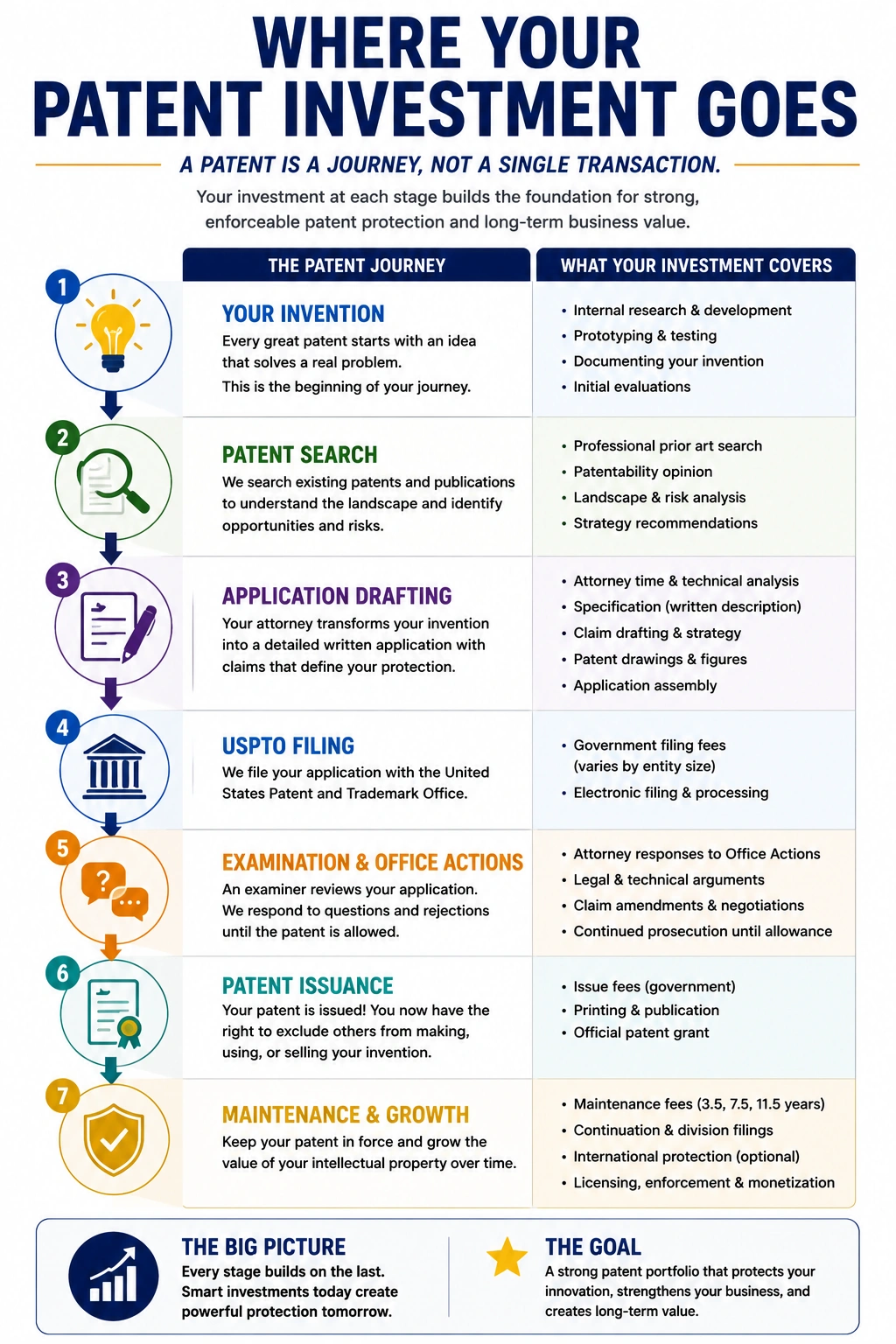
In reality, patent costs occur throughout the life of the application.
Before filing, many inventors invest in a professional patent search and patentability opinion.
This early investment helps identify prior art, reduce surprises, and improve drafting strategy.
For most inventors, this represents the largest investment.
This stage includes:
A stronger application often reduces problems later during examination.
The United States Patent and Trademark Office charges government filing fees.
These fees vary depending on:
Government fees are separate from attorney fees.
Very few patent applications are allowed immediately.
Most applications receive Office Actions that require legal and technical responses.
Those responses are part of the normal patent process and should be anticipated when planning your budget.
After a patent issues, additional costs may include:
A patent should be viewed as part of a long-term intellectual property strategy.
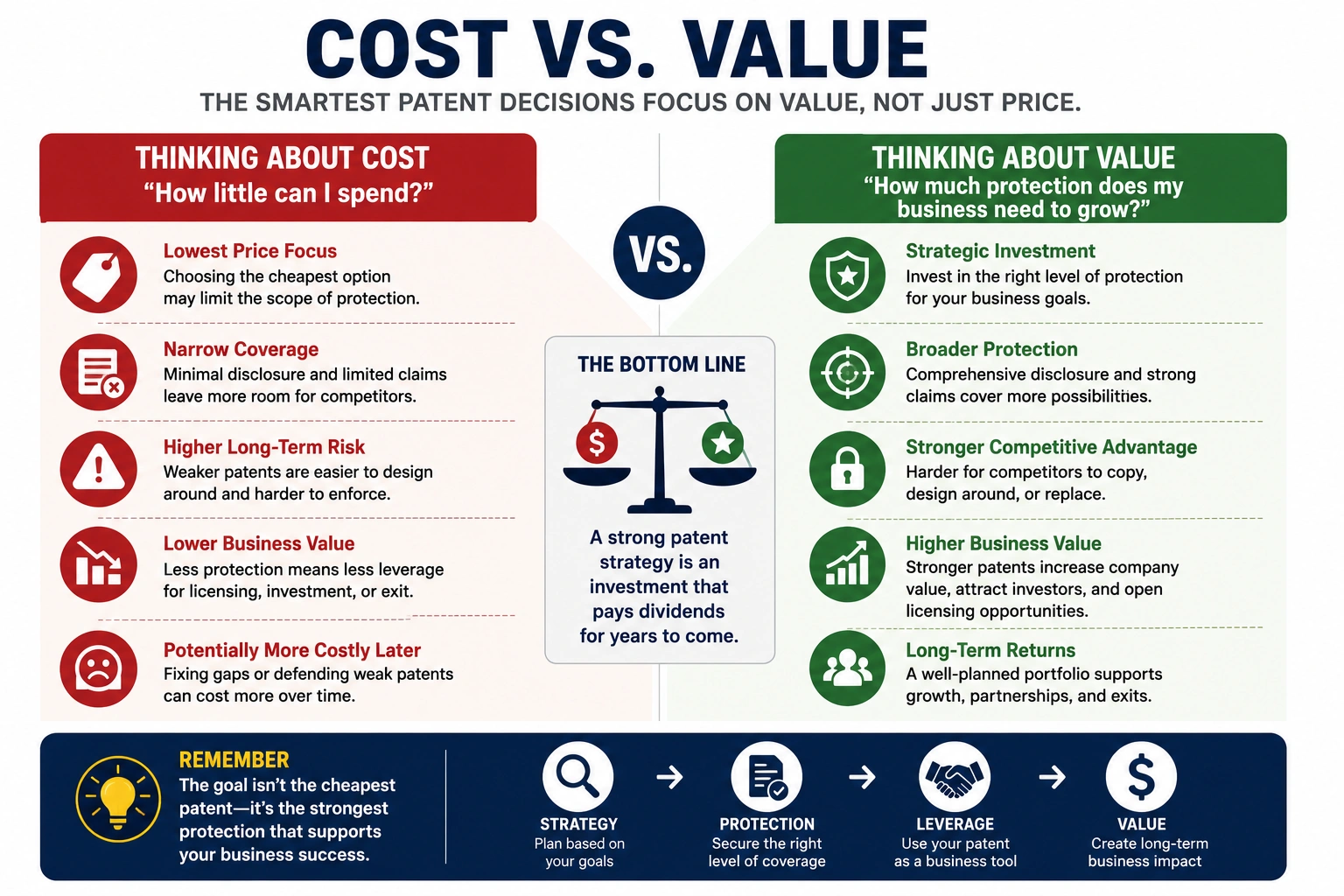
One of the most valuable lessons in this chapter is changing the question.
Instead of asking:
“What’s the cheapest patent?”
Ask:
“What’s the smartest investment for my business?”
A patent can help:
Viewed through that lens, patent costs become part of building a valuable business asset.
AI is already helping patent professionals become more efficient.
It can assist with:
But AI does not replace:
Think of AI as a productivity tool—not a substitute for experience.
Many inventors accidentally increase costs by:
❌ Waiting until the last minute to file
❌ Providing incomplete technical information
❌ Choosing an attorney based solely on price
❌ Assuming filing is the final expense
❌ Ignoring long-term portfolio planning
A thoughtful strategy often saves money over the life of a patent.
One of the questions I hear most often is:
“How much does a patent cost?”
It’s an important question—but I encourage inventors to look beyond the initial price.
A patent isn’t simply a legal document.
It’s a business asset.
The right filing strategy depends on your invention, your industry, your competition, your budget, and your long-term goals.
Sometimes the smartest investment is filing broadly.
Sometimes it’s starting with a narrower strategy and expanding later.
Every invention deserves a strategy that fits the business behind it.
Patent costs vary widely depending on the complexity of the invention, the drafting required, government filing fees, and prosecution after filing.
Experience, technical expertise, drafting quality, service model, and the complexity of the technology all influence pricing.
Usually not. USPTO filing fees are separate from professional legal fees.
AI can help organize information and accelerate drafting, but it cannot replace the legal judgment needed to prepare strong, enforceable patent claims.
Not necessarily. A well-prepared patent application often provides greater long-term value than a lower-cost application that offers weaker protection.
✔ Patent costs vary because every invention is different.
✔ Patent protection is a long-term investment—not a one-time purchase.
✔ Budget for the full patent journey, including prosecution and maintenance.
✔ Strong preparation today can reduce problems tomorrow.
✔ Focus on value and strategy—not simply the lowest price.
🎥 Video: Understanding Patent Costs: What Every Inventor Should Expect
In this video, J.D. explains the major cost components of obtaining a patent, why pricing varies between inventions, and how to budget for protecting your innovation with confidence.
Every invention deserves a strategy that fits both your technology and your business goals.
During a Discovery Call, we’ll discuss your invention, explain the factors that influence patent costs, and help you develop a filing strategy that aligns with your budget and long-term objectives.
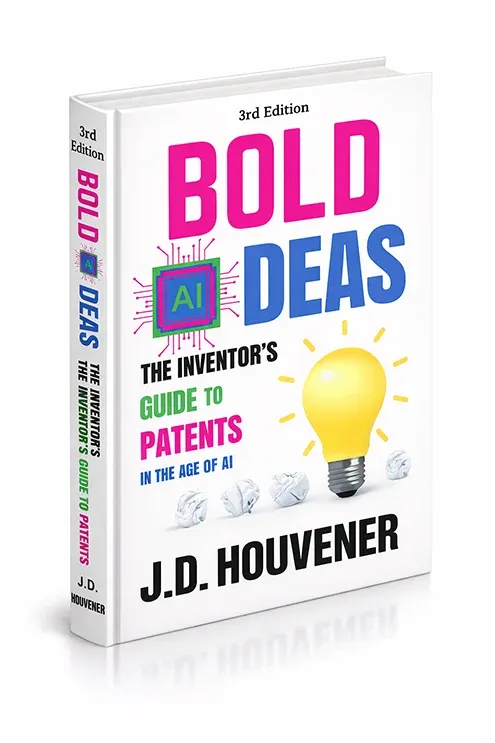
Written by Patent Attorney J.D. Houvener, this updated edition provides inventors, entrepreneurs, and startups with practical guidance for protecting ideas, avoiding costly mistakes, and navigating the patent process with confidence.
Whether you’re exploring a new invention, building a startup, or preparing to file a patent application, our team is here to help you move forward with confidence. Get personalized guidance from experienced patent professionals who understand the challenges inventors face.






We are a full-service patent and trademark prosecution firm. We help inventors and entrepreneurs research, protect, and monetize their intellectual property in the marketplace.
Schedule a Discovery Call 601-298-8425
Copyright © 2026 - Bold Patents• All Rights Reserved. Digital Marketing By: 