
Many inventors believe that if someone copies their idea, infringement automatically exists.
Not necessarily.
Likewise, many companies assume that if they didn’t intend to infringe, they can’t be liable.
That isn’t necessarily true either.
Patent law separates what someone did from what they knew or intended when they did it.
Understanding that distinction helps inventors enforce patents more effectively—and helps businesses avoid unintentionally creating unnecessary legal risk.
Alex learned that credibility comes from proving both issues independently, rather than assuming one automatically proves the other.
Reading Time: 15 minutes
Video: 12 minutes
When Alex first suspected a competitor was copying the invention, frustration quickly turned into confidence.
“They’re clearly infringing.”
The patent attorney paused.
“Maybe.”
Then came another question.
“Can you prove every element of the claim?”
Alex wasn’t sure.
A week later another question followed.
“Even if they infringe, can you prove they knowingly encouraged infringement or intentionally ignored your patent?”
Again…
Not yet.
Alex realized that successful patent enforcement wasn’t built on assumptions.
It was built on evidence.
Two separate questions had to be answered.
Did infringement occur?
And…
What was the other party’s intent?
Patent disputes often involve two independent analyses.
Did someone practice every required element of a patent claim?
This is the infringement question.
What did they know—and what did they intend?
This becomes important when evaluating issues like induced infringement, contributory infringement, or enhanced damages.
One question does not automatically answer the other.
You may prove infringement without proving bad intent.
You may prove bad intent and still lose if infringement never occurred.
Many inventors compare products at a high level.
Patent law doesn’t.
Patent law asks a much more detailed question:
Does the accused product include every required limitation of at least one patent claim?
That means:
General similarities are not enough.
Strong infringement analysis always begins with the claims.

The most straightforward form of infringement is direct infringement.
It generally occurs when someone:
a product or method that falls within the scope of a patent claim.
Alex focused first on proving direct infringement because it creates the foundation for many other legal theories.
Literal infringement exists when every limitation of a patent claim is present exactly as claimed.
Alex built claim charts that mapped:
Every limitation required supporting evidence.
The goal was precision—not assumptions.
Sometimes a competing product changes small details while performing essentially the same invention.
In limited circumstances, courts may still find infringement under the Doctrine of Equivalents.
Rather than asking whether every word matches perfectly, this doctrine considers whether the accused feature performs substantially:
Alex viewed the Doctrine of Equivalents as a safety net—not the primary strategy.
Whenever possible, the goal remained proving literal infringement.
Different claim types create different enforcement challenges.
Often easier to enforce because a single company may make or sell the complete system.
Require proving that every required step was actually performed.
Sometimes different parties perform different steps.
That creates additional complexity.
Alex drafted future patent applications with these enforcement realities in mind.
Modern technology often involves:
If different parties perform different claim steps, enforcement becomes more difficult.
Whenever possible, Alex structured future claims so that one primary entity performed—or controlled—the key steps.
This simplified future enforcement.
Some companies may never directly practice every claim.
Instead, they encourage others.
Two important theories may apply.
This may occur when someone knowingly encourages another party to infringe.
Examples might include:
Knowledge and intent become important considerations.
Sometimes a company supplies a specialized component designed primarily for an infringing use.
If that component has little or no meaningful non-infringing use, contributory infringement issues may arise.
Alex carefully evaluated whether components had legitimate alternative uses before relying on this theory.
Willful infringement involves more than simple infringement.
Courts generally evaluate whether the conduct demonstrates deliberate or reckless disregard for another’s patent rights.
Alex treated willfulness carefully.
It was never the centerpiece of the first conversation.
Instead, it became relevant only if the evidence supported it.
Alex also wanted to avoid becoming an accused infringer.
The company adopted several best practices.
Good documentation often becomes valuable evidence of good faith.

Alex also maintained proper patent marking.
This included:
Consistent marking helped preserve important legal rights and supported later enforcement efforts.
Patent owners should also understand the difference between legitimate repair and impermissible reconstruction.
Customers generally may repair products they own.
However, rebuilding an entirely new patented product under the guise of repair may raise infringement issues.
Alex evaluated these distinctions carefully before pursuing enforcement.
Software introduces unique challenges.
Questions often include:
Alex worked closely with technical experts to ensure the evidence accurately reflected how cloud-based systems actually operated.
AI can help organize:
AI can also identify similarities between competing products.
However:
AI accelerates preparation.
Experienced legal judgment determines the conclusions.
Whenever evaluating a potential dispute, Alex separated the analysis into two independent tracks.
Can we prove intent?
Keeping these tracks separate made every enforcement decision more disciplined and more credible.
Alex never skipped a final checklist.
Preparation consistently produced better outcomes.
Avoid these common errors:
❌ Assuming similar products automatically infringe
❌ Ignoring individual claim elements
❌ Treating intent and infringement as the same issue
❌ Relying entirely on the Doctrine of Equivalents
❌ Sending demand letters before gathering evidence
❌ Uploading confidential patent materials into public AI systems
❌ Failing to document good-faith engineering decisions
One of the biggest misunderstandings in patent law is the belief that copying automatically equals infringement.
Patent cases are much more precise than that.
The question isn’t whether products look alike.
The question is whether the patent claims cover what the other party is actually doing.
That’s why strong patent drafting matters so much.
Clear claims create clearer enforcement.
Likewise, companies shouldn’t assume good intentions eliminate legal exposure.
The best defense is thoughtful engineering, careful documentation, and prompt action whenever patent issues arise.
Preparation builds credibility on both sides of the dispute.
✔ Infringement and intent are different legal questions.
✔ Every claim limitation matters.
✔ Literal infringement is usually the strongest theory.
✔ Method claims often present additional enforcement challenges.
✔ Good-faith business practices reduce legal risk.
✔ AI can organize evidence but should never replace legal analysis.
🎥 Video: Patent Infringement and Intent Explained
Learn how courts evaluate patent infringement, why intent matters, how claim charts are built, and what businesses can do to strengthen both enforcement and defense strategies.
Whether you’re concerned about protecting your own patents or avoiding infringement of someone else’s, understanding how courts evaluate patent claims is critical.
During a Discovery Call, we’ll review your patent portfolio, evaluate potential infringement issues, discuss enforcement strategies, and help you develop practical solutions that support your long-term business objectives.
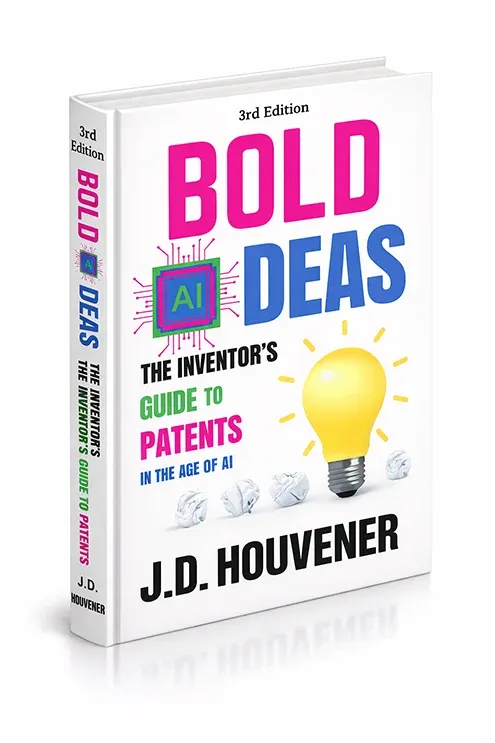
Written by Patent Attorney J.D. Houvener, this updated edition provides inventors, entrepreneurs, and startups with practical guidance for protecting ideas, avoiding costly mistakes, and navigating the patent process with confidence.
Whether you’re exploring a new invention, building a startup, or preparing to file a patent application, our team is here to help you move forward with confidence. Get personalized guidance from experienced patent professionals who understand the challenges inventors face.

We are a full-service patent and trademark prosecution firm. We help inventors and entrepreneurs research, protect, and monetize their intellectual property in the marketplace.
Schedule a Discovery Call 601-298-8425
Copyright © 2026 - Bold Patents• All Rights Reserved. Digital Marketing By: 