
After completing your patent search, selecting a registered patent attorney, and understanding the costs involved, you’re ready for one of the most important steps in the patent process—preparing and filing your patent application.
A well-drafted patent application does much more than describe your invention. It creates the legal foundation for the rights you hope to enforce, license, or use to grow your business.
The quality of your application today can determine the value of your patent for years to come.
Reading Time: 12 minutes
Video: 3 minutes
Alex had spent months refining the invention.
The prototype worked.
The patent search was complete.
The budget was in place.
Now it was time to put everything on paper.
At first, Alex thought the patent application would simply describe the finished product.
Instead, the patent attorney asked questions Alex hadn’t anticipated.
“What other ways could this work?”
“What if a competitor changed this component?”
“What would Version 2.0 look like?”
Alex quickly realized the application wasn’t just documenting today’s invention.
It was protecting tomorrow’s business.
Many first-time inventors believe a patent application is simply a technical manual.
In reality, it serves several important purposes.
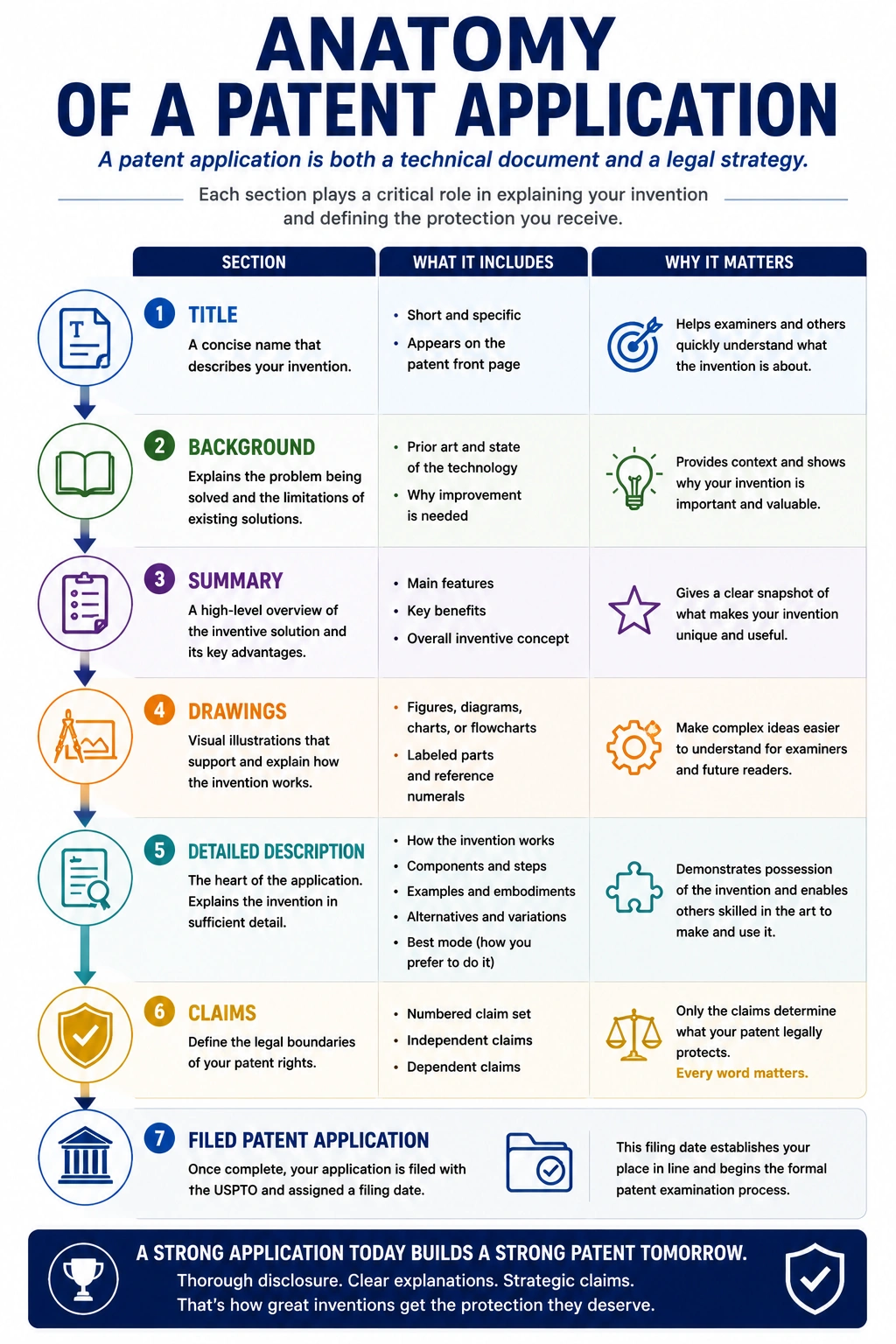
A strong application should:
The application becomes the foundation for everything that follows during examination.
A concise description of the invention.
Explains the problem being solved and the shortcomings of existing technology.
Provides a high-level overview of the inventive solution.
Illustrate the invention and help explain how it works.
Good drawings improve understanding for both examiners and future readers.
The heart of the application.
This section teaches:
The goal is to make the invention understandable while supporting future claim flexibility.
The claims define the legal boundaries of your patent rights.
Every word matters.
Claims—not the drawings or description—ultimately determine what your patent protects.
One of the most common mistakes inventors make is describing only the version they’ve built.
A stronger application also describes:
These additional embodiments provide flexibility if competitors attempt to design around your patent.
Ask yourself:
Documenting these possibilities today may strengthen your protection tomorrow.
AI can be extremely useful during preparation by helping to:
However, AI should never replace the strategic legal judgment required to determine claim scope, disclosure, or filing strategy.
Think of AI as an assistant—not the architect.
Avoid these frequent pitfalls:
❌ Describing only one embodiment
❌ Using marketing language instead of technical language
❌ Leaving out important alternatives
❌ Assuming drawings explain everything
❌ Failing to explain why the invention is different
One of the greatest values a patent attorney brings isn’t simply writing.
It’s asking the questions inventors don’t think to ask.
Many of the strongest patents I’ve prepared were strengthened because we explored possibilities beyond the first prototype.
A patent application should protect not only what you’ve built today—but where your innovation may go tomorrow.
There’s no ideal page count. The application should be as detailed as necessary to fully describe and support the invention.
Not always. Informal sketches can be valuable during drafting, but formal drawings are generally required before examination.
You can clarify existing disclosure, but you generally cannot add new subject matter after filing. That’s why a complete application is so important.
The description teaches the invention. The claims define the legal protection.
Yes. If you can describe alternative embodiments and foreseeable improvements, they may support broader protection.
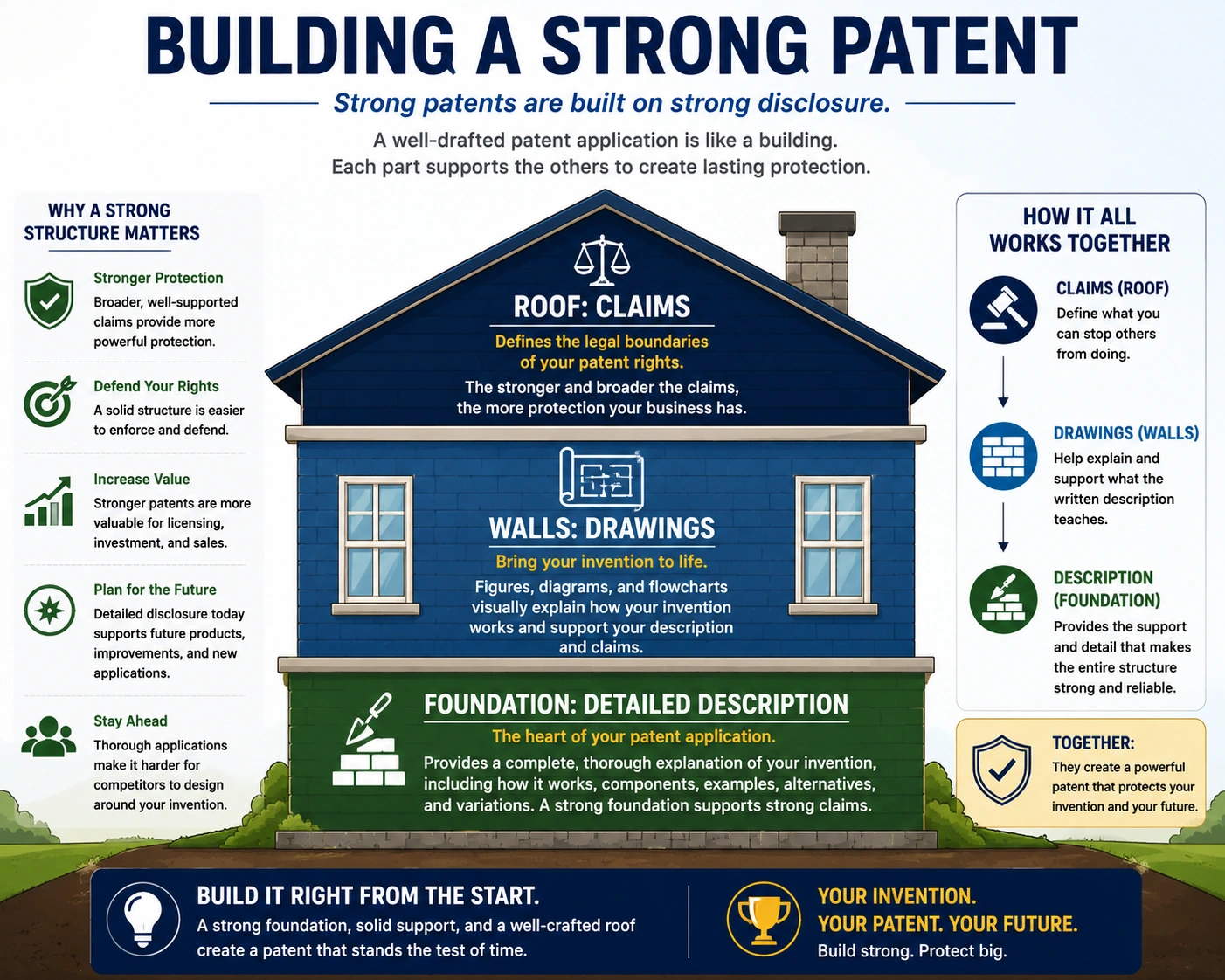
✔ A patent application is the foundation of your patent rights.
✔ Strong applications explain both today’s invention and tomorrow’s possibilities.
✔ Claims define legal protection.
✔ Detailed disclosure supports stronger claims.
✔ Thoughtful drafting today can provide greater business value later.
🎥 Video: Patent Application Drafting: Building Strong Protection from the Start
Learn how patent applications are structured, why detailed disclosure matters, and how thoughtful drafting can strengthen your intellectual property strategy.
A well-prepared patent application is one of the most valuable investments you can make in your innovation.
During a Discovery Call, we’ll discuss your invention, explain the drafting process, and develop a filing strategy designed to maximize both protection and long-term business value.
Written by Patent Attorney J.D. Houvener, this updated edition provides inventors, entrepreneurs, and startups with practical guidance for protecting ideas, avoiding costly mistakes, and navigating the patent process with confidence.
Whether you’re exploring a new invention, building a startup, or preparing to file a patent application, our team is here to help you move forward with confidence. Get personalized guidance from experienced patent professionals who understand the challenges inventors face.







We are a full-service patent and trademark prosecution firm. We help inventors and entrepreneurs research, protect, and monetize their intellectual property in the marketplace.
Schedule a Discovery Call 601-298-8425
Copyright © 2026 - Bold Patents• All Rights Reserved. Digital Marketing By: 