
It deserves a patent strategy.
Once you’ve completed a patent search and understand the competitive landscape, the next step isn’t simply hiring a lawyer.
It’s choosing the right partner to help protect your innovation, navigate the patent system, and build intellectual property that supports your long-term business goals.
In this chapter, you’ll learn how to choose a registered patent attorney, what questions to ask before hiring one, and how to build a productive relationship from day one. That is exactly how Alex approaches Step Two in the manuscript.
Reading Time: 11 minutes
Video: 9 minutes
Alex had done the hard work.
The invention was real.
The patent search was complete.
The prior art made sense.
Now it was time to turn engineering into legal protection.
At first, Alex searched online for an “IP lawyer.”
Thousands appeared.
Some advertised trademarks.
Others handled copyrights.
Some practiced every imaginable area of law.
Alex quickly realized something important.
Hiring a lawyer wasn’t the goal.
Hiring the right patent attorney was.
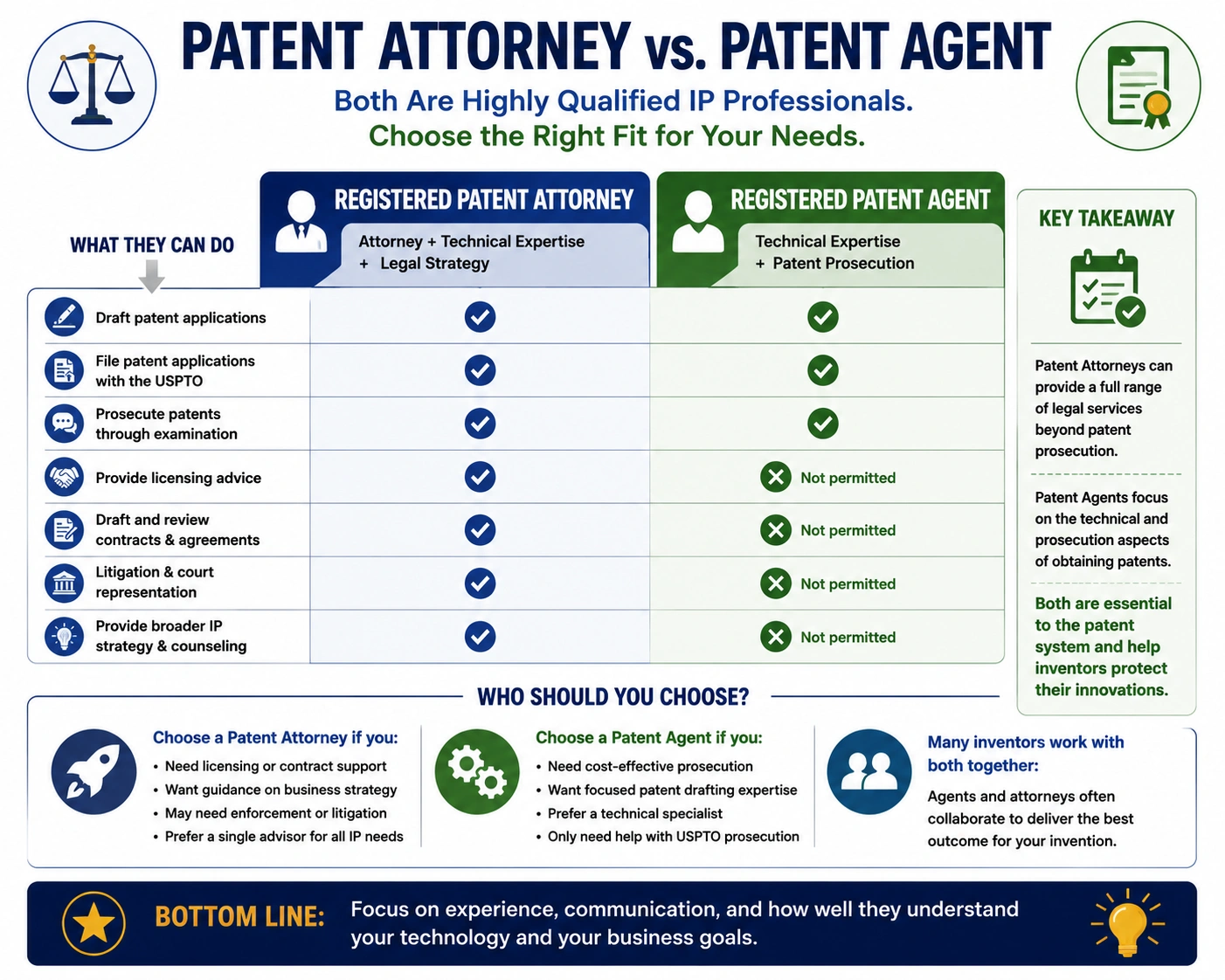
Not every attorney can prepare and prosecute patent applications before the United States Patent and Trademark Office.
For that, you generally need a registered patent attorney or registered patent agent.
Both can:
Patent attorneys can also advise on:
Because Alex wanted someone who could guide both prosecution and long-term business strategy, the focus remained on registered patent attorneys, while recognizing patent agents as valuable technical teammates.
One of my favorite lessons from your manuscript.
Alex didn’t choose a firm because of its size.
He chose one because the attorney understood his technology.
Within minutes, the attorney wasn’t asking vague questions like:
“Tell me about your invention.”
Instead, the conversation became technical.
Questions about:
Alex immediately knew:
This person speaks my language.
Technical fit creates better patents.
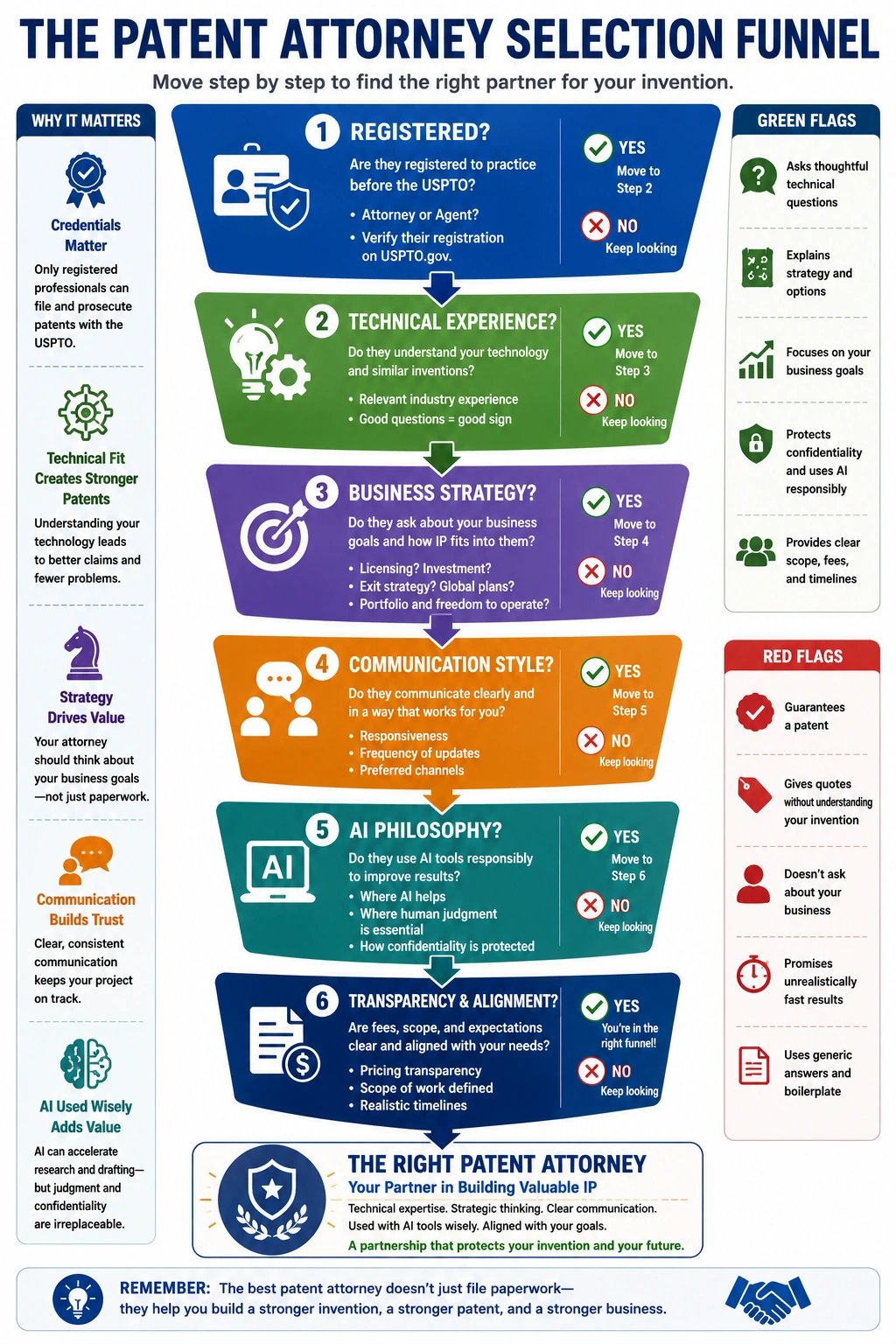
Before hiring a patent attorney, ask:
(Pro Tip: Ask for their registration number. You can verify it through the USPTO.) Your manuscript even encourages inventors to look it up themselves.
Not necessarily identical.
But similar technologies.
The partner?
An associate?
A patent agent?
A technical specialist?
Know who is doing the work.
Monthly updates?
Email?
Video calls?
Project management portal?
The best relationship is one built on clear expectations.
I think this question is becoming increasingly important.
A modern patent attorney should be able to explain:
AI should improve efficiency.
Never replace judgment.
Ask your attorney:
“Where does AI help your process—and where do you intentionally avoid using it?”
The answer tells you a lot about their philosophy.
Be cautious if someone:
❌ Guarantees you’ll receive a patent.
❌ Promises unrealistically fast results.
❌ Doesn’t ask technical questions.
❌ Quotes a price without understanding the invention.
❌ Treats every invention exactly the same.
Good patent attorneys ask lots of questions.
Great patent attorneys ask the right questions.
Hiring your attorney is only the beginning.
The best patent applications are collaborative.
Alex came prepared.
He brought:
The attorney transformed that information into an enforceable patent strategy.
That partnership produced a stronger application than either could have created alone.
Over the years, I’ve learned that the best client relationships don’t begin with legal jargon.
They begin with curiosity.
I want to understand what problem you’re solving, why your solution is different, and where you want your business to go—not just where you are today.
A patent application shouldn’t simply describe your invention.
It should support your business strategy for years to come.
❌ Hiring based solely on price.
❌ Assuming every IP lawyer handles patents.
❌ Choosing someone without technical understanding.
❌ Waiting until after public disclosure.
❌ Treating the attorney like a form-filler instead of a strategic advisor.
Before hiring a patent attorney, ask yourself:
✔ Do I understand my invention well enough to explain it?
✔ Have I completed a patent search?
✔ Do I know my business goals?
✔ Am I looking for a document—or a long-term strategy?
✔ Do I feel comfortable asking questions?
If so…
You’re ready to begin building a strong partnership.
Choosing the right patent attorney isn’t just about credentials.
It’s about:
✔ Technical understanding.
✔ Strategic thinking.
✔ Clear communication.
✔ Business alignment.
✔ Long-term trust.
The best patent attorneys don’t simply file applications.
They help inventors build valuable intellectual property portfolios.
🎥 Video: How to Choose the Right Patent Attorney for Your Invention
Choosing a patent attorney shouldn’t feel intimidating.
During a Discovery Call, we’ll discuss your invention, answer your questions, explain our process, and help you determine whether we’re the right fit for your innovation journey.
Our goal isn’t simply to earn your business.
It’s to earn your trust.
Written by Patent Attorney J.D. Houvener, this updated edition provides inventors, entrepreneurs, and startups with practical guidance for protecting ideas, avoiding costly mistakes, and navigating the patent process with confidence.
Whether you’re exploring a new invention, building a startup, or preparing to file a patent application, our team is here to help you move forward with confidence. Get personalized guidance from experienced patent professionals who understand the challenges inventors face.


We are a full-service patent and trademark prosecution firm. We help inventors and entrepreneurs research, protect, and monetize their intellectual property in the marketplace.
Schedule a Discovery Call 601-298-8425
Copyright © 2026 - Bold Patents• All Rights Reserved. Digital Marketing By: 