
The complexities of patenting algorithms present a challenge many face today in our increasingly technology-driven world. With the unprecedented rise of artificial intelligence and machine learning in recent years, algorithms have ascended to the status of precious assets for tech companies and inventors. The support of patenting an algorithm or AI attorney is crucial to successfully navigate this constantly changing system.
Exploring the current legal landscape, weighing the pros and cons, and learning the best practices for patenting algorithms are important to understanding this intriguing intersection of technology, law, and intellectual property. At Bold Patents, we have decades of experience and can give you the legal support you need as you navigate this unfolding area of IP law.
Algorithms have become an integral part of our daily lives, even if we might not always realize it. At their core, algorithms are specific sets of instructions or rules that solve a problem or accomplish a task. They’re the backbone of the digital world, dictating everything from your Google search results and your Facebook news feed to complex weather forecasts and financial market predictions.
In the world of computer science, algorithms are akin to the recipe that instructs a computer on how to perform a specific function or solve a particular problem.

However, not all algorithms are created equal. Some are relatively simple and straightforward, while others are incredibly complex, involving advanced mathematical concepts and processes. For instance, the algorithms that power artificial intelligence and machine learning systems are often extraordinarily intricate, enabling these systems to “learn” from data and improve their performance over time.
Algorithms can also be proprietary, kept as a trade secret by companies or individuals, or they can be open source, shared freely for anyone to use or modify.
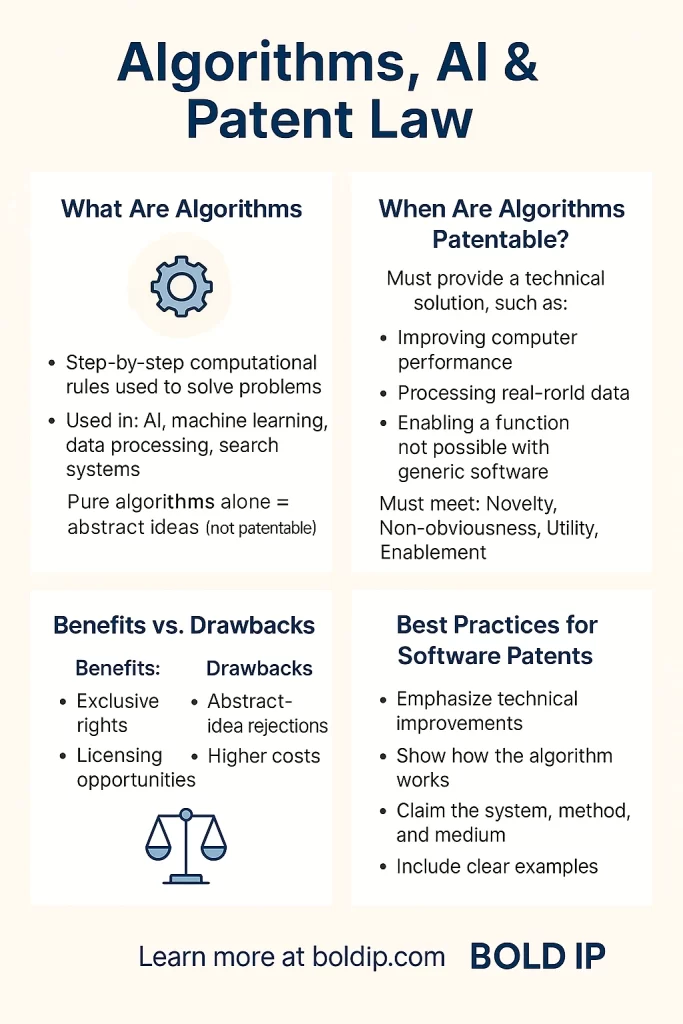
In the realm of patent law, innovations that can be patented typically involve a new and useful process, machine, manufacture, or composition of matter. In essence, a patentable invention must possess novelty, utility, and non-obviousness. This might include tangible products like a new type of engine or machinery, novel methods such as a unique manufacturing process, or innovative compositions like a new pharmaceutical drug. Importantly, the innovation must also have a specific, practical utility.
In the context of software and algorithms, the line becomes less clear. Algorithms are essentially mathematical methods, and these, as well as abstract ideas, are generally not considered patentable subject matter. However, if an algorithm is used in a specific and novel way that results in a technical effect, it might be patentable. For instance, Google’s original PageRank algorithm, which revolutionized online search, was granted a patent because it was a specific method that produced a new and useful result.
The current legal landscape for patenting algorithms is complex and somewhat uncertain, particularly in the United States. This uncertainty primarily arises from the landmark Supreme Court case, Alice Corp. vs. CLS Bank International, which ruled that abstract ideas implemented using a computer were not eligible for a patent unless the patent adds something extra that embodies an innovative concept. This has made it significantly more challenging to patent software and algorithms, as many have been viewed as mere abstract ideas.
However, it’s not an insurmountable barrier. Many companies successfully patent software and algorithms by demonstrating their invention provides a concrete and tangible result. Essentially, to stand a chance of being patented, an algorithm must contribute to the solution of a technical problem.
However, there’s considerable subjectivity in this, and patent applications for algorithms are often dependent on the interpretation of patent examiners and courts. International laws and regulations can vary widely, adding an additional layer of complexity to the issue.
Some algorithms are created by AI, which adds more complications to the patenting process. The ownership, or inventorship, of an AI-generated invention becomes important in these cases, on top of the application of the algorithm.
You must be able to show that there was significant human contribution when conceiving or creating the invention. When filing for a patent, you cannot list any AI as the inventor. Instead, you have to show significant contributions of a human inventor or inventors, such as:
If you meet this requirement and you can show a specific problem that the method of using your algorithm is solving, you are more likely to be able to patent this invention.
Patenting an algorithm can have several benefits, especially for businesses and individuals looking to safeguard their intellectual property. This includes:
However, there are also notable challenges and downsides to patenting an algorithm. This includes:

If you’re considering patenting an algorithm, a crucial first step is to ensure that your invention falls under the criteria for patentability. As algorithms are generally viewed as mathematical methods or abstract ideas, it’s important to focus on the practical application of the algorithm.
Highlight how it’s used in a specific, novel way to solve a technical problem, rather than the algorithm itself. Be sure to present the algorithm as part of a larger system or process, clearly demonstrating its functionality, novelty, and non-obviousness.
Next, meticulous documentation is essential throughout the development process. Keep a comprehensive record of your invention, including its conception, development, and refinement stages. These documents can be vital in proving the originality of your invention and resolving potential disputes.
You may be able to obtain a patent on an AI algorithm, although it vastly depends on the use of the algorithm and other factors. The algorithm itself is a mathematical formula, which patent courts in the U.S. consider to be either natural phenomena or abstract ideas, neither of which is patentable. However, the way an algorithm is used can be patented. The method and application of an algorithm that creates a new outcome could be patented.
The cost of an AI intellectual property lawyer depends on the attorney’s experience and your unique legal needs. There are very different costs when you need legal advice on patentability compared to taking action against infringement of your IP rights. Pre-litigation actions are much more costly. Most IP lawyers charge hourly, so if it takes longer to assemble an application, address infringement, or explain your rights, it will also be more costly.
The cost to patent an algorithm includes several potential costs. A patent for an algorithm will usually be a utility patent, which has a filing fee of $350. Conducting a patent search is $770, examination of the application is $880, and the fee for issuing the patent is $1,290. There are also maintenance fees during the patent’s lifetime. All of these fees could be reduced by 60% to 80% if you qualify as a small or micro entity.
You should hire a patent attorney to patent AI and algorithms because this is a gray area in patent law, and not everything can secure a patent. Filing for a patent is costly, and you don’t want to waste that money on something you can’t patent. A patent attorney helps you assess the patentability of your AI algorithm or other algorithm. They also gather documentation to describe the invention and how the invention is made and used.
Patenting an algorithm is undoubtedly a complex and nuanced endeavor. While there are clear benefits to securing a patent, such as protecting and potentially monetizing your invention, it’s equally important to acknowledge the challenges, including legal hurdles, costs, and potential drawbacks to innovation.
As you decide whether to embark on this path, thorough research, a firm grasp of the current legal landscape, and professional guidance are indispensable. Contact an AI patent attorney at Bold Patents who can help guide you through the process of getting your algorithm patented.
Written by Patent Attorney J.D. Houvener, this updated edition provides inventors, entrepreneurs, and startups with practical guidance for protecting ideas, avoiding costly mistakes, and navigating the patent process with confidence.
Whether you’re exploring a new invention, building a startup, or preparing to file a patent application, our team is here to help you move forward with confidence. Get personalized guidance from experienced patent professionals who understand the challenges inventors face.







We are a full-service patent and trademark prosecution firm. We help inventors and entrepreneurs research, protect, and monetize their intellectual property in the marketplace.
Schedule a Discovery Call 601-298-8425
Copyright © 2026 - Bold Patents• All Rights Reserved. Digital Marketing By: 