
Many inventors assume there’s only one kind of patent.
In reality, the United States offers three primary types of patents, each protecting a different aspect of innovation.
Understanding the differences can help you make smarter decisions about protecting your invention, strengthening your brand, and maximizing the value of your intellectual property.
As Alex discovered, protecting both the technology inside a product and the appearance customers recognize can create a much stronger competitive advantage than relying on a single patent alone.
Reading Time: 12 minutes
Video: 10 minutes
Alex originally believed the invention needed only one patent.
After all, the real innovation was hidden inside the electronics.
Then the patent attorney asked two simple questions.
“What if someone copied the appearance but used different electronics?”
Alex frowned.
That would certainly hurt sales.
“What if they copied the electronics but made the product look different?”
That would be just as damaging.
Suddenly Alex realized there wasn’t just one invention to protect.
There were multiple competitive advantages.
One patent would protect how the product worked.
Another could protect what customers recognized on the shelf.
Instead of building one fence around the business, Alex built two.
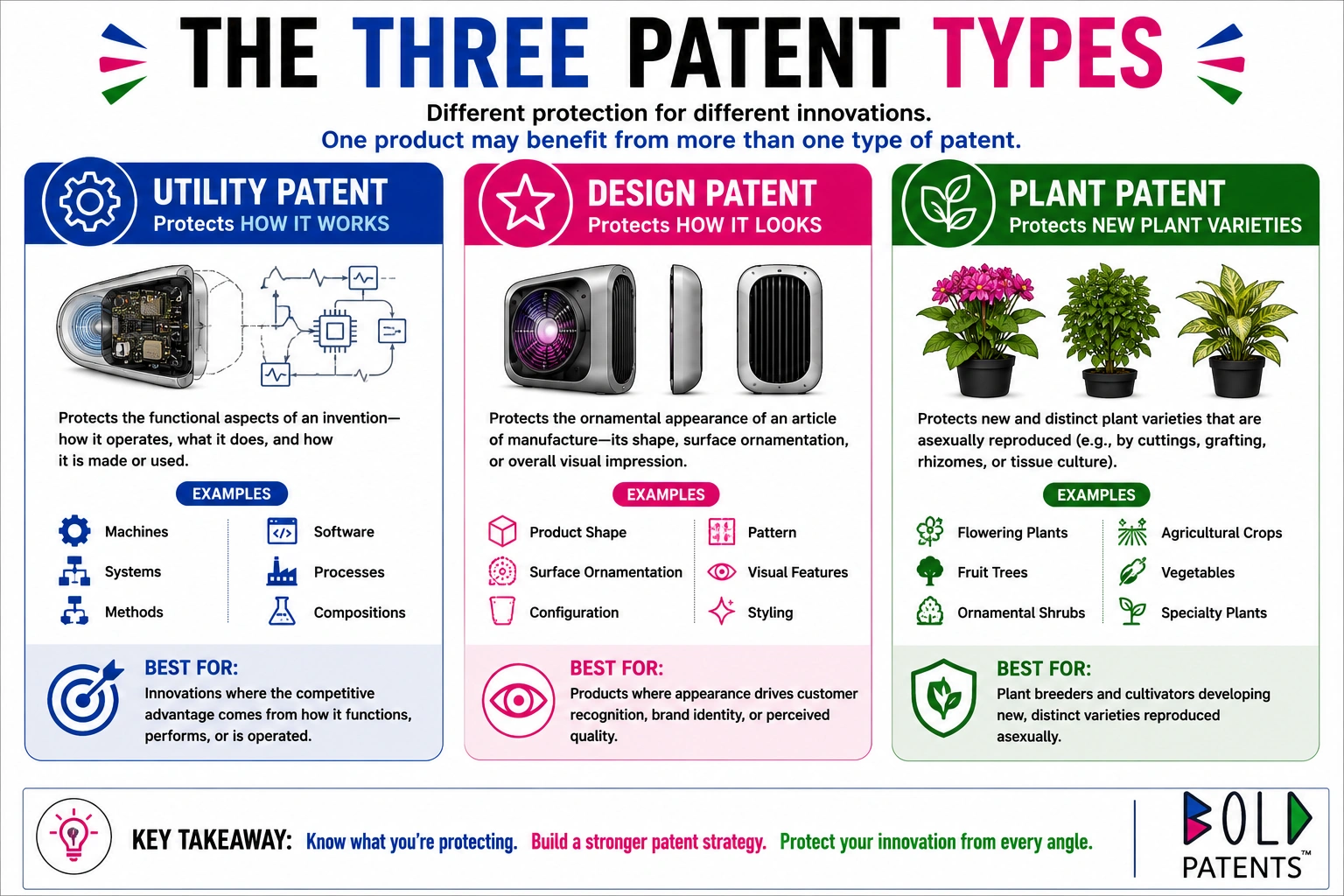
Although people often say “get a patent,” patents actually fall into three different categories.
Each protects something entirely different.
Understanding those differences is the first step toward building an effective intellectual property strategy.
Utility patents protect the functional aspects of an invention.
Examples include:
If your competitive advantage comes from how something operates, a utility patent is usually your primary form of protection.
For many technology companies, the utility patent becomes the cornerstone of the patent portfolio.
What Makes a Strong Utility Patent?
Strong utility patents don’t simply describe a product.
They explain:
The claims define the legal boundaries of protection, while the specification supports those claims with detailed disclosure.
The broader and more complete the disclosure, the greater the opportunity to pursue meaningful claim protection.
Utility patents are especially valuable when protecting:
If competitors can copy the functionality—even while changing the appearance—a utility patent may provide your strongest protection.
Design patents protect the ornamental appearance of a product.
Instead of protecting functionality, they protect visual characteristics.
Examples include:
For many consumer products, appearance becomes one of the company’s most valuable assets.
Unlike utility patents, where written claims define protection, design patents rely primarily on the drawings.
Every line matters.
Professional patent drawings clearly distinguish:
Well-prepared drawings often determine the strength of a design patent.
Design patents are particularly effective for:
When customers recognize your product because of its appearance, design patents deserve serious consideration.
Plant patents protect new and distinct plant varieties that are reproduced asexually.
They commonly apply to:
Although most inventors won’t need plant patents, they play an important role in agriculture, horticulture, and biotechnology.
Alex ultimately pursued both utility and design protection.
The utility patent protected:
The design patent protected:
This strategy created two independent layers of protection.
If someone copied only the technology…
➡️ Utility patent.
If someone copied only the appearance…
➡️ Design patent.
If they copied both…
➡️ Both patents became valuable enforcement tools.
| Utility Patent | Design Patent |
| Protects function | Protects appearance |
| Technical claims | Patent drawings |
| Engineering focused | Visual focused |
| Usually longer examination | Often faster examination |
| Covers operation | Covers ornamental design |
Neither is “better.”
Each protects something different.
Together they often create significantly stronger protection.
AI can be useful during early patent planning by helping you:
However, AI should never replace:
Think of AI as a research assistant—not your patent attorney.
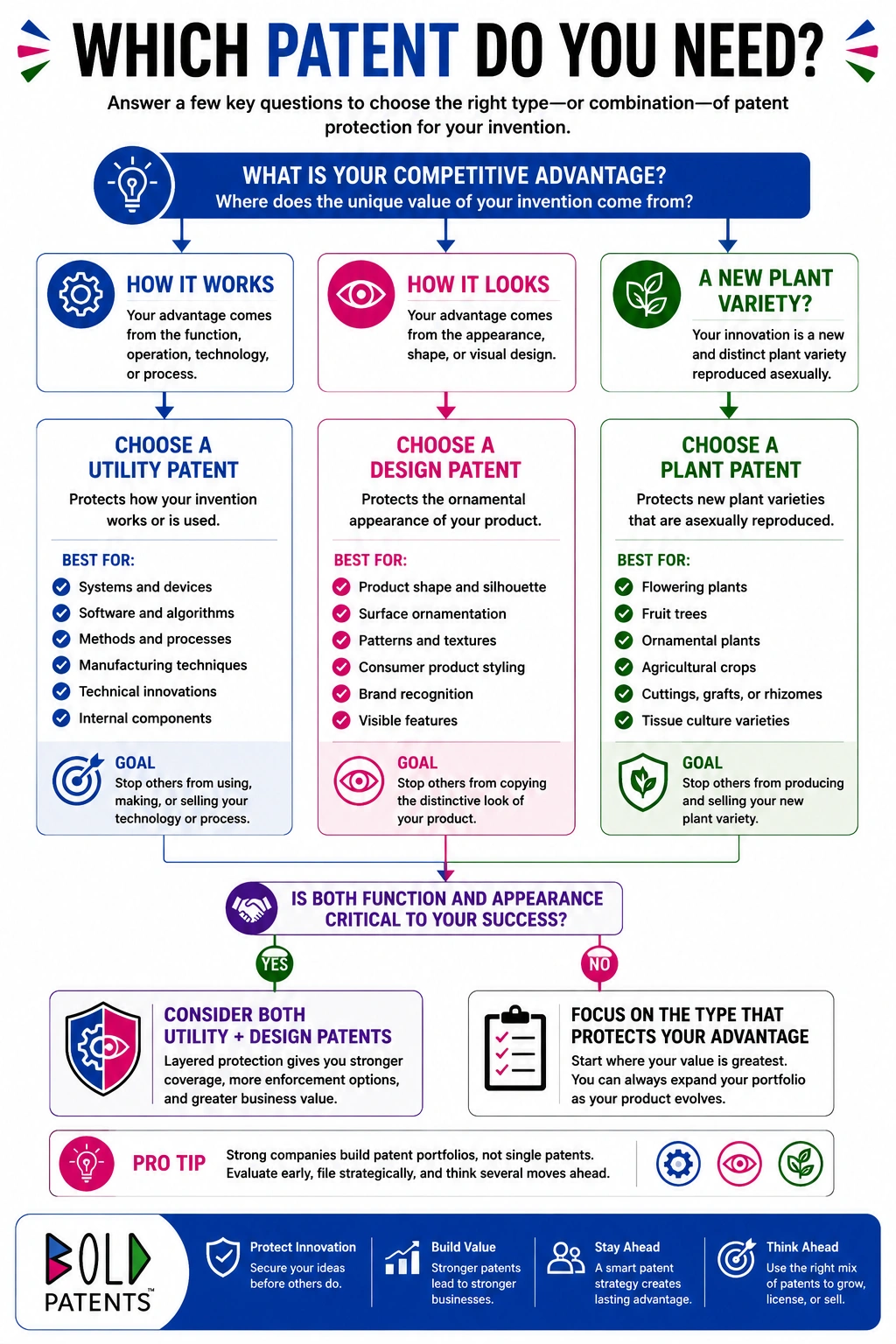
Ask yourself these questions.
→ Start with a Utility Patent.
→ Consider a Design Patent.
→ Consider filing both.
→ Discuss a Plant Patent with your attorney.
Many successful companies own portfolios containing multiple patent types because competitors attack products from multiple directions.
Avoid these frequent errors:
❌ Assuming every invention needs only a utility patent
❌ Ignoring valuable product appearance
❌ Using poor design drawings
❌ Waiting too long to consider design protection
❌ Treating utility and design patents as alternatives instead of complementary tools
One of the biggest missed opportunities I see is inventors overlooking design patents.
Everyone gets excited about the technology.
Few stop to consider that customers often buy products because they recognize them.
Think about some of the world’s most successful products.
Many became iconic because of both what they did and how they looked.
Your patent strategy should reflect that reality.
Protecting only the engineering may leave valuable intellectual property exposed.
Protecting both creates multiple barriers that competitors must overcome.
Absolutely. Many products are protected by both utility and design patents because they safeguard different aspects of the same invention.
That depends on your business. Technology-driven companies often rely heavily on utility patents, while appearance-driven products may gain tremendous value from design patents.
Design patents generally involve different examination standards and often proceed more quickly, although high-quality drawings remain critical.
No. Plant patents are specialized and primarily benefit agricultural, horticultural, and biotechnology innovations.
Often, yes. Combining multiple forms of protection can strengthen licensing opportunities, discourage copying, and increase the overall value of an intellectual property portfolio.
✔ Utility patents protect functionality.
✔ Design patents protect appearance.
✔ Plant patents protect qualifying new plant varieties.
✔ One product may deserve multiple forms of patent protection.
✔ Strong intellectual property portfolios often combine patent types to create broader competitive advantages.
🎥 Video: Understanding the Three Types of Patents
Learn when to use utility, design, and plant patents—and how combining multiple forms of protection can strengthen your business and your intellectual property strategy.
Choosing the right patent is about more than filing paperwork—it’s about protecting what makes your business unique.
During a Discovery Call, we’ll evaluate your invention, identify the forms of protection that best fit your goals, and develop a patent strategy designed to maximize both innovation and long-term business value.
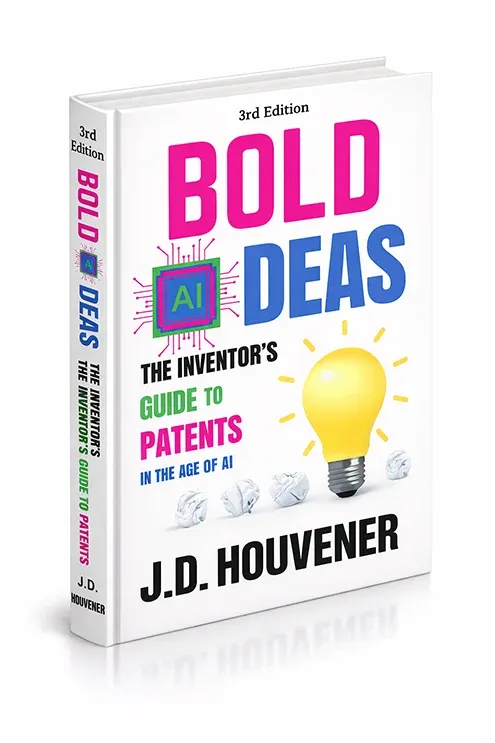
Written by Patent Attorney J.D. Houvener, this updated edition provides inventors, entrepreneurs, and startups with practical guidance for protecting ideas, avoiding costly mistakes, and navigating the patent process with confidence.
Whether you’re exploring a new invention, building a startup, or preparing to file a patent application, our team is here to help you move forward with confidence. Get personalized guidance from experienced patent professionals who understand the challenges inventors face.







We are a full-service patent and trademark prosecution firm. We help inventors and entrepreneurs research, protect, and monetize their intellectual property in the marketplace.
Schedule a Discovery Call 601-298-8425
Copyright © 2026 - Bold Patents• All Rights Reserved. Digital Marketing By: 