
Many inventors assume monetizing a patent means finding an infringer and filing a lawsuit.
That is only one possibility—and often not the best one.
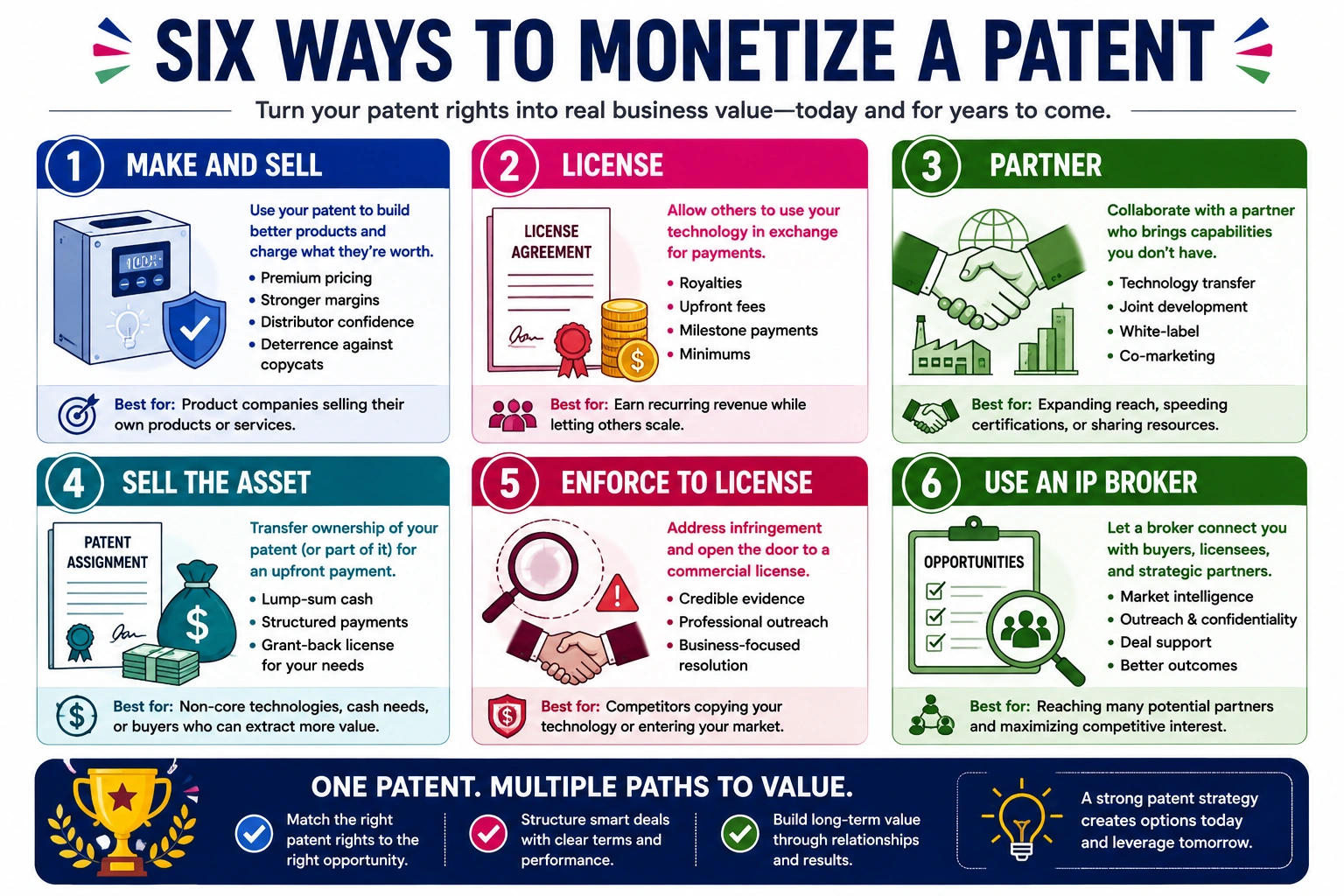
Patents can create value in many ways. They can support premium pricing, attract partners, generate licensing revenue, strengthen supplier negotiations, improve company valuation, and create leverage during a sale or financing.
The key is matching the right patent rights to the right opportunity at the right time.
Alex did not treat the patent as a framed certificate or a litigation weapon. He treated it as a flexible business asset that could support multiple revenue streams throughout the product’s life.
Reading Time: 15 minutes
Video: 12 minutes
Once Alex’s patent portfolio began taking shape, the next question was obvious:
“How do we actually make money from this?”
At first, Alex imagined licensing the patent to a large company and collecting royalty checks.
That was one option.
But the patent attorney encouraged a broader view.
The patent could also help Alex:
Alex realized that monetization was not one transaction.
It was an ongoing process of connecting patent rights to real business opportunities.
The most valuable use of a patent may happen without ever entering a courtroom.
A patent can help you:
The patent creates leverage.
Your business model determines how that leverage becomes value.
Before contacting licensees, investors, or potential buyers, Alex created a simple portfolio map.
It answered three important questions:
What do we own?
Where does it matter?
How long will it last?
The portfolio map included:
This prevented Alex from making vague claims about “having patents.”
He could explain exactly what the portfolio protected and why it mattered commercially.
A patent has greater commercial value when you can show how its claims relate to a real product.
Alex maintained two types of claim charts.
Mapped patent claim elements to Alex’s own product.
This helped confirm that the product practiced the patented invention.
Mapped claim elements to publicly available information about a competitor or potential licensee.
Sources could include:
The goal was not to accuse everyone of infringement.
It was to understand where the patent created realistic commercial leverage.
Alex’s first patent-generated revenue did not come from royalties.
It came from margin.
The patent supported:
When customers understood that Alex’s performance advantages were backed by protected technology, the company could defend its price instead of competing only on cost.
Licensing allows another company to use the patented technology under agreed terms.
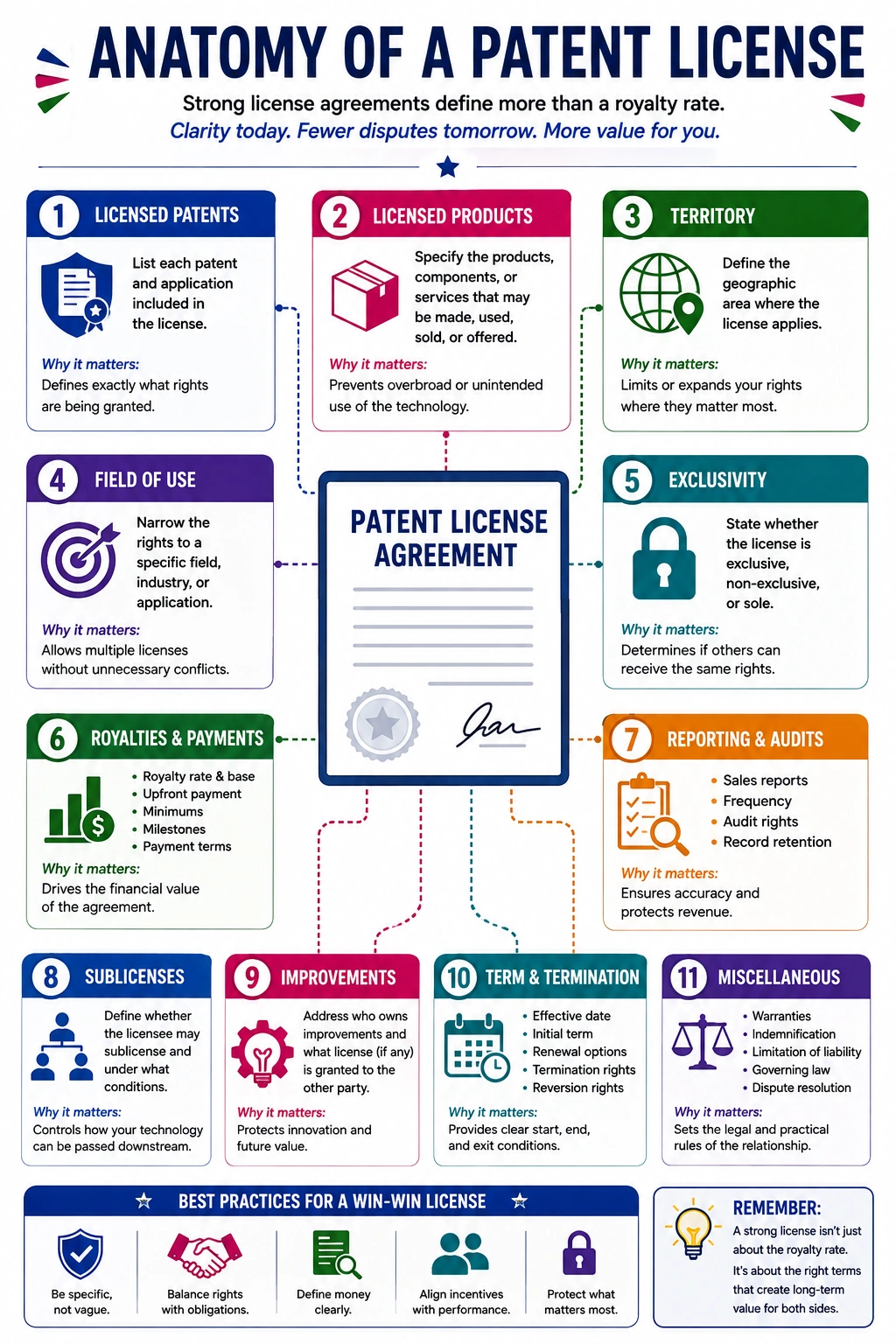
A license may be limited by:
For example, Alex could grant one company rights for warehouse retrofits while preserving rights for residential products, outdoor lighting, or international markets.
This allowed the same patent family to support multiple deals without surrendering the entire opportunity.
Sometimes the best partner brings capabilities Alex did not have.
These might include:
A partnership might include:
The patent gave Alex a valuable contribution to the partnership and helped define what each side brought to the table.
Selling a patent means assigning ownership to another party.
This may make sense when:
Alex considered selling a secondary embodiment while retaining a limited license for internal use.
The lesson was simple:
Do not sell a patent merely because someone offers cash.
First determine whether it could support future products, continuations, negotiations, or licensing opportunities.
Sometimes a competitor begins using technology that appears to fall within the patent claims.
Alex’s preferred goal was not immediate litigation.
It was a business resolution.
The first communication focused on:
The message was professional and commercially focused.
Litigation remained a possible escalation path, but licensing was the intended offramp.
An intellectual property broker may help identify buyers or licensees, especially when the potential market is broad.
A broker may:
Alex used a broker when reaching many potential counterparties simultaneously created more value than approaching them one at a time.
A broker does not create value inside a weak patent.
A good broker helps expose existing value to more qualified buyers.
Multiple companies may receive rights.
Advantages may include:
One company receives defined exclusive rights.
Exclusivity may apply to:
Exclusivity should rarely be given away without meaningful performance commitments.
Alex required:
If the licensee failed to perform, exclusivity could end or convert to non-exclusive rights.
Inventors often focus immediately on the royalty percentage.
That is usually premature.
The structure of the deal may matter more than the headline rate.
Important terms include:
A high royalty rate means little if the licensee has no minimum performance obligation or can manipulate the royalty base.
Many royalty agreements calculate payments as a percentage of net sales.
That definition must be clear.
Permitted deductions might include:
Problematic deductions might include:
Alex tested the definition against sample invoices before signing.
If both finance teams could calculate the same royalty from the same invoice, the definition was probably working.
The licensee pays a percentage of revenue from licensed products.
Best when product prices vary.
A fixed amount is paid for each licensed unit sold.
Best when products are standardized and units can be tracked easily.
Paid when the agreement is signed.
This may compensate for access, exclusivity, prior development, or technology transfer.
An upfront payment credited against future royalties.
This provides immediate funding while preserving long-term royalty potential.
The licensee must generate a minimum amount each year.
This prevents an exclusive licensee from shelving the technology.
Payments triggered by events such as:
Patent valuation is not an exact science.
Alex used three practical approaches to develop credible ranges.
Estimate what a company would reasonably pay to license the patent rather than operate without permission.
This considers:
Review licensing or sale transactions involving similar technology.
Adjustments may be needed for:
Estimate what it would cost a competitor to avoid the patent.
That might include:
A license should generally cost less than a rational, commercially acceptable design-around.
Alex did not begin negotiations by sending hundreds of pages.
He prepared a focused package.
A one-page explanation of:
Included:
A short visual presentation mapping a few key claim elements to public product information.
Confirmed that:
Outlined the business structure before extensive legal drafting began.
The goal was to provide enough information to create interest without giving away unnecessary technical or strategic detail.
AI can help with:
But Alex maintained strict guardrails.
AI accelerated preparation.
Human judgment closed the deal.
Alex treated every concession as an exchange.
Examples:
Narrower field of use
Higher royalty rate
Temporary exclusivity
Performance minimums and reversion rights
Lower upfront payment
Higher annual minimums
Broader sublicensing rights
A share of sublicense revenue and approval rights
This kept negotiations balanced and prevented Alex from surrendering valuable rights without receiving meaningful value in return.
Licensing relationships often generate new improvements.
The agreement should explain:
Alex avoided broad provisions assigning every future improvement to the licensee.
Instead, each party generally owned what it invented, with carefully limited rights granted to the other party when needed.
Not every company will agree to a license voluntarily.
Alex used an escalation ladder:
Preparing for enforcement often made settlement more likely.
Clean ownership, strong evidence of use, realistic damages analysis, and a clear litigation budget gave Alex credibility.
The objective remained commercial resolution—not conflict for its own sake.
Avoid these frequent errors:
❌ Offering exclusivity without minimum performance requirements
❌ Focusing only on the royalty percentage
❌ Using a vague definition of net sales
❌ Giving away all future improvements
❌ Granting unlimited sublicensing rights
❌ Sharing full claim charts or confidential files too early
❌ Assuming every patent has the same buyer
❌ Letting licensing undermine your own product margins
A patent is not valuable simply because it exists.
Its value depends on what it covers, who needs access to that technology, and how the rights support a real business opportunity.
The strongest monetization strategies begin with clarity.
What do the claims cover?
Which products or markets matter?
Who has a reason to make a deal?
What would happen if they did not?
Once those questions are answered, licensing and partnership conversations become much more concrete.
The goal is not to force every patent into a royalty agreement.
The goal is to use each patent in the way that creates the greatest strategic value for the business.
Not always. Pending patent applications may support partnerships, investments, or early licensing discussions, although issued claims generally provide stronger certainty and leverage.
Licensing allows you to retain ownership and potentially create recurring revenue. Selling provides more immediate certainty but transfers future control and upside.
There is no universal rate. It depends on claim strength, market value, available alternatives, remaining term, geography, and the patent’s contribution to the product.
Only when exclusivity creates enough value to justify limiting other opportunities. Performance minimums and reversion rights are essential.
A broker identifies potential buyers or licensees, manages outreach, organizes materials, and may support negotiations. Brokers are most useful when the target market is large or difficult to access directly.
Yes. Licenses can be divided by territory, field of use, product type, or channel, allowing one patent family to support several commercial arrangements.
✔ Monetization is broader than litigation.
✔ Patents can support product sales, pricing, licensing, partnerships, assignments, and financing.
✔ Understand what your claims cover before approaching counterparties.
✔ Deal structure matters as much as the royalty rate.
✔ Exclusivity should include measurable performance obligations.
✔ Good materials create interest without oversharing.
✔ Monetization works best as a repeatable business process—not a one-time event.
🎥 Video: How to Make Money From a Patent
In this video, J.D. explains the major patent monetization models, how licensing deals are structured, what makes a patent commercially attractive, and how inventors can turn intellectual property into lasting business value.
Your patent may support more than one path to revenue.
During a Discovery Call, we’ll discuss what your rights cover, identify potential licensing or partnership opportunities, and explore a monetization strategy aligned with your products, market, and long-term goals.
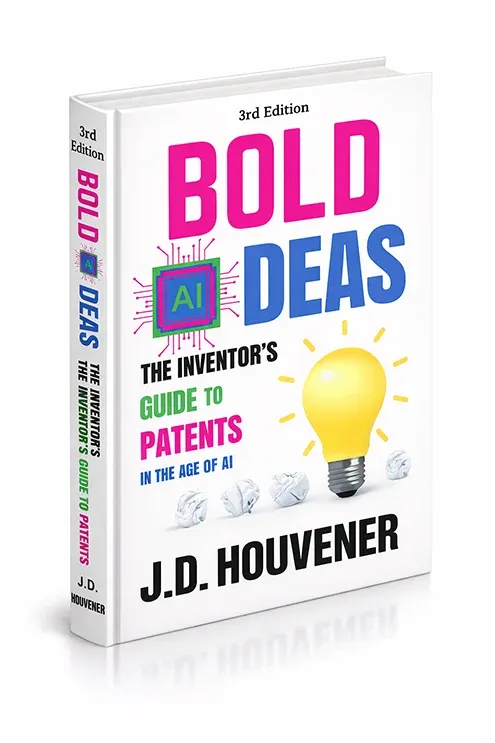
Written by Patent Attorney J.D. Houvener, this updated edition provides inventors, entrepreneurs, and startups with practical guidance for protecting ideas, avoiding costly mistakes, and navigating the patent process with confidence.
Whether you’re exploring a new invention, building a startup, or preparing to file a patent application, our team is here to help you move forward with confidence. Get personalized guidance from experienced patent professionals who understand the challenges inventors face.

We are a full-service patent and trademark prosecution firm. We help inventors and entrepreneurs research, protect, and monetize their intellectual property in the marketplace.
Schedule a Discovery Call 601-298-8425
Copyright © 2026 - Bold Patents• All Rights Reserved. Digital Marketing By: 