
Building a successful invention requires communication.
You may need to pitch investors.
Demonstrate a prototype.
Talk with manufacturers.
Meet potential customers.
Attend trade shows.
Publish research.
Promote a launch.
But every conversation creates an important question:
How much should you reveal?
Say too little and opportunities may disappear.
Say too much, too early, and you may jeopardize patent rights, expose valuable know-how, or give competitors a roadmap.
Alex learned that the answer wasn’t secrecy.
It was sequencing.
File first. Speak second.
And when you do speak, lead with what the invention accomplishes—not necessarily every detail about how it accomplishes it.
Reading Time: 15 minutes
Video: 12 minutes
As Alex’s invention gained traction, opportunities started arriving quickly.
Investors wanted presentations.
Potential customers wanted demonstrations.
A trade show wanted product specifications.
Marketing wanted website copy.
An industry group wanted Alex to give a technical presentation.
Everyone wanted information.
Alex wanted momentum.
The patent attorney wanted one thing first:
“What exactly are you planning to disclose?”
That question changed Alex’s approach.
Instead of treating every presentation the same, the company developed a disclosure strategy.
Some information could be shared publicly.
Some could be shared only after filing.
Some belonged behind an NDA.
And some information simply didn’t need to leave the company at all.
Alex wasn’t trying to hide the invention.
Alex was learning how to sequence disclosure intelligently.
There are really two disclosure problems inventors need to manage.
This is what you tell:
The goal is to communicate enough value to move the business forward without unnecessarily giving away protectable technology.
The second audience is very different.
During patent prosecution, inventors and others involved in the application process have disclosure obligations to the USPTO concerning information material to patentability.
Here, the objective isn’t secrecy.
It’s candor.
These two forms of disclosure require different strategies.
Alex eventually reduced the public-disclosure strategy to three rules.
Before broadly discussing the mechanics of the invention, Alex wanted a patent application on file.
That application needed to actually describe the invention—not merely reserve a date with a few rough ideas.
After filing, Alex still didn’t reveal every technical detail.
Marketing focused on:
The proprietary implementation remained protected where appropriate.
Before major:
Alex compared what the team planned to reveal against what had actually been filed.
If the technology had evolved, the patent strategy was updated first.

The most dangerous disclosures aren’t always formal technical papers.
Sometimes they’re ordinary business activities.
Alex maintained two versions.
Included:
Could include:
Sensitive material was reserved for appropriate confidential settings.
Marketing wanted to explain why Alex’s product was better.
That was fine.
But the website emphasized benefits instead of implementation details.
Instead of teaching competitors how the system worked, the site explained what customers gained from using it.
Crowdfunding can create a particularly difficult disclosure problem.
Successful campaigns often require:
Those same materials can reveal significant portions of an invention.
Alex’s rule was simple:
File before the campaign goes live.
Trade shows created another challenge.
Customers wanted technical answers.
Competitors were standing ten feet away.
Alex divided information accordingly.
The booth showed:
Detailed technical conversations occurred separately and, when appropriate, under confidentiality protections.
Researchers face another potential conflict.
Academic success often rewards early publication.
Patent systems reward early filing.
Alex coordinated publications, theses, posters, and conference presentations with patent filings so that the company didn’t accidentally sacrifice rights while trying to share research.
Standards organizations can require detailed technical discussions.
Alex participated strategically.
The team advocated for:
But proprietary implementations remained confidential until appropriate filings were secured.
One of the most important lessons Alex learned was that disclosure rules differ internationally.
The United States provides certain protections associated with an inventor’s own disclosure.
But relying on those protections can be dangerous if international patent rights matter.
Many foreign jurisdictions apply much stricter novelty requirements.
Alex therefore adopted a global rule:
Even when U.S. law might provide some flexibility, the company didn’t assume the rest of the world would.
Alex used nondisclosure agreements frequently.
They were particularly useful with:
But an NDA didn’t automatically solve every problem.
Alex thought of NDAs as seatbelts, not armor.
They help create contractual protections around confidential information.
They don’t make information impossible to leak.
And they don’t necessarily prevent someone from independently developing or reverse engineering the same technology.
The first question remained:
Do they actually need to know this?
Eventually, products need to leave the lab.
Alex structured private beta programs carefully.
Depending on the circumstances, participants agreed to restrictions involving:
Prototype units could also be identified as confidential evaluation units.
When a genuinely public pilot became necessary, Alex’s preferred sequence remained the same:
File first. Pilot second.
Not every innovation needs to become a patent.
Sometimes Alex intentionally published an idea so it could become prior art rather than allowing someone else to patent the concept later.
This strategy was reserved for technology the company did not intend to protect through patents or trade secrets.
Defensive publication was deliberate.
It wasn’t accidental disclosure disguised as strategy.
Once information is intentionally placed into the public domain, you generally cannot simply make it secret again.
Alex created a simple rule for presentations.
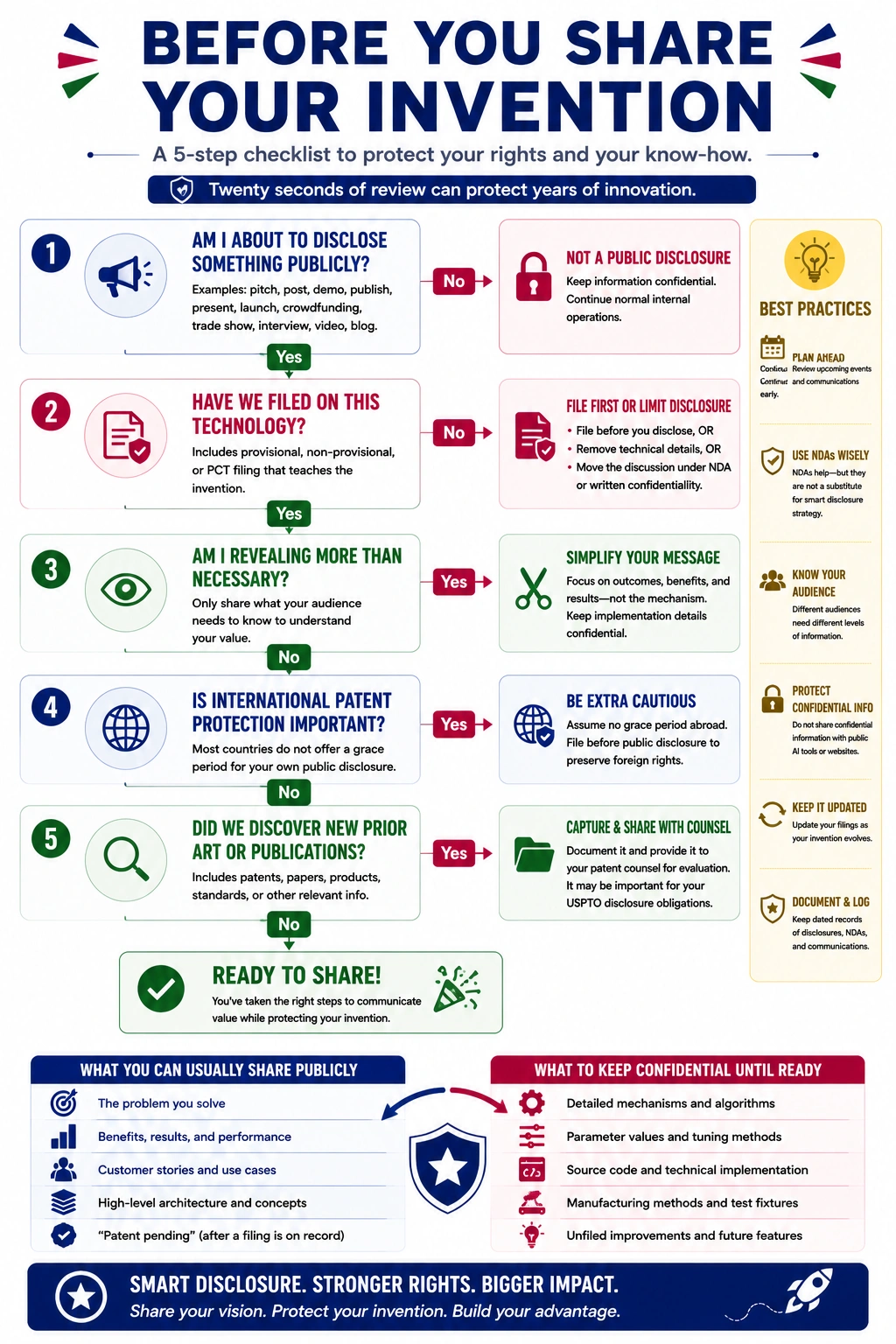
✔ The problem
✔ Customer benefits
✔ Measurable outcomes
✔ High-level architecture
✔ Comparative performance
✔ Properly supported “patent pending” messaging after filing
❌ Detailed parameter values
❌ Calibration methods
❌ Source code
❌ Detailed state-machine logic
❌ Manufacturing techniques
❌ Proprietary test fixtures
❌ Unfiled improvements
The exact line will vary by invention.
But the principle remains:
You can explain value without publishing the recipe.
Once Alex had an appropriate patent application on file, “patent pending” became a useful business signal.
It told:
that intellectual property protection was being pursued.
But Alex never treated “patent pending” as a promise that every product feature would ultimately be patented.
The phrase was used accurately and connected to actual pending applications.
Public disclosure is about protecting confidential information.
USPTO disclosure is different.
During prosecution, those substantially involved in the application process have obligations concerning information material to patentability.
Alex treated that responsibility seriously.
The objective wasn’t to hide difficult prior art.
It was to build a patent that could withstand scrutiny later.
Alex maintained an ongoing list of relevant materials encountered during:
Potential references included:
Counsel could then evaluate what needed to be submitted through an Information Disclosure Statement, or IDS.
Organization prevented important references from getting lost.
Alex carried the same philosophy into examiner interviews and Office Action responses.
Don’t exaggerate.
Don’t distort what a reference says.
Don’t make arguments you can’t support.
Instead:
Alex discovered that credibility compounds.
A clean prosecution record can become valuable years later during licensing or enforcement.
AI can be extremely useful when preparing public communications.
Alex used it to help:
But there was a hard boundary.
Alex never put confidential:
into public AI systems.
A useful internal rule was:
AI helped organize public information.
It never became the place where Alex stored the invention.
The value of the disclosure process became obvious shortly before a major trade show.
Marketing prepared a beautiful new poster.
Unfortunately, one diagram showed considerably more than anyone realized.
It included technical relationships and operating details that had evolved since the previous patent filing.
Because Alex required pre-event IP review, the problem was caught before the poster was printed.
The team reviewed the new technology.
Patent counsel addressed the new subject matter as appropriate.
Marketing replaced the detailed diagram with an outcomes-focused graphic.
The trade show proceeded.
The invention stayed protected.
The process worked.
Alex didn’t want patent counsel reviewing every social media sentence forever.
The goal was to create habits.
Before anything public, the team asked:
A designated internal review channel collected:
before publication.
A few minutes of review could prevent months—or years—of problems.
Before sharing anything about an invention, ask:
If no, continue protecting confidentiality.
If yes, keep going.
If no:
File, remove the technical detail, or move the discussion under confidentiality.
If yes:
Simplify.
If yes:
Be especially cautious about disclosure before filing.
If yes:
Capture it for review with patent counsel.
Twenty seconds can prevent an extremely expensive mistake.
Avoid these disclosure mistakes:
❌ Presenting before filing
❌ Assuming an NDA solves everything
❌ Putting technical mechanisms into pitch decks unnecessarily
❌ Launching crowdfunding campaigns before IP review
❌ Forgetting about foreign patent rights
❌ Using “patent pending” before an application has been filed
❌ Sharing unfiled improvements after an initial provisional
❌ Uploading confidential inventions into public AI tools
❌ Ignoring relevant prior art during prosecution
Inventors sometimes think patent strategy requires choosing between secrecy and promotion.
It doesn’t.
A growing business needs to communicate.
You need customers.
You need partners.
You may need investors.
The objective isn’t to stop talking about your invention.
It’s to control the sequence.
Protect first. Promote second.
And remember that you usually don’t need to reveal the mechanism to communicate the value.
Explain the problem.
Explain the result.
Explain why customers care.
Then protect the details that create your competitive advantage.
That’s not being secretive.
That’s being strategic.
Public disclosure before filing can create significant patent risks, particularly if international protection matters. The safer strategy is generally to evaluate filing before publicly revealing the invention.
An NDA can be valuable, but it isn’t a substitute for a broader IP strategy. Control what you disclose and share confidential information only when necessary.
The risks depend on the circumstances, but filing before detailed disclosure can provide a cleaner strategy. You can also structure presentations so that public-facing materials emphasize business value rather than unnecessary implementation details.
Focus on benefits, outcomes, performance, and appropriately protected product features. Be cautious about displaying unfiled technical mechanisms or improvements.
After an applicable patent application has actually been filed.
Yes, but be extremely careful with confidential information. Public AI systems should not receive proprietary technical information unless you’ve specifically determined that the system and disclosure are appropriate for that information.
✔ File first. Speak second.
✔ Talk about outcomes before mechanisms.
✔ Review major public disclosures before they happen.
✔ Treat NDAs as useful tools—not magic shields.
✔ International rights make disclosure timing especially important.
✔ Keep relevant prior art organized for patent counsel.
✔ Never casually feed confidential invention details into public AI systems.
✔ The goal isn’t silence. It’s sequencing.
🎥 Video: How to Talk About Your Invention Without Giving It Away
Learn how to discuss your invention with investors, customers, manufacturers, trade shows, and the public while protecting patent rights and valuable confidential information.
You shouldn’t have to choose between protecting your invention and building your business.
The right patent strategy helps you do both.
During a Discovery Call, we’ll help you evaluate what you’ve developed, identify potential disclosure risks, determine what may need to be filed, and create a strategy that lets you move forward confidently.
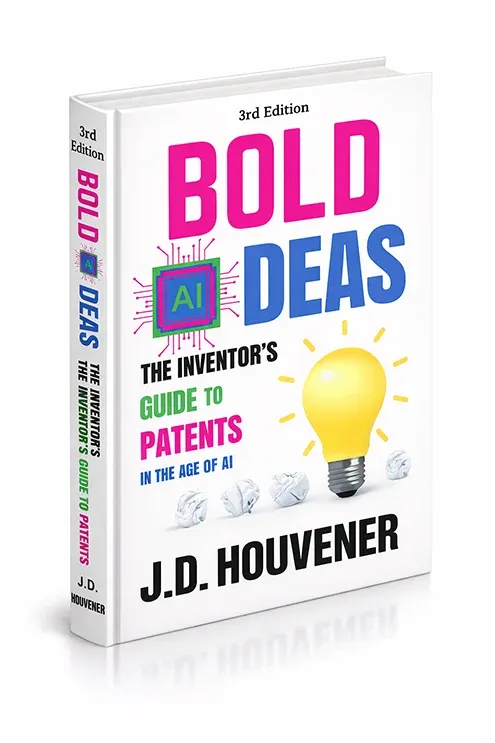
Written by Patent Attorney J.D. Houvener, this updated edition provides inventors, entrepreneurs, and startups with practical guidance for protecting ideas, avoiding costly mistakes, and navigating the patent process with confidence.
Whether you’re exploring a new invention, building a startup, or preparing to file a patent application, our team is here to help you move forward with confidence. Get personalized guidance from experienced patent professionals who understand the challenges inventors face.



We are a full-service patent and trademark prosecution firm. We help inventors and entrepreneurs research, protect, and monetize their intellectual property in the marketplace.
Schedule a Discovery Call 601-298-8425
Copyright © 2026 - Bold Patents• All Rights Reserved. Digital Marketing By: 