
It is a common misconception that inventors and business people have, that as soon as an invention is granted a Patent from the USPTO, that interested tech companies will come knocking at the door looking to license your invention or buy the technology. Or, that magically there will be a massive demand for it and customers will be out looking for the invented product.
For as long as Bold Patents has been around, and the Patent Attorneys behind it, we have enlightened inventors to understand the bigger picture and challenged them, right from the onset, that they should fully understand that it takes both a new technology and a solid business plan to make any product or service have a lasting impact on the economy. The Patent Success Matrix was created to help these inventors, entrepreneurs, and business owners see that marketability (the economic viability) is just as important as the patentability (the ability to get a patent) when it comes to having a successful invention.

U.S. patent law sets out the criteria for obtaining a patent. An invention must meet all of these criteria to be eligible to receive a patent under the current patent law.
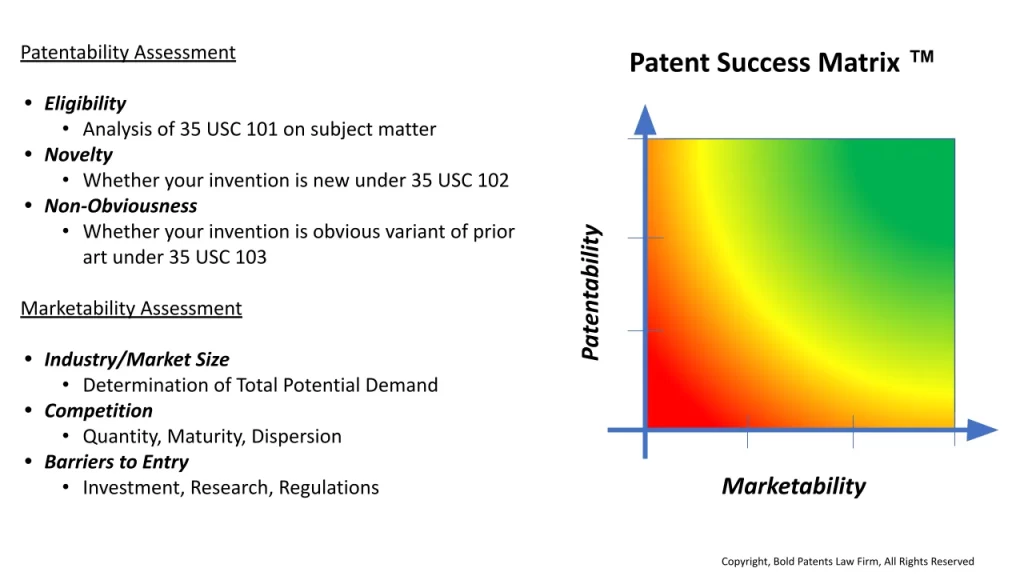
Section 101 of the Patent Act sets out the classes of inventions that can be patented:
Patent law excludes certain subjects from patenting. These exceptions prevent anyone from having exclusive use of certain subject matter. Some of the exclusions for patenting under U.S. patent law include:
Patentable inventions must have a specific use under the patent law. Very few inventions fail this requirement. For example, inventions that fail the usefulness test under U.S. patent law include instruments of torture and inventions that are inoperable.

Patentable inventions must be novel under the patent law. Novelty means that the invention as a whole was not known, used, or described in a printed publication before the date of its invention.
Your patent attorney will emphasize two points about novelty. First, U.S. patent law uses a “first inventor to file” priority system. This means that an invention is novel if the invention was not publicly known or used before the first application for the invention was filed by an inventor or the inventor’s patent attorney.
Secondly, an inventor’s actions can be used to reject a patent application for lack of novelty. For example, if an inventor writes about the invention in a journal article or sells the invention before filing the patent application, that disclosure or sale might be used to reject the application for lack of novelty.
Be sure to discuss any pre-filing activity that you may have undertaken already with your patent. Pre-filing disclosures, sale, use, and publication might render your invention unpatentable unless your patent attorney can fit the activity into an exception under the Patent Act.
When U.S. patent law uses the word “obvious,” it does not rely on the dictionary meaning of the word. Rather, obviousness encompasses the principle that an invention should not receive a patent if it is a trivial improvement over the state-of-the-art.
Generally, an invention will be rejected as obvious if it is, as a whole, either:
Keep in mind that there are three points a patent lawyer will use to analyze obviousness. Obviousness is judged at the time of the invention. Even if an invention is obvious in retrospect, it may not have been obvious when it was invented.
Secondly, obviousness is measured by a patent attorney by looking at the invention as a whole rather than looking element by element.
Finally, obviousness is determined by a patent lawyer from the viewpoint of someone with ordinary skill in the art. This means that an invention might not be obvious if the improvement or combination would have been obvious only to an expert.
Marketability is based on the nature of the market, the readiness of the market for the invention, and the readiness of the invention for sale to the public. If the invention is marketable, you stand a much better chance of achieving patent success by exploiting the invention through manufacturing or licensing and recouping your investment.
Industry size can affect an invention’s marketability. Larger markets are often dominated by a few players. You might need to prove your invention’s success before these competitors stop trying to put you out of business and offer you a licensing deal.
On the other hand, large industries are supported by a lot of customers. For a small business, picking off a few customers can provide a foot in the door to become a major player in the industry.

Competitive markets can be difficult to break into because your intended customers will have a greater number of alternatives to your invention that can satisfy their demand. As a result, an invention might struggle to find a customer base.
Furthermore, competitive markets can drive down prices. This might prevent you from finding a profitable price point for your invention.
Non-market forces can impede the entry of new market participants. This artificially limits competition by benefiting those already in the market at the expense of those who want to enter the market.
Some examples of barriers to entry that protect existing competitors’ market share include:
At Bold Patents, our patent attorneys have the knowledge and experience to analyze the patentability and marketability of your invention. With the help of our patent lawyers, you can identify exactly where you fall on the patent success matrix. This will help you to decide whether to file a patent application for your invention or not.
Acquiring patent rights on your invention is one thing but forming a fundable business venture around the IP and technology is another. Starting up a company is exciting and for many inventors, it is their chosen path to commercialization. There are many things to consider when starting a company and growing it to the point to where an investor would want to bet on your success.
One of the best resources I have found is the free diagnostic called the Minimum Fundable Company® (MFC) Test, created by Bryan Brewer, founder of Funding Quest. Answer the 20 questions on the MFC Test and it will give you a measure of your level of readiness to secure funding for your company.
One of Bryan’s clients—Lisi Global, Inc.—has been successful at developing a technology, securing patent protection, forming a company, writing a business plan, and securing funding to help move them to the next level of growth. Co-founders Jason Crisp and Jeffery McComb conceived of the idea of using high-voltage electricity to kill underground soil pests called nematodes. These parasites typically attach to the root of a plant and deplete the plant’s vigor, resulting in more than $150 billion in crop losses annually.
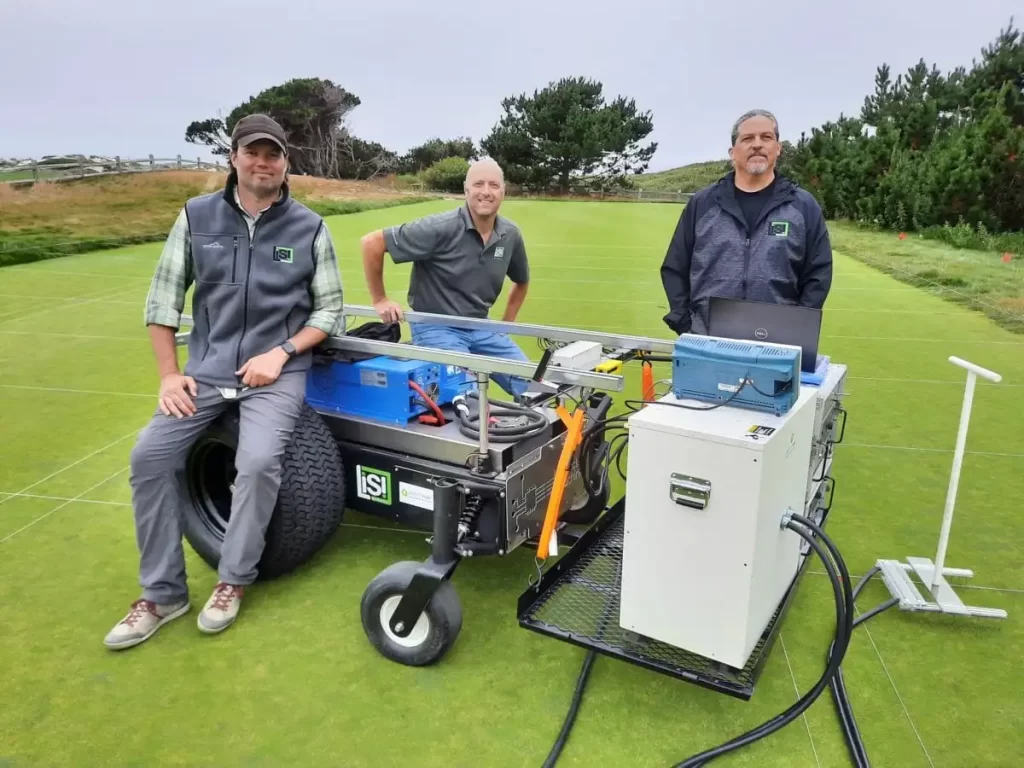
Lisi Global executives (L to R): Conan Doherty, Director of
Partnerships; Jeff McComb, COO; Jason Crisp, CEO.
They were joined by third co-founder Ekaterini Riga, PhD, as inventors on a patent that was granted in 2018. The company has continued to innovate its hardware solutions and has raised approximately one million dollars in investor funding. Lisi Global is planning its first commercial applications of their Direct Energy System (DES) to kill nematodes on golf course greens in Florida this summer.
Of course, there is more to patent success than simply filing an application for patent protection. It can help to have your patent professionally drafted by an experienced patent attorney who understands technology and who can ensure the application meets international standards — even if you have no immediate plans to seek international patents.
A successful patent application, which is the first step toward a successful patent, includes a complete description of the invention, specifying alternative modes for it. Figures should be clear and complete, and claims should be carefully and clearly drafted.
Patent success may look slightly different for different companies. In general, a successful patent:
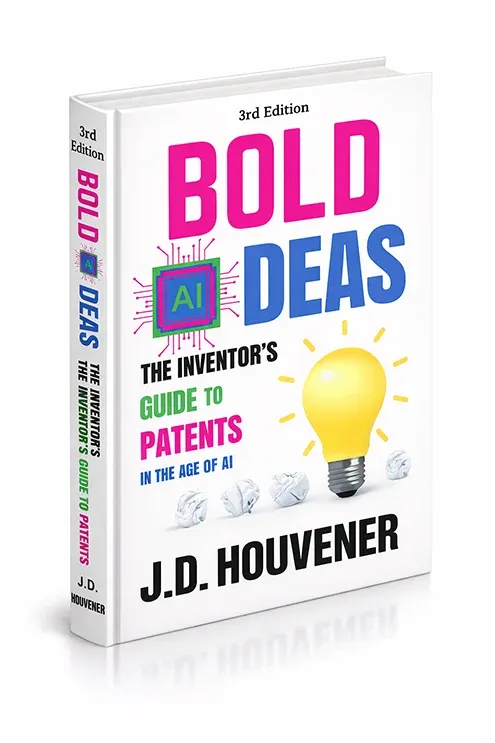
Written by Patent Attorney J.D. Houvener, this updated edition provides inventors, entrepreneurs, and startups with practical guidance for protecting ideas, avoiding costly mistakes, and navigating the patent process with confidence.
Whether you’re exploring a new invention, building a startup, or preparing to file a patent application, our team is here to help you move forward with confidence. Get personalized guidance from experienced patent professionals who understand the challenges inventors face.


We are a full-service patent and trademark prosecution firm. We help inventors and entrepreneurs research, protect, and monetize their intellectual property in the marketplace.
Schedule a Discovery Call 601-298-8425
Copyright © 2026 - Bold Patents• All Rights Reserved. Digital Marketing By: 