
For many businesses, one of the most stressful moments comes when a patent demand letter unexpectedly arrives.
The letter may accuse your company of patent infringement.
It may demand licensing discussions.
It may threaten litigation.
Or it may simply ask for a meeting.
Regardless of the language, your first response can dramatically affect the outcome.
Some patent owners manufacture products.
Others exist primarily to license or enforce patent rights. These organizations are commonly called Non-Practicing Entities (NPEs) or Patent Assertion Entities (PAEs).
Some own strong patents that deserve serious attention.
Others rely on broad allegations and the high cost of litigation to pressure companies into quick settlements.
The challenge isn’t determining whether someone is a “patent troll.”
The challenge is determining whether the assertion has merit—and responding strategically.
Alex learned that process consistently beats panic.
Reading Time: 15 minutes
Video: 12 minutes
Monday morning started like any other.
Coffee.
Email.
Engineering meeting.
Then Alex noticed a letter from an unfamiliar law firm.
The letter alleged patent infringement and invited Alex to discuss a licensing opportunity.
Alex’s immediate reaction was emotional.
“This has to be one of those patent trolls.”
The patent attorney stopped Alex before responding.
“Maybe.”
“Maybe not.”
Instead of drafting an angry email, Alex’s team spent the next several days asking better questions.
Who actually owned the patents?
Were the claims specific?
Did the letter include evidence?
Could the product be redesigned?
Was insurance available?
Did suppliers have indemnification obligations?
By the end of the week, nothing had been solved.
But everything had become organized.
Alex realized the first seventy-two hours after receiving a demand letter often determine how expensive the next three years become.
The phrase “patent troll” is commonly used in the media, but it isn’t a legal term.
Most attorneys instead refer to:
These organizations generally earn revenue by licensing or enforcing patents rather than manufacturing products themselves.
Some purchased patents from inventors.
Some acquired portfolios from operating companies.
Some invest heavily in intellectual property as business assets.
Others send thousands of demand letters hoping companies will settle rather than spend money defending a lawsuit.
The important lesson is simple:
Not every NPE has weak patents.
Not every practicing company has strong ones.
Evaluate the patent—not the label.
Alex never treated every demand letter the same.
Instead, the team classified each one before deciding how much attention and money it deserved.
These letters often contain:
They deserve attention—but usually more investigation before significant spending.
These are much more detailed.
They may include:
These letters require careful legal and technical review.
Some organizations repeatedly assert the same patent family against multiple companies.
Studying prior lawsuits and settlements often provides valuable insight into likely strategies.
Some entities acquire patents from operating companies specifically for licensing or enforcement.
Ownership history may become an important part of the evaluation.
Understanding who you’re dealing with helps determine the most effective response.
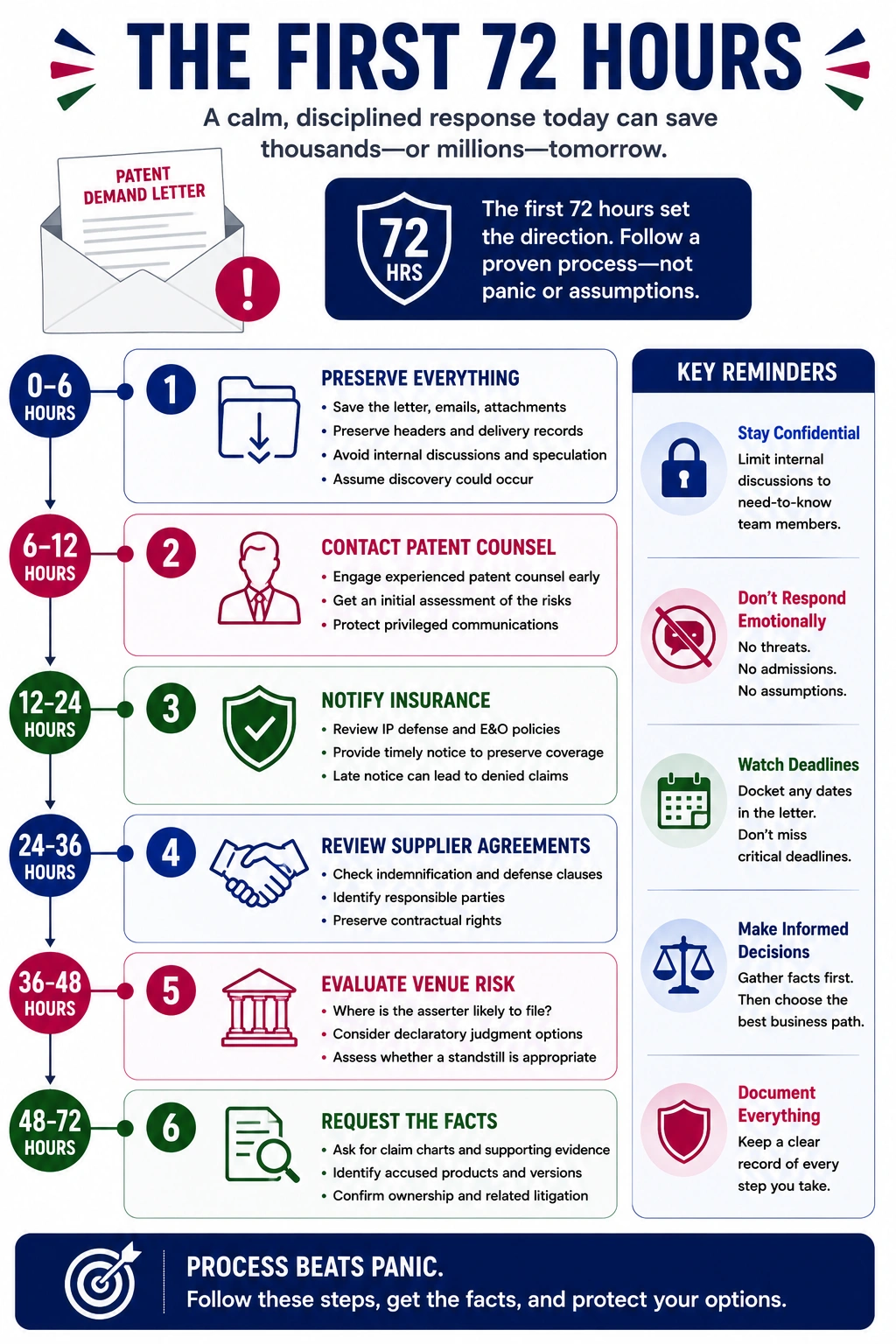
Alex developed a checklist that every demand letter followed.
The process became routine.
Save:
Avoid unnecessary internal discussions that speculate about infringement.
Those communications may later become discoverable.
Bring experienced patent counsel into the discussion immediately.
Early legal guidance often prevents expensive mistakes later.
Some businesses carry:
Many policies require prompt notice.
Waiting too long can jeopardize coverage.
If the accused technology came from another supplier:
Sometimes the supplier becomes an important participant in the defense.
Patent disputes often involve strategic questions about where litigation could occur.
Understanding venue early allows the business to make informed decisions before reacting emotionally.
Alex’s first response was rarely argumentative.
Instead, the team requested information.
Examples included:
Good decisions require good information.
Receiving a demand letter doesn’t automatically mean litigation.
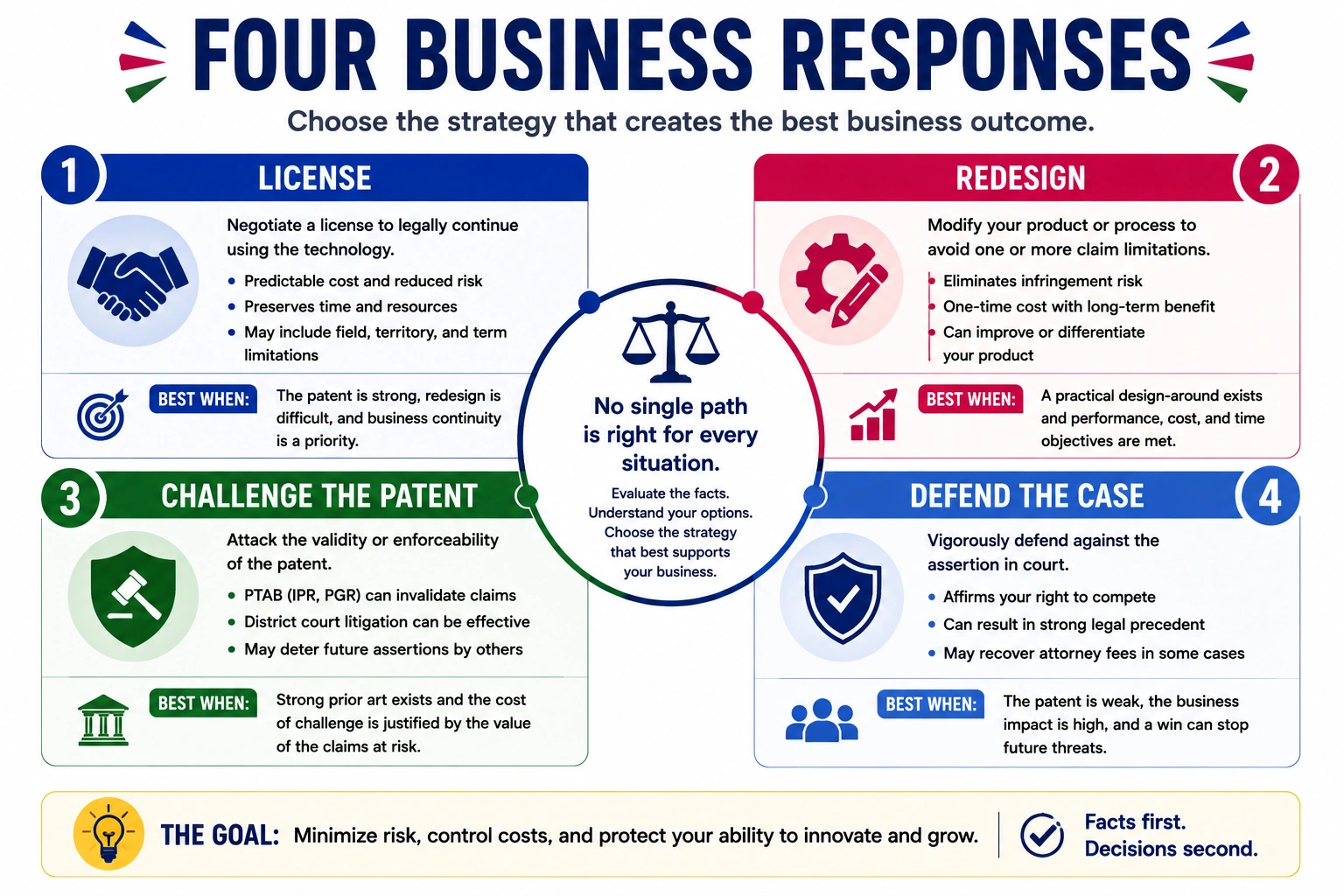
Alex evaluated several possibilities.
Sometimes a reasonable license created the best business outcome.
If a small engineering change eliminated infringement concerns, redesign often became the most economical solution.
Strong prior art occasionally justified challenging patent validity through administrative proceedings or litigation.
Sometimes the claims simply lacked merit.
In those situations, a vigorous defense became appropriate.
The correct path depended on the strength of the patent—not emotion.
Many inventors assume redesign means defeat.
Alex learned otherwise.
Sometimes changing a single technical feature:
Good engineering often creates better business outcomes than years of litigation.
One lesson surprised Alex.
Sometimes the company’s strongest ally wasn’t another attorney.
It was:
Well-written contracts may include:
Understanding those agreements early creates more options later.
Alex adopted one important rule.
Never refer to the other side as “patent trolls.”
Internal emails.
Public statements.
Negotiations.
Court filings.
Professionalism consistently produced better outcomes.
Business people negotiate with professionals.
Judges appreciate professionalism.
Emotional language rarely improves legal positions.
AI can help organize large amounts of information during the early stages of a patent dispute.
Examples include:
However, AI should never:
AI accelerates investigation.
Experienced counsel makes the legal decisions.
Before spending significant money, Alex answered six questions.
✔ Is the patent strong?
✔ Is the claim chart credible?
✔ Can we redesign?
✔ Does insurance apply?
✔ Does a supplier have responsibility?
✔ What outcome best supports the business?
Once those questions were answered, negotiations became much more productive.
Avoid these common errors:
❌ Responding emotionally
❌ Assuming every NPE has weak patents
❌ Ignoring the letter
❌ Waiting too long to notify insurance
❌ Overlooking supplier indemnification
❌ Failing to investigate redesign opportunities
❌ Spending heavily before understanding the strength of the patent
I’ve represented inventors, startups, and established companies on both sides of patent disputes.
One thing is consistently true.
Businesses spend the least when they stay organized.
Receiving a demand letter doesn’t mean you have a bad case.
It doesn’t mean you have a good case either.
It simply means it’s time to gather facts.
Strong companies don’t react emotionally.
They classify the assertion, understand the technology, evaluate the patent, and choose the business strategy that creates the best long-term outcome.
That’s exactly what Alex learned.
The term generally refers to a Non-Practicing Entity (NPE) or Patent Assertion Entity (PAE) that primarily generates revenue through patent licensing or enforcement rather than manufacturing products.
Generally, no. Even weak assertions deserve careful evaluation and an informed response.
No. Many disputes are resolved through licensing, redesign, business discussions, or administrative proceedings.
Often, yes. If a product can be modified to avoid one or more claim limitations while preserving commercial value, redesign may become the most economical solution.
If your business carries intellectual property or technology-related coverage, early notification may preserve important rights.
✔ Not every patent assertion has the same strength.
✔ The first 72 hours are often the most important.
✔ Gather facts before responding.
✔ Consider licensing, redesign, PTAB review, or defense based on the specific circumstances.
✔ Professional communication creates better business outcomes than emotional reactions.
✔ Strong processes reduce both costs and uncertainty.
🎥 Video: Patent Trolls: How to Respond to Patent Demand Letters
Learn how to evaluate patent demand letters, classify patent assertions, reduce legal risk, and respond strategically when faced with a Non-Practicing Entity or Patent Assertion Entity.
If you’ve received a patent demand letter—or simply want to prepare before one arrives—we can help you assess the strength of the claims, evaluate your options, and develop a response strategy that protects both your intellectual property and your business.
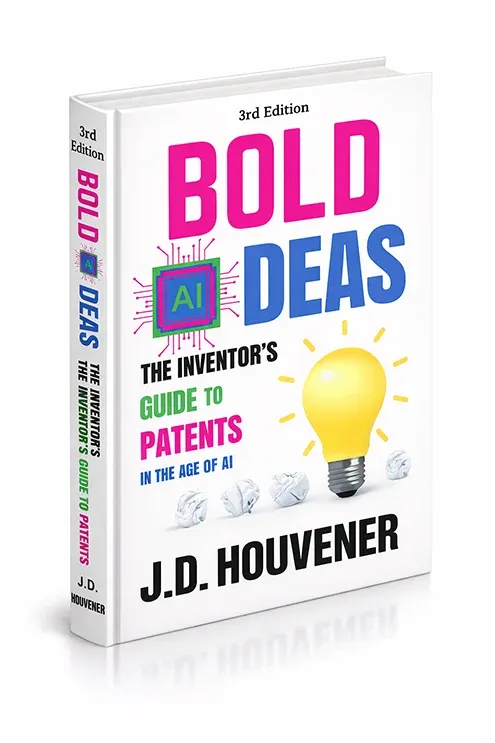
Written by Patent Attorney J.D. Houvener, this updated edition provides inventors, entrepreneurs, and startups with practical guidance for protecting ideas, avoiding costly mistakes, and navigating the patent process with confidence.
Whether you’re exploring a new invention, building a startup, or preparing to file a patent application, our team is here to help you move forward with confidence. Get personalized guidance from experienced patent professionals who understand the challenges inventors face.


We are a full-service patent and trademark prosecution firm. We help inventors and entrepreneurs research, protect, and monetize their intellectual property in the marketplace.
Schedule a Discovery Call 601-298-8425
Copyright © 2026 - Bold Patents• All Rights Reserved. Digital Marketing By: 