Last Modified on October 02, 2026

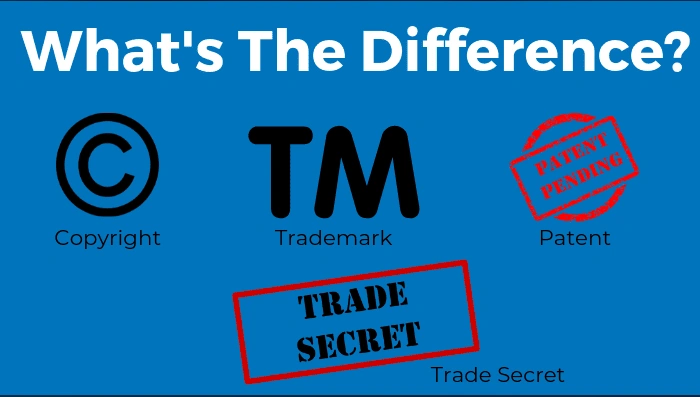
When you’re entering into the world of intellectual property, there are a lot of terms that may seem to all blend together. What’s the difference between patents, trademarks, copyrights, and trade secrets? Each is its own type of intellectual property and has unique options for IP protection, with massive differences between each one.
Intellectual Property (IP) comprises the four main areas of law we will cover today:
- Patents (Title 35 United States Code)
- Trademarks (Title 15 United States Code)
- Copyrights (Title 17 United States Code)
- Trade Secrets (Title 18 United States Code)
With social media, news outlets, non-attorney “experts”, and do-it-yourself gurus, there is a lot of misinformation about IP. When you start a business or have started planning one, you want to know how to stand out among competitors and find ways to be different. IP and IP protection is a great place to start.
By analyzing the IP you and your team have created, you can understand where they fit into these four areas of IP law, the similarities and differences between each type of IP protection, and how an Intellectual Property (IP) attorney can help.
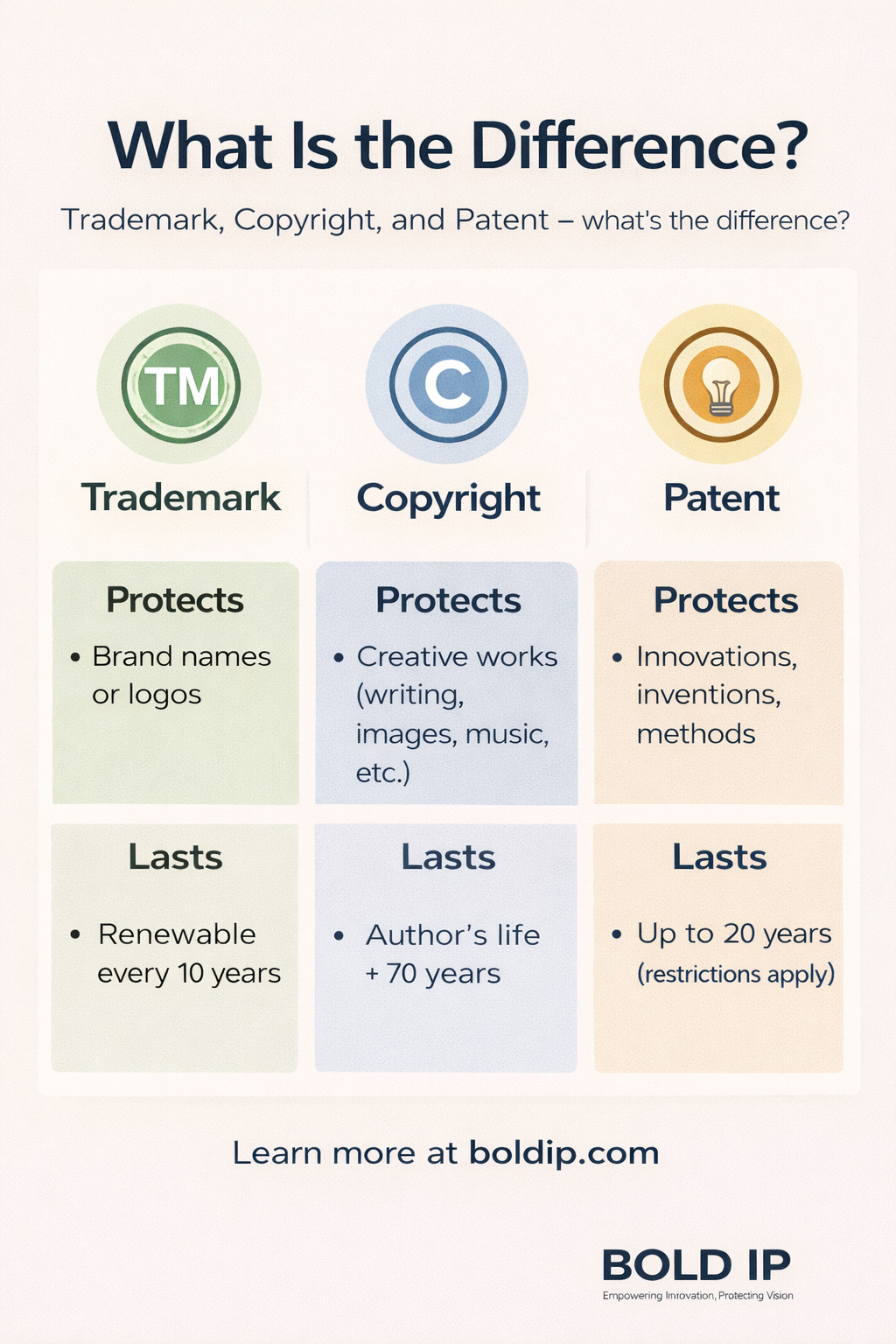
So, you’ve started a business (or at least done some serious planning) and are now looking to try and stand out among competitors and find ways to be different.
A great place to start is by analyzing the intellectual property you and your team have created.
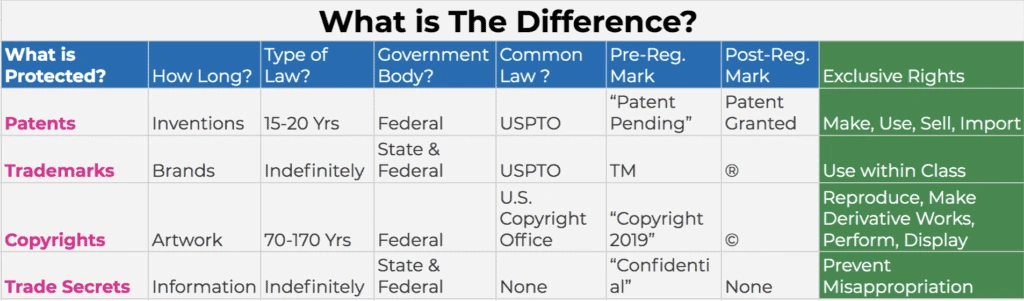
I’ve created a VERY simple chart which shows the core 8 differences between these four areas of IP.
This chart gives you some quick answers with links to help you begin to explore each area in more detail should you wish to do so.
In addition, here is a video that explains the different types of intellectual property for more visual learners. Enjoy! 🙂
What Are You Trying to Protect?
It’s first important to determine what it actually is that you want protection for, and which of the big four areas of IP it fits into: patents, trademarks, copyrights, and trade secrets.
1. Patents

Patents protect inventions.
Patents grant the inventor an exclusive right, or monopoly, for a limited time on the claimed subject matter disclosed in the issued patent.
In fact, patents are such a big deal (along with copyright) that they were called out in the U.S. Constitution by our founding fathers:
Article 1, Section 8, Clause 8 of the United States Constitution grants Congress the power “[t]o promote the Progress of Science and useful Arts, by securing for limited Times to Authors and Inventors the exclusive Right to their respective Writings and Discoveries.”
At the time of the Founding Fathers, the term “science” was more closely related to the term “natural philosophy” or “knowledge” of today while the term “art” was more closely related to the terms “craft” or “technique” of today.
For patents, this means Congress is to help progress useful arts by providing inventors with exclusive rights to discoveries for a limited period of time.
While it does not give you an exclusive right to use and sell the invention you create, a patent instead acts like a shield. It is a right to exclude others from making, using, offering for sale, or selling the invention throughout the United States or importing the invention into the United States.
The patent system can be viewed as a reward arrangement to those who discover things that will be useful to the nation.
Patent-eligible subject matter is intended to include “anything under the sun that is made by man.” However, there are some limitations. Chapter 35 of the United States Code specifies that “whoever invents or discovers any new and useful process, machine, manufacture, or composition of matter, or any new and useful improvement thereof, may obtain a patent therefor, subject to the conditions and requirements of this title.”
A significant distinction for patents compared to other types of IP is that the published patent must have documentation that enables someone of ordinary skill in the art to make and use the invention. A patent is not enforceable until it has passed examination from the United States Patent and Trademark Office (USPTO) and has been issued.
Essentially, if you have created something you can use, it is possibly patent eligible. To get a patent, your idea must be new (it cannot have already existed) and cannot be an obvious combination of existing art to someone of ordinary skill in the art.
There are three types of patents: utility patents, design patents, and plant patents.
Utility Patents
The most common type of patent is a utility patent, which secures the inventor’s rights to the functionality of an invention. It is called a utility patent because the novel elements of the invention are functional or have utility. There is a very detailed process for filing for utility patents.
Utility patent sub-types include process or method patents, machine or device patents, and composition of matter patents:
- Utility Patents: Process
Process patents claim ownership over a specific method or process. Claims usually lay out a series of steps. If someone does not perform the steps in that manner and in that way, they will not be infringing. Consequently, these patents tend to be more difficult to enforce.
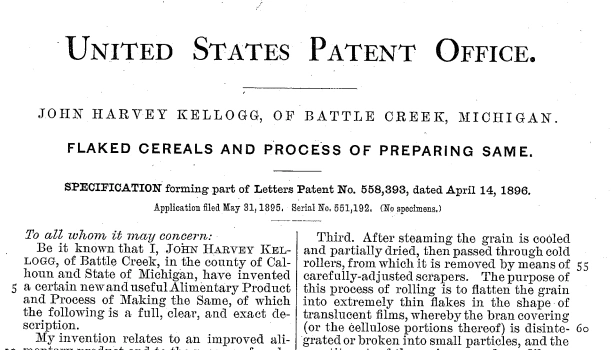
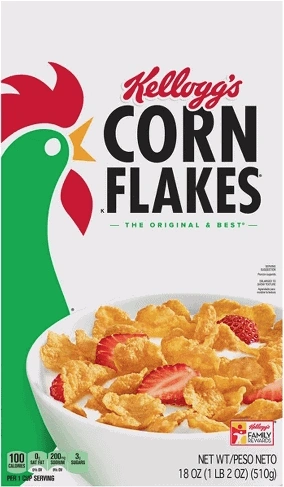
An example of a process is the method for making cereal, patented in 1895.
- Utility Patents: Machine
This is likely the most popular of all invention types. Machine inventions, or apparatus inventions, claim physical features, elements, and the functionality they provide for one or more users. They are often very complex inventions.
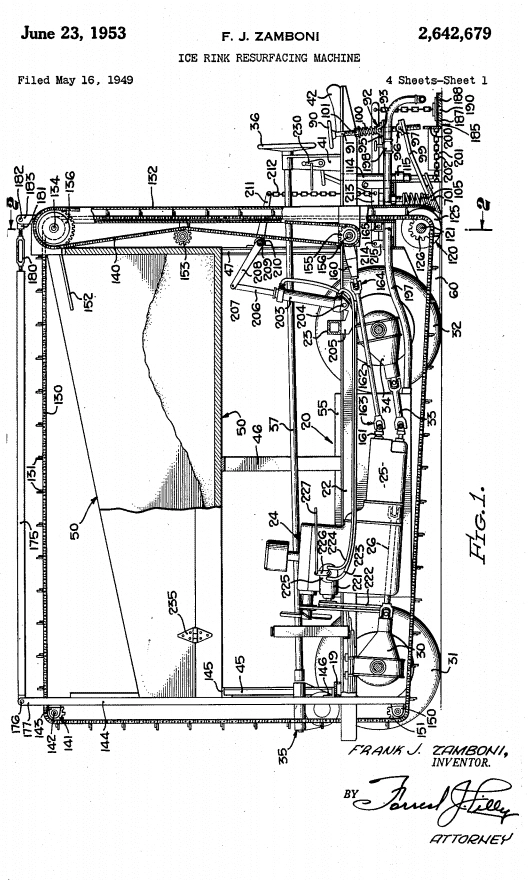
An example of a machine is the ice rink resurfacing machine, aka the Zamboni.
Improvements of existing inventions make up the biggest group of issued patents out there today. You don’t always have to come up with ground-breaking technology, but an improvement on current tech. The improvement, however, cannot be an obvious derivative of something that exists, or an improvement that is obvious to anyone with knowledge in the relevant field.
An example of an improvement to an article of manufacture is the improvement in paper-bag machines.
In the green-highlighted area, Claim #1 says, “in a paper-bag machine,” meaning they didn’t come up with the paper-bag machine. They found a way to “adapt [the paper bag machine] to carry the folded paper beyond the front edge of the main folding blade”.
“Claim 2” goes on to claim the specifics of the cooperation of the main folding blade and the finger to “form the diamond fold”.
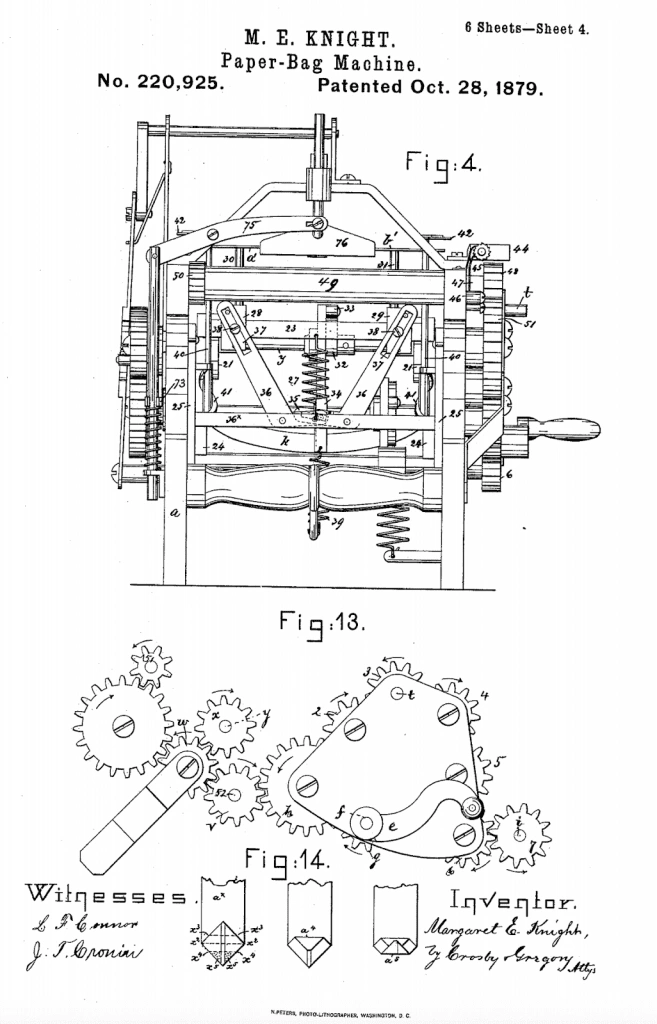
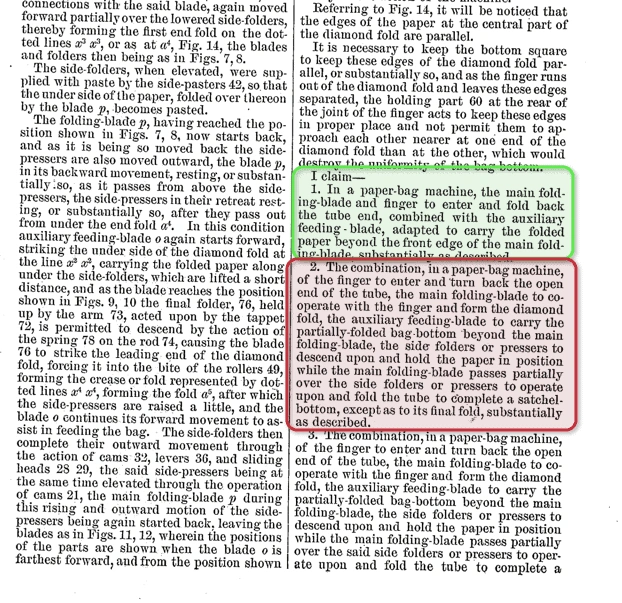
You can see in the green highlighted area Claim #1 which starts out saying, “In a paper-bag machine…” meaning they didn’t come up with the paper-bag machine at all! They found a way to
“adapt [the paper bag] to carry the folded paper beyond the front edge of the main folding blade…”
“Claim 2” goes on to claim the specifics regarding the cooperation of the main folding blade and the finger to “form the diamond fold…”
- Utility Patents: Composition of Matter
This third type of utility patent applies when you have a molecular combination of elements that forms a completely new substance. This can be solid, liquid, gas, or plasma. This type of patent is commonly used for new pharmaceuticals.
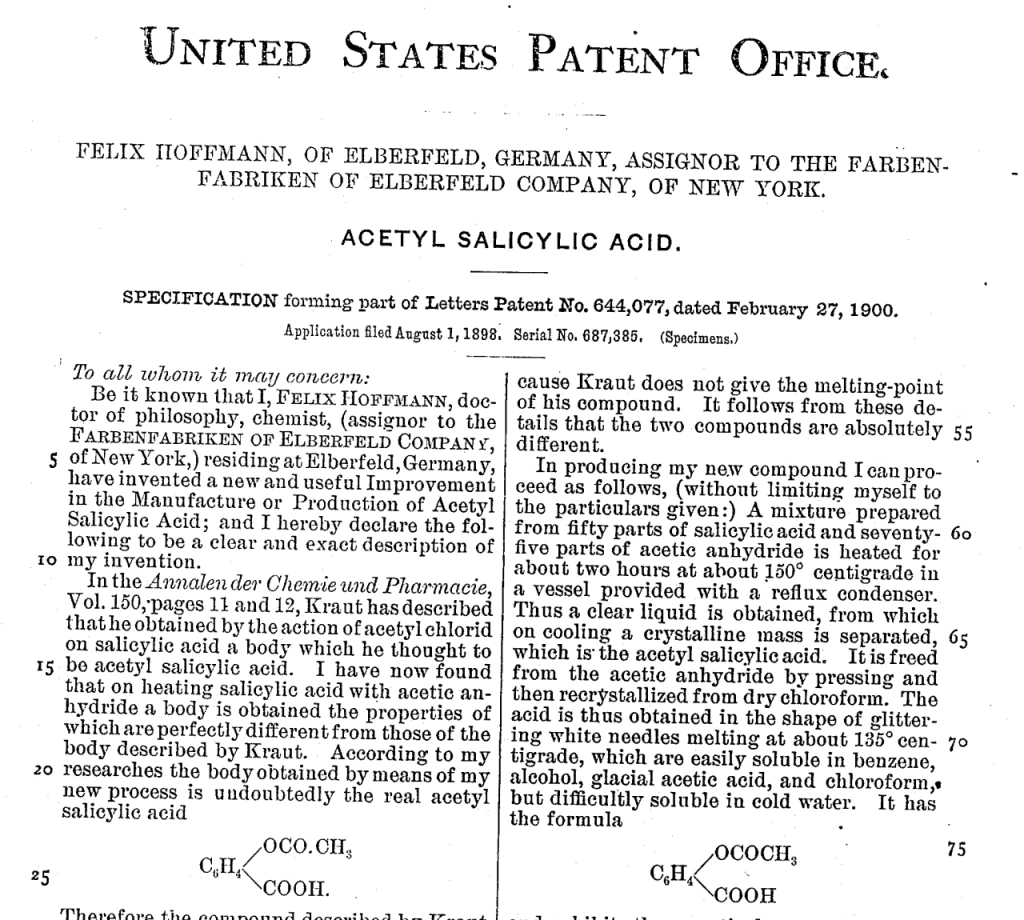
An example of a composition of matter is acetyl salicylic acid, aka Aspirin.
The chemical formula must be shown along with how each element bonds or is joined with the others at a molecular level.
It is also common to describe and claim the method of forming the combination, compound, mixture, or amalgam. In this case, they go on to state: “A mixture prepared from fifty parts of salicylic acid and seventy-five parts of acetic anhydride is heated for about two hours […].”
- Utility Patents: Business Methods and Processes
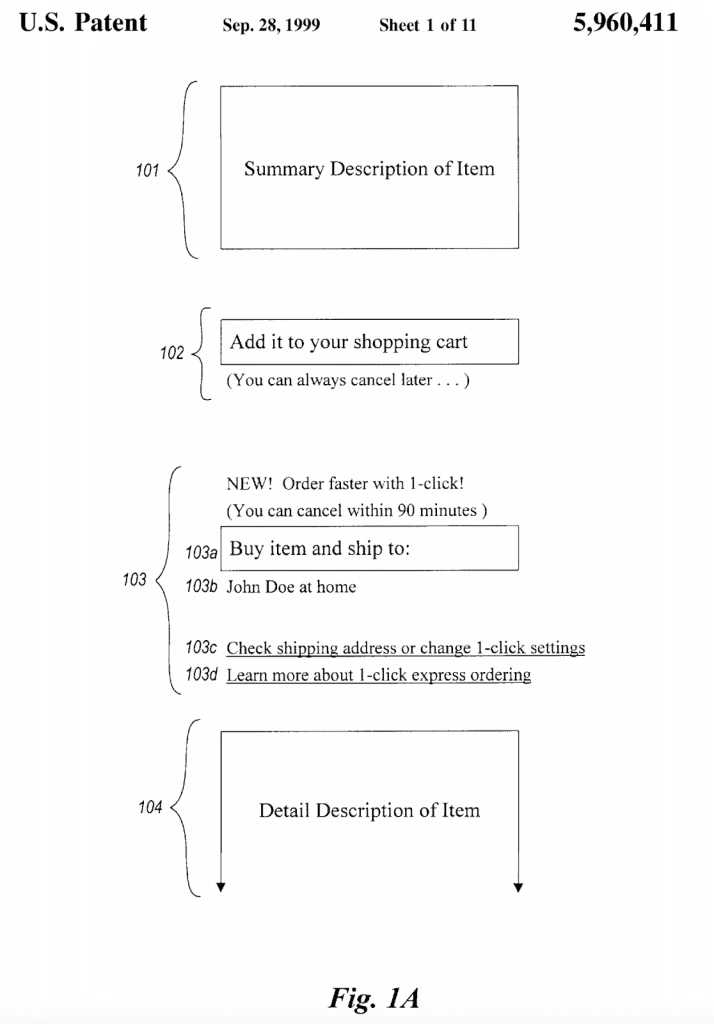
Business methods may be patent-eligible, such as the method and system for placing a purchase order via communications network, aka Amazon’s 1-Click.
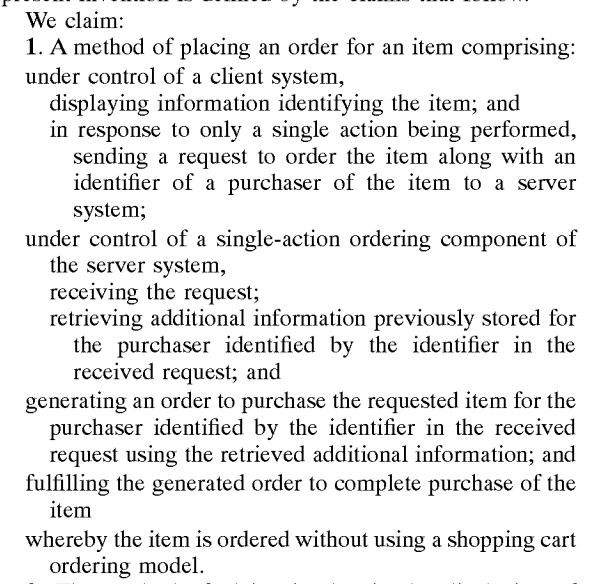
The “drawings” are not physical parts or items, because there are no physical items. Instead, there is a flow chart showing the information that is input or output from each functional box. Business methods, which generally use software to be performed on a computer, follow the same methods. Here is the claim set for the same patent:
You can see there actually has to be several moving parts in order for there to be an infringing action.
Plant Patents
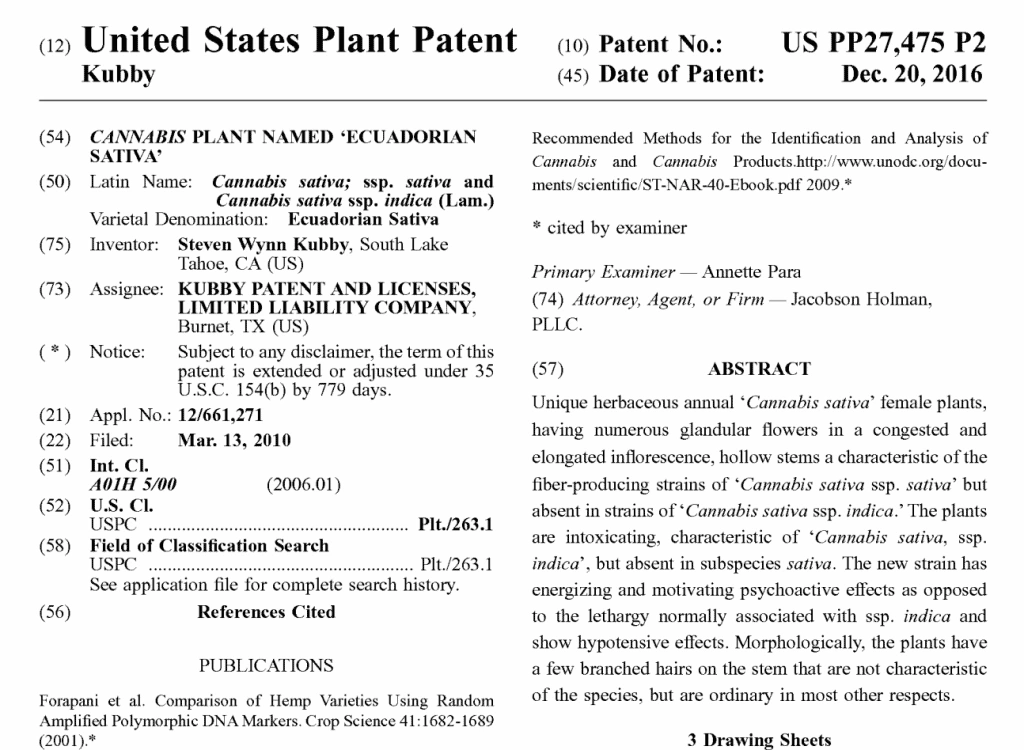
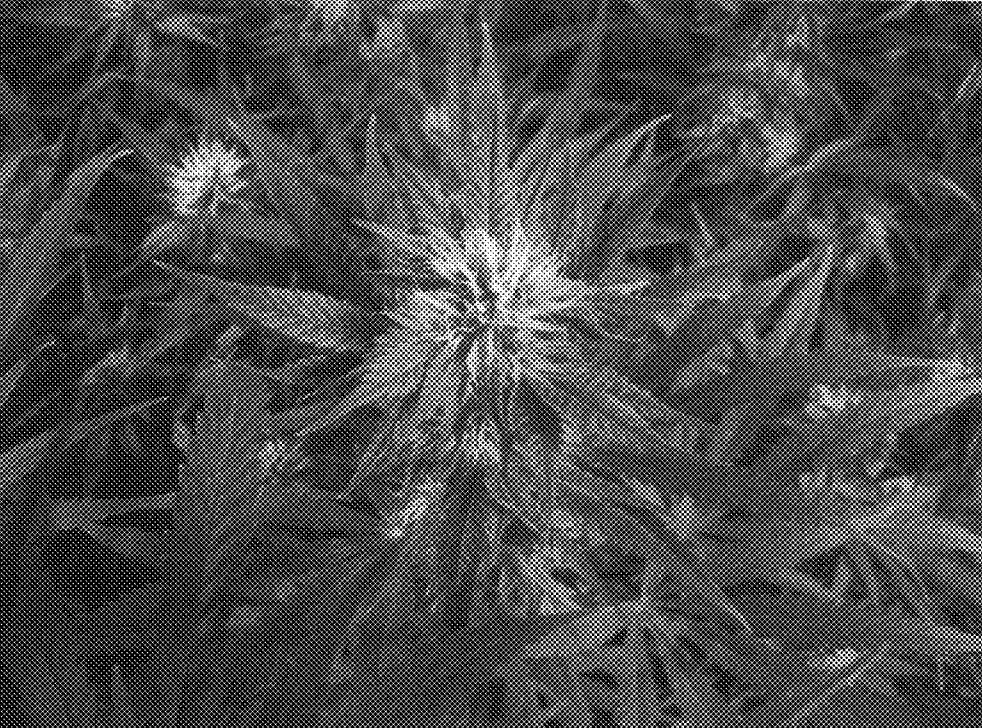
Plant patents protect the botanical structure of a novel plant and specially cultivated species of plants. They also protect the products of the plant, such as flowers or fruit. One example of this is: P27475P2 “Ecuadorian Sativa”.
For MUCH more about plant patents, requirements and process check out my blog about How to File a Plant Patent.
Design Patents
An inventor can also protect the unique ornamentation and 3D aesthetic features of their invention through a design patent, such as with Apple’s iPhone design patent.
It is important to understand the difference between utility and design patents, because a utility patent is for an invention’s function while a design patent is for its appearance. An invention could benefit from both types of patents.
A major feature of design patents is the careful arrangement of shapes, dashed lines, and solid lines. Dashed lines in the invention drawing are not claimed, but solid lines are claimed. In the above, the claim is for the shape of the screen.
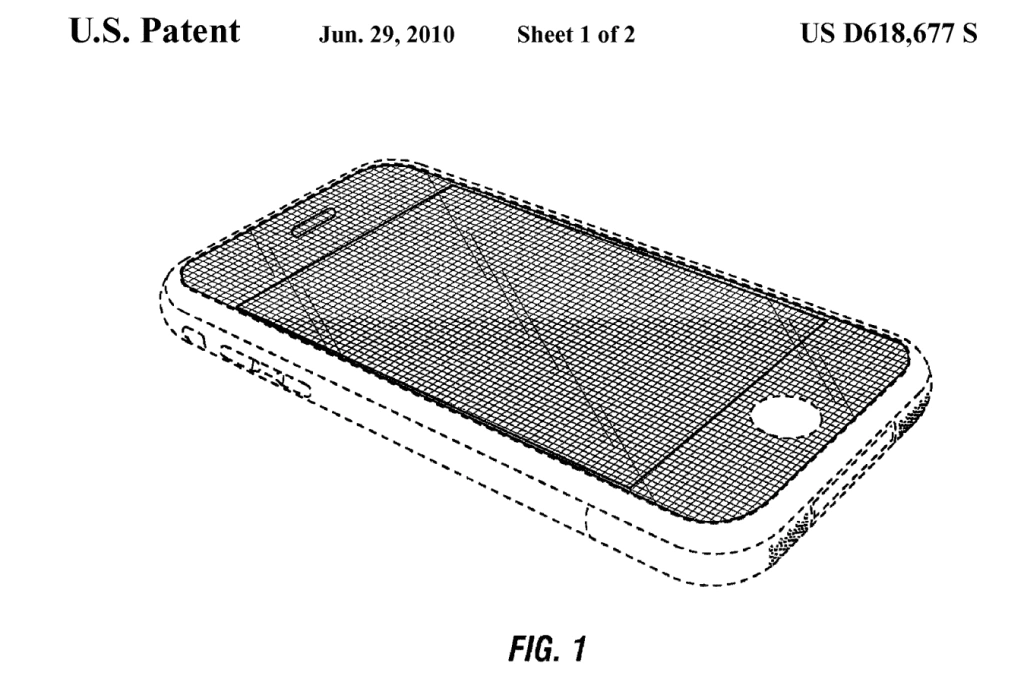
A major feature of design patents is the very careful arrangement of shapes and dashed lines and solid lines. What is in dashed lines is NOT claimed, but what is in solid lines IS being claimed. In the above, it’s the shape of the screen that is being claimed in this D618,677 patent.
A significant distinction for patents compared to other types of intellectual property is that the published patent documentation must enable someone of ordinary skill in the art to make and use the invention.
A patent is not enforceable until it has passed examination from the United States Patent and Trademark Office (USPTO) and has been issued.
Essentially, if you have created something you can use, it is possibly patent eligible. To get the patent, your idea must be new (cannot have already existed) or an obvious combination of existing art (to someone of ordinary skill in the art).
2. Copyrights

Copyrights protect art.
The vast domain of copyright law covers the many ways that artists express themselves. This includes works of authorship in categories like:
- Literary works
- Musical works
- Lyrics
- Dramatic works, including any accompanying music
- Pantomimes and choreographic works
- Pictorial, graphic, and sculptural works
- Motion pictures and other audiovisual works
- Sound recordings
- Architectural works
Restating Article 1, Section 8, Clause 8 with a focus on copyrights, Congress is to promote the creations of artists and authors by providing exclusive rights to authors over their respective writings for limited times.
17 U.S.C. § 102 specifies that:
“copyright protection subsists, in accordance with this title, in original works of authorship fixed in any tangible medium of expression, now known or later developed, from which they can be perceived, reproduced, or otherwise communicated, either directly or with the aid of a machine or device.”
An example of a copyrighted work is The Happy Birthday Song, which only recently passed into the public domain in 2016.

A copyright provides the owner of the copyright the exclusive right to reproduce and distribute copies, prepare derivative works and perform or display the work publicly.
To author an original work, a person must have independently created the work, and the work possesses at least some minimal degree of creativity. The author does not need to register the work in order to have the copyright, such as when posting pictures or video to the internet, but the author must register the copyright to file a civil claim against another party for copyright infringement. Registering your copyright is an important way to protect your IP.
3. Trademarks (Title 15 United States Code)

Trademarks protect brands.
A trademark is a word, name, logo, symbol, device, or combination thereof that is used to identify the source of goods or services to potential purchasers. A device trademark could also include sound, smell, or color. Trademarks make it easier for consumers to quickly identify the source of a given good and differentiate between similar products.
Trademarks allow potential customers and clients to weigh the reputation of the manufacturer of the goods or provider of the services. Unregistered trademarks fall under common law, while registered trademarks enjoy certain advantages under the Lanham Act.
- Name trademark. An example of a trademarked name is “NIKE,” used to identify clothing, footwear, etc., along with the “swoosh” logo. Trademarking a name acquires secondary meaning in the brand and notoriety with consumers, as the trademark becomes a valuable business asset to the owner that can be leveraged and create revenue through licensing agreements.
- Sound trademark. Examples of a sound mark include the MGM lion roar and the Lucasfilm THX theme.
- Typeface trademark. Although fonts cannot be trademarked, infringement could still occur when trying to imitate a trademark’s unique typeface, such as used by Coca-Cola.
- Slogan and catchphrase trademark. A slogan or catchphrase, such as “The Greatest Show on Earth,” can also be trademarked and enforced only after acquiring secondary meaning in the market.
- Packaging trademarks. Characteristics of a product’s packaging, such as color or shape, can also be trademarked if those features identify the source of the goods. Additionally, specific labels, wrappers, containers, or advertising materials could be protected under trademark.
- Design patent turned trademark. In exceptional circumstances, the subject matter of a design patent can subsequently be protected under trademark protection, as in the case of Coca-Cola’s bottle having a “distinctively shaped contour” that was well-known in the market.
While trademarks can certainly take a wide variety of forms, trademarks cannot be the essence of the product. For instance, smell marks are available, but the perfume Chanel No. 5 is trademark ineligible as it is the essence of the product.
Trademark law provides remedies for infringement when a mark conflicts with the phonetic sound, appearance, meaning, or commercial impression of another trademark. While registering a trademark is not required to obtain protectable rights, registering a trademark provides significant advantages over common law rights alone.
The advantages of registration include:
- A legal presumption of your ownership of the mark.
- The ability to record your U.S. registered mark with U.S. Customs and Border Protection to prevent importation of infringing foreign goods.
- The right to use the federal registration symbol ®.
- The ability to bring an action concerning the mark in federal court
- The use of the U.S. registration as a basis to obtain registration of the mark in foreign countries.
4. Trade Secrets (Title 18 United States Code)

Trade secret laws protect valuable information.
Trade secret law exists to allow companies to maintain some information that is earned or gained through experience or happenstance, and even allows for a legal mechanism to enforce trade secret protection against any individual who breaches that trust.
The “breaching” of the trust, i.e. spilling of the beans is called “misappropriation” in legal parlance.
Trade Secret Misappropriation has laws on the books in every state. However, almost every state has adopted the Uniform Trade Secret Act (UTSA), and the federal government has now instituted the Federal Defend Trade Secrets Act (2016) [18 U.S. Code § 1836], which defines a “trade secret” very carefully as:

Subparts (a) and (b) are the basis of a trade secret:
- The owner of the trade secret must take “reasonable measures to keep such information secret”. This might include basic physical security of the company, password protection, protocols for employee onboarding, and non-disclosure agreements or certain types of non-compete agreements.
- The trade secret must be valuable economically on its own. It also must be more valuable because it is not generally known.
A trade secret includes the recipe for Coca-Cola, TikTok’s algorithm, or Google’s specific search algorithm process. The type of information that is considered a trade secret is generally unrestricted, meaning it doesn’t have to be the secret recipe or some very technical information that is complex and mysterious.
The information can be quite boring. It could be as simple as a customer list, manufacturing technique, vendor list, sell-sheet, internal pricing models, or script.
How Long Do They Last?
Each type of IP protection lasts for a different period of time:
Patents
As mentioned above, there are 3 main types of patents available: utility, design, and plant patents. Each lasts a different period of time:
- Utility and plant patents. These last 20 years from the date of filing, offering a long period of time for IP protection. The 20-year countdown begins from the earliest priority date. A priority date is the date that shows inventorship. Since the passage of the America Invents Act (2013), whichever inventor files first is awarded patent rights. If a later-filing inventor files the same or similar invention, the earliest filing inventor wins, even if the later-filing inventor invented the idea first.
- Design patents. These last 15 years from the date of issuance. Once the USPTO gives the inventor a patent for the invention, the inventor and any assignees have 15 years of exclusivity.
Trademarks
How long trademarks last could be forever. Of course, it is unlikely that this will be the case, as the business would need to exist forever. Trademarks represent brands, products, and slogans, as well as a trademark symbol of a business or enterprise, and these live and die with the underlying business.
Copyrights
An artistic work is granted copyright as soon as it is fixed in tangible form. Once registered with the Library of Congress, copyright lasts for 70 years plus the life of the author.
This generous timeline is because artwork generally takes longer than patents to be monetized. It may take decades before the artwork begins to turn a profit due to the nature of art. Therefore, the lawmakers wanted to be sure the artist and their estate get rewarded for ingenuity.
Trade Secrets
Much like trademarks, a trade secret may remain in effect as long as the secret does. As long as the business’ information is a part of what makes the company special, gives them a competitive edge, and meets the definition of a trade secret, it will exist.
What Type of Law Governs Each?
Each type of IP is handled in unique ways by state and federal laws:
Patents
Patents are governed solely under federal law. There are no state laws that create or enforce patent rights. Patents are awarded by the USPTO and are enforced in federal court as well as the Patent Trial and Appeal Board. The Federal decisions can be appealed to the Federal Circuit and the Supreme Court.
Trademarks
Trademarks are protected under both state and federal law.
Every state has some trademark law. These state-level trademarks have varying levels of authority, but all of them suffer from the limitation that they can only be enforced within their own borders.
Much of commerce these days is interstate, meaning customers are purchasing products and services outside of the state in which the products or services are originating. Whenever a company does business out of state, including selling, hiring employees, or marketing, they are competing in interstate commerce, and should seek federal trademark protection.
Federal trademark registration is sought after by most modern businesses that exist online and have services or products that have plans to expand to multiple states in the U.S. at any point in their business’s future. Like patents, trademarks are handled by the USPTO.
Copyrights
Copyrights are registered only at the federal level.
The US Copyright Office houses all of the copyright records.
Trade Secrets
Interestingly enough, there is NO government body that awards “trade secrets” to any companies. The secrets are “trade secrets” by virtue of their ability to be enforced under a misappropriation statute (as seen above).
However, there are both state and federal statutes on the books for trade secret misappropriation.
Is there Common Law?
In the context of IP protection, this question asks whether you get IP protections automatically, without taking action to register the IP. Each type of IP protection differs:
Patents
No, there is no common law protection. Patents must be filed in order to secure exclusive rights. There are no rights provided to any inventor without filing with the USPTO.
Trademarks
Yes, there is common law protection. Companies that use a name in conjunction with commerce are awarded rights as of the first use date, as long as they can provide evidence that their products or services are associated with a specific name or logo that is not confusingly similar to another prior name or logo. However, there is a geographical limit on unregistered trademarks.
Copyrights
Yes, there is instant common law protection for copyrighted materials. Immediately when an artist records their original expression in fixed tangible means, they have copyrights to that recording. A later registration is prima facie evidence of this creation process and the ownership therein.
Trade Secrets
There may be common law protection. There is protection if the information gathered is inherently trade secret. By virtue of a prior relationship, such as employee-employer, a trade secret can be created by the act or process of defining the information that has trade secret value or significance.
What Is the Use of Pre/Post Registration Markings?
How do you know if IP has been registered or patented? Different forms of IP have different registration marks to help you understand the rights a person holds:
Patents
“Patent Pending” means that there are no rights that are associated with that product (at least not at the time of manufacturing any physical product). Patent pending is provided after an inventor files a provisional patent. Patent pending could become a full patent. By the time you are holding the product, it very well could have been issued, and there could be enforceable rights.
Once granted, patents simply bear the name “Patented”. Typically, a manufacturer will indicate the patent number next to it: “Patented 10,110,001”. You can tell if it’s a design patent if there’s a “D” in the patent number: “Patent No. D476,001”.
Trademarks
There are costs associated with trademark search and applying for registration, so there may be resistance to seeking registration.
However, even before registering, you can claim some ownership of the mark by telling customers, clients, and third parties that you intend to seek this logo or word mark to be your trademark. You do this by indicating (™). This should be done immediately upon the selection of a compelling design/mark.
Once the trademark is registered, you will use the ®.
Like patents, you can seek additional damages in federal court if you can prove that a party was on notice of your rights or prospective rights in a mark and continued using the logo or otherwise infringing on your rights. This can make the cost of a trademark well worth it.
Copyrights
Before registering for copyright protection, you can simply indicate that you have ownership and control of a piece of work by writing “Copyright, [Company Name] 2019”. This indicates and puts people on notice that you own the artistic expression. It also shows that you’re making a claim that no one has the right to reproduce your work without your permission.
Once registered, you can indicate the work with a © that indicates that you own the registered copyright.
Trade Secrets
To a third party, there is no marking for a trade secret. If a third party was reading the trade secret, it wouldn’t be a trade secret anymore.
Internally, the markings for a trade secret are important. They can be anything that signifies that this information is supposed to stay within the company, such as “proprietary,” “confidential,” or “trade secret.”
What Is the Extent of IP Exclusive Rights?
Having IP rights gives its owner the ability to be the only one in the market for a set period of time. What these rights are depends on the type of IP:
- Patents. These give inventors the exclusive right to make, use, sell, or import into the US.
- Trademarks. These give owners the ability to exclude any other business from using their mark, or any other confusingly similar mark, in commerce for the class of goods or services they sell in commerce
- Copyrights. These give owners the exclusive right to the circulation of, distribution of, access to, and control of their recorded artwork.
- Trade secrets. These give exclusive control to the owners of valuable information as long as it remains secret.
FAQs
What Is Better, Patents or Trade Secrets?
Whether patents or trade secrets are better depends entirely on the specific type of IP you are trying to protect, its function in a company, and the type of protection you want. A patent lasts only for a set number of years, but offers strong protections during that time. A trade secret can last as long as your business, but it must be financially essential to your company, and you have to take steps to keep it a secret.
Is a Trade Secret the Same as a Copyright or Patent?
No, a trade secret is not the same as a copyright or patent. A copyright applies to artistic works and a patent applies to a new and useful invention. A trade secret might be IP that is either copyrightable or patentable, or another type of IP entirely. What makes something a trade secret is that it is important for a business and is kept secret. When you hire a patent attorney, they can determine the right type of IP protection.
What Is the Difference Between a Patent, Trademark, Copyright, and Trade Secret?
There are numerous differences between a patent, trademark, copyright, and trade secret. They last for different lengths of time, are handled by different governmental bodies, cover separate types of IP, and have unique markings for registration. They also grant different types of rights to the IP. If you are unsure what type of IP protection is ideal for you and your business goals, an IP attorney can help.
What Are the Three Things Not Protected By Copyright?
There are several things that are not protected by copyright, including: 1) names, 2) ideas, and 3) Facts. Names, domain names, slogans, titles, and short phrases cannot be copyrighted, but could be trademarked. Ideas and concepts cannot be copyrighted until they exist in a written or drawn format. Facts are not IP.
Hire a Patent Attorney at Bold Patents
Navigating the world of IP and IP protection can be confusing, especially when you are new to running a business or defending your right to your work. Getting IP protection can make a big difference in the success of your start-up and business, or a big difference in other key ventures.
As of August 2026, the USPTO has an unexamined patent inventory of 759,413 applications and 672,691 trademark applications to date. There are hundreds of thousands of copyrighted works and plenty of trade secrets. When registering IP or requesting a patent, mistakes can lead to denials and lengthy processes. It’s important that you do things properly to get your IP the protection you need.
When you are unsure what type of IP protection applies to your creation, it helps to work with an experienced patent and IP attorney.
At Bold Patents, we have decades of experience in patent, trademark, and IP laws. We work all around the nation helping inventors get the protection they need. We can help you whether you work with a small business, are beginning a new start-up, or are an independent inventor. Our firm knows what makes IP eligible for protection and what is needed to create enforceable rights.
If you are ready to Go Big and Go Bold℠, reach out to Bold Patents today. We know how important IP protections are for your financial future, and we help you get the head start you need.
Legal Note: This blog article does not constitute legal advice. Although the article was written by a licensed USPTO patent attorney, there are many factors and complexities that come into patenting an idea. We recommend you consult a lawyer if you want legal advice for your particular situation. No attorney-client or confidential relationship exists by simply reading and applying the steps stated in this blog article.