Last Modified on September 15, 2026

Anyone can be an inventor. In life, difficult things to achieve are often the most highly valued. Inventing and patenting an invention are a couple of those difficult things. Anyone can be an inventor if they put in the effort and time needed to get it done. Knowing how to invent something in 10 steps can put you in the ideal position to dent the universe and inspire people with your innovation.
Inventing is a process and is unique for every inventor. While the step-by-step format is outlined for the benefit of many inventors, it’s okay if some sections work for you and others don’t. Use these steps as you deem worthy, for whatever supports your inventing needs.

Step 1: Believe in Yourself: Develop Confidence
Believing in yourself is more than just a positive mental attitude. It involves starting this invention process with the right mindset and believing that you can do this.
Bold Patent’s founder and patent attorney J.D. Houvener recommends the book Think & Grow Rich by Napoleon Hill and Rosa Lee Beeland. A key line from that book is: “Whatever the mind can conceive and believe, the mind can achieve.”
You want to have a growth mindset as you plan a potential invention. Your invention idea may be one way to solve one problem, but you want to think bigger to get excited and understand the potential of your solution.
If it’s a tangible product, consider the other materials your invention might be made up of, including wood, metal, plastic, and composite.
Assess the types of structure or substrate your invention could operate in.
If it’s an intangible process or method, determine how else your invention could perform its novel function, and whether you could store, gather, analyze, or output information differently.

Assess how else to apply your method to a completely new industry.
Take small steps, but take those steps outside your comfort zone and consider the range of potential for your idea.
Being an inventor doesn’t mean you have to be an instant CEO of a business, but you will need to take some business intuition. You’ll want to develop a business plan, learn to network, and get into some sales-like and marketing-type roles. These roles often make inventor-types who are more technical and introverted feel uncomfortable, but this is often an important part of your invention’s success.
Just talking about your invention can be nerve-racking, but there are ways to overcome this. What’s important is to continually expand your comfort zone as you innovate.
You’ll need to be willing to take some risks and learn from failures. There is the classic example of Thomas Edison’s 1,000+ failed attempts at the right material for the lightbulb filament. It’s a similar story for Michael Jordan and many others.
Failures are often a part of the process and can help you create a better invention. At Bold Patents, we see inventors every day who work through and improve on their inventions because of failure. Take a swing at solving the problem knowing full well that you might stumble and look dumb. Failure only gets you if you give up, so keep trying.aby steps in any direction – but steps OUTSIDE YOUR COMFORT ZONE!
Step 2: Pay Attention – Write Down Problems or Struggles in Everyday Life

With the mindset for innovation, you’re inspired to grow, and you’re not going to let failure stop you. The next step is to pay attention and look around. There’s potential for innovation everywhere. Consider your everyday routines, and the simple problems you encounter throughout them. Take notes, and consider things like:
- What annoys you. Consider things that cause you pain, discomfort, or make you frustrated. Assess the things you avoid because you know they’re going to lead to trouble, and find solutions.
- Make your life easier. Combine technology solutions in a way that would make the one thing you do better or more efficient.
- Accepted issues. If you ever catch yourself saying “that’s just the way it is,” don’t accept that anymore. Find a way to fix the issue.
- Built-in failure and right to repair. If you are disgusted by repair prices for appliances or gadgets when they break, and how it’s almost always cheaper and less hassle to buy a new one, find a solution. Take that uncomfortable step to find new ways to save time and money, and to make it better than when you bought it new.
- What you are passionate about. Don’t limit yourself based on the training or education you have on a subject. If you are interested in and passionate about a subject matter, there are plenty of ways to learn, both online and within your community. That way, you can expand your information and learn new ways to fix problems.
Step 3: Map Out Your Solution
Once you have a good list of problems and you’ve identified some ways in which you could improve your life, you need to think through these solutions more and map them out.
For example, if the problem you’ve identified is electric toothbrushes, specifically when toothpaste gets stuck in the motorized gears, requiring constant cleaning, you want to clearly assess this issue and its solutions. Expand and bound the problem. In the morning, when you have to clean the toothbrush off while exhausted, it’s fair to feel aggravated. But when planning a solution, you should consider your options to fix the issue.

You need to think about all the places you dislike having toothpaste, like the detachable head area, the handle, the bottom, and even deep inside the bristles. This is how you can start to expand the problem and fully define it in its greatest form.
A potential solution should try to address the larger problem to expand and bound the issue. Consider a case that covers the whole brush or a peelable film. You can brainstorm all the possible fixes to the issue.
Step 4: Evaluate Value vs. Effort in Solving Your Problems
When you have a bounded problem with one or more feasible solutions, you should determine how much effort it’s going to take to make those solutions before you go too much further. You want to estimate the market size and potential revenue for your solution.

As you develop several invention ideas, review them and ask yourself how much value this will bring compared to how much effort it will cost. You want to focus on the inventions that take the least amount of effort while providing the highest value. This is both beneficial to the people who can use your invention and beneficial to you as the creator looking to protect your financial future.
Ask yourself the impact the project will have, the confidence you have in your ability to solve the problem, and the ease with which you believe you can solve this problem. Determine these factors on a 1-10 scale. Focus on the inventions that have the highest numbers. The team at Bold Patents can help you conduct this assessment and determine what invention is most useful for your future.
Step 5: Do Basic Marketing Research (Is there a Product / Market fit?)
Do some basic research on the inventions you choose to determine if the invention has a product-market fit, and why it would fit in the market.
Some important tips on “product-market fit” include:
- Use one-on-one interviews to get to know your potential customers.
- Welcome feedback, but always weigh it based on customer value, meaning keep an eye on where it comes from.
- Do not try to please everyone.
- Be honest and open about your product roadmap.

It’s important to determine if the product is something that people would buy and use. Be careful in this stage, because public disclosure of your invention could prevent you from patenting it. Take steps to protect your invention, including confidentiality agreements or working with an attorney to handle things properly.
You should also determine if your product is something that has already been patented. Conduct a basic patent search using Google Patents. Do your own searching before hiring a patent attorney to conduct a comprehensive search to make sure the solution you’ve got is unique.
Step 6: Hire an Attorney to Perform a Patent Search & Give a Legal Opinion
Now it’s time to hire a patent attorney. Working with a patent attorney helps you do a patent search, saves you time and money, and helps you get a professional legal opinion. A legal opinion is essential.
The opinion will give you peace of mind on whether your invention is patentable and worth pursuing. If it is, you can push forward with the invention process. If not, you are liberated to move on to the next idea and try again. An experienced attorney can provide you with a patentability search opinion and support you on your patent journey. Bold Patents has years of experience helping inventors and visionaries like you find a way to protect their bold ideas.
Step 7: File a Provisional Patent Application
If the patent search comes back positive, you should move forward with a provisional patent to gain patent-pending status. This helps ensure your invention is safe. The United States patent system is based on “first to file,” not “first to invent.” An earlier filing helps you protect your rights sooner. Not all patent types allow for a provisional patent, but you should file one if you can. Otherwise, your goal is to quickly build and file a full, nonprovisional patent application.
One of the most exciting parts of learning how to write a patent application and filing it is being able to say you are “Patent Pending.” This should be emblazoned on your products for tangible inventions and mentioned in any and all marketing material for both tangible and intangible products. You have a major point of distinction, and you should show it proudly.
Deciding whether to file a provisional or nonprovisional application is very situation-dependent, and your Bold Patent attorney can help you decide. There are different situations to use a provisional patent application or a nonprovisional patent application, just as there are different aspects of your invention that you would use utility patents and design patents for.
Step 8: Test Your Idea, Raise Money, Prove Proof of Concept
The testing that you do in this phase is critical. You have an entire year from when you file a provisional patent application to when the nonprovisional must be filed. Use that year to learn how your customers want to use your invention and make small modifications and tweaks to it to adjust for the demand.
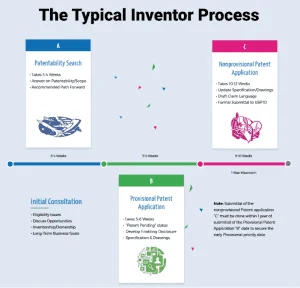
As you begin testing, gathering funding, and creating a proof of concept for your invention, you should proceed with caution. When discussing your invention with a third party, you should use a nondisclosure agreement (NDA) or confidentiality agreement.
When you file a patent application, this doesn’t provide you with rights to the invention yet, and the information is not necessarily published. You could disclose trade secrets or improvements of your invention that were not filed, threatening the patentability of improvements. Public disclosure before filing for a patent can prevent you from any patent rights, especially if you want international patent protection:
- Domestic grace period. In the U.S., there is a grace period offered. You can file for a patent within 12 months of public disclosure of your invention. This only applies to certain types of disclosures, like trade agreements, and is meant for industrial designs.
- International grace periods. For international patent protection, this grace period may not always exist. Although some countries have grace periods of between six and 12 months, others require absolute novelty. Disclosing your invention before applying for a patent could potentially make your invention unpatentable. If you want international patent protection, it’s important to understand these laws and follow their requirements.
If you make an early disclosure of things you haven’t filed for yet, it would bar you from getting protections for those improvements. Discussing the invention without confidentiality could also lead to a third party taking the information and profiting from it with no recourse.
Public disclosure can include:
- Product-market fit research
- Trade agreements
- Kickstarter campaigns
- Blog posts
- Internet videos
- Trade shows
- Presentations
Confidentiality agreements create signed agreements that another party will not publicly disclose your invention. You can also file for other types of intellectual property protection, like trademarks. When you work with an experienced attorney, they can help you understand your rights and protect your invention.
Step 9: Launch a Business or License and Sell
Now that you’ve filed at least a provisional patent application, you should have a very good idea whether you are planning to start and grow a business of your own, or if you are looking to license or sell your invention to a third party whose business is already up and running or plans to be.
Key things to think about as you make this decision include:
- The big barriers to entry in the market, such as regulation, governmental red tape, or requiring a large investment, and whether that leads to wanting to license/sell to those that have already cleared those expensive hurdles.
- Infringers of your patent that exist, such as companies that are unknowingly selling similar products, which makes them great candidates to take a license or lump sum payment to be able to continue selling those products.
- Big investors who are prepared to help form a team or supply chain, because they feel you’ve got a head start with production to beat anyone else to market, can improve the outcomes of starting your own business.
Step 10: Patent and Portfolio Development
Filing the nonprovisional patent application on time is crucial to ensure you are properly protected. You brought your visionary invention to market, inventing a new product. Now, you just have to wait for the United States Patent and Trademark Office (USPTO). This process can take 29.3 to 45.2 months on average, as of July 2026.
As the patent application proceeds through the USPTO examination process and the assigned examiner, there will be opportunities for you to make continuation or divisional filings to expand the scope of rights of your “parent” filing.
Continuation and divisional filings are a great way to get the most out of your patent and make it more valuable to a potential licensee. Developing a patent family is important in a patent strategy.
FAQs
What Are the Steps to Inventing Something?
There are many steps to inventing something, including 1) assessing common problems in life and potential solutions to those problems, 2) considering the value of the potential solution compared to the effort it will take to implement, and 3) conducting market research. If it’s a useful and marketable invention, you want to begin 4) creating the product, 5) working with a patent attorney, and 6) filing for patent protection.
Can You Legally Own an Idea?
No, you cannot legally own an idea. If you turn your idea into something tangible, like a work of art, an invention, or a logo, that is considered intellectual property. You could be able to secure certain intellectual property protections for those creations and the rights to protect them. Patents, for example, offer you the ability to prevent others from selling or making your invention when you have a patent from the USPTO. Patents are not allowed for abstract ideas.
Does a Poor Man’s Patent Work?
No, a poor man’s patent does not work. A poor man’s patent is the concept of mailing an idea for an invention to yourself, meaning that there is an official date for your idea that could be used to show you invented something first. However, first-to-invent is no longer how the U.S. handles patenting. As of 2013, the USPTO handles patents under the first-to-file system. You must have filed a patent application first to have rights to an invention.
Can I Just Sell My Invention Idea?
Yes, you can sell your invention idea, but it’s important to take precautions. If you present your invention to a third party without any protections, they could easily steal your idea without compensating you or agreeing to any beneficial deal.
Protecting your invention can include securing a patent through the USPTO and getting third parties to sign nondisclosure agreements or confidentiality agreements. An experienced attorney can help you assess how to protect your rights.
Hire a Patent Attorney and Work With Bold Patents Today
No matter who you are, if you have the grit to stick with your idea to the end, you have the potential to be an inventor. Find problems that you can solve, find the market for your idea, and file for patent protection. That way, you can become an inventor in no time. Instead of worrying about whether you have the qualifications or innate gift to invent, focus on improving the world for yourself and others.
It’s important to hire a patent attorney to help protect your rights during the invention and patenting process. At Bold Patents, we have decades of experience in patent law and want to help you protect your interests. Reach out to our team today.
Legal Note: This blog article does not constitute as legal advice. Although the article was written by a licensed USPTO patent attorney there are many factors and complexities that come into patenting an idea. We recommend you consult a lawyer if you want legal advice for your particular situation. No attorney-client or confidential relationship exists by simply reading and applying the steps stated in this blog article.