
Last Modified on September 15, 2026

It can be incredibly exciting to receive a USPTO notice of allowance, but it’s important to know the next patent steps to consider after a notice of allowance (NOA). When you finally receive a NOA, it can be tempting to pay the required fee immediately and put a quick end to your patent journey. Doing this could mean you are short-changing yourself. It’s important that you talk with experienced legal counsel, understand the fee, and determine your other patent options.
If you submitted your patent application close to a year ago, or even longer, and have patiently waited and responded to one or more office actions, you are likely ready to be done with the patent filing process. Applying for patent protection can, at times, seem like a never-ending process. Getting a NOA can feel like the last step, but it’s important to be cautious.
Make no mistake, receiving an NOA is what you’ve been hoping for all along. Essentially a patent allowance notification, the NOA lets you know that your invention is eligible for patent protection. However, the NOA is not quite the end of the process. There are some additional steps to consider before you celebrate your success.
What Is In the NOA?
When you receive a NOA, the envelope will include several specific documents, including:
- Notice of allowability (PTOL-37). This states that the application is in a state where it is allowed by the USPTO, or the precursor to awarding a patent.
- Allowed claims list. Part of the notice of allowability is a list of which claims were allowed, and the exact scope of protection your invention is provided. There may have been amendments, so it’s important to review this.
- Examiner’s statement of reasons for allowance. There may be stated reasons for the allowance of the application if it would not otherwise be clear to the court. If the reasons are evident, there may be no reasons.
- Fee transmittal form (PTOL-85B). This outlines the fees you are required to pay and when they are due, and provides methods for paying the fee.
Step 1: Understand Fee Requirements
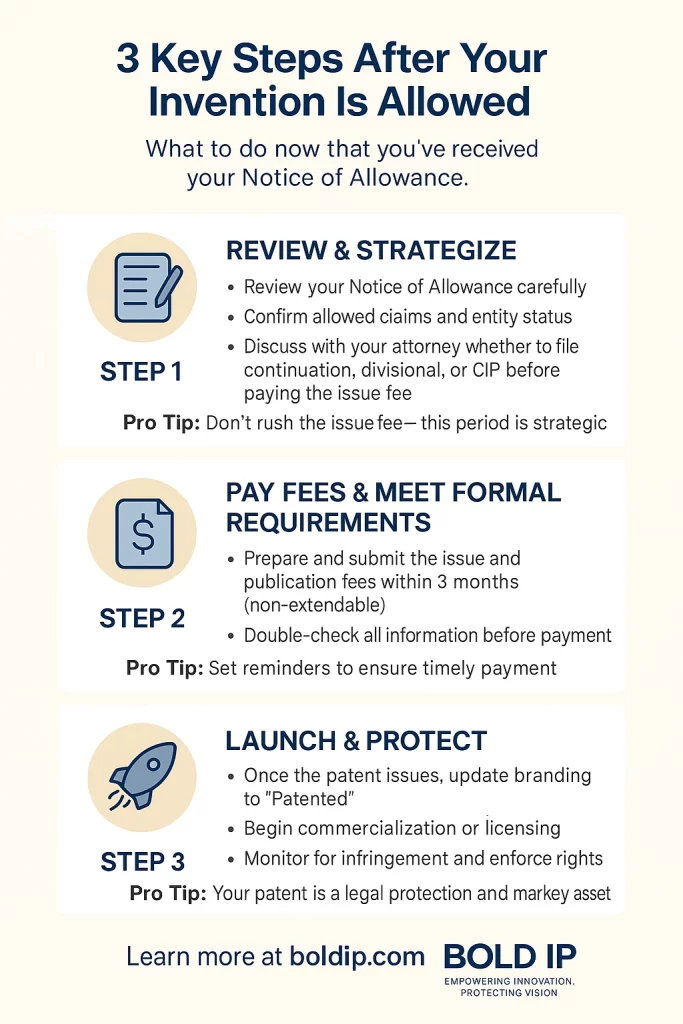
Your notice of allowance USPTO mailing will include details about required fees and whether revised or final drawings are needed. You have three months from the date the patent allowance was issued to pay these fees and submit any final information. It is important to keep an eye on the three-month filing deadline. If you fail to pay the fees by the due date, you are essentially abandoning all the work you did to get to this point.
Once you pay your fee, you should obtain patent rights and protection within approximately 4 to 6 weeks. You can expect to receive an official patent number and date, and a hard ribbon copy of the patent.
In certain situations, it may make sense to pay the patent fee right away. For example, if you have investors who made their investment in your business contingent on you obtaining a patent and you need the capital, paying the fee promptly may make sense.
However, there are several reasons to exercise patience and consider holding off on making that payment, including securing expanded legal rights.
Step 2: Consult With Your Patent Attorney
When you receive a notice of allowance patent mailing from the USPTO, you have one more chance to submit improvements or variations not originally covered in your filings.
Consulting with your patent attorney at this point is critical, so you can determine whether it makes sense to make any additional filings for your patent portfolio.
You have the right to file continuations, divisionals, or continuations-in-part for your patent, which are collectively referred to as “child patents”. However, you can only do this while the application is still pending. If you pay the patent fee without exploring the additional protection these filings can provide, you may be giving up legal rights.
Continuation applications allow you to extend your patent protection to include new claims. This can be particularly valuable in situations where your competition is actively designing around your patent application. You can also use filings to broaden the scope of your existing claims to make it even more difficult for others to try to avoid patent infringement claims by designing around your patent.
Step 3: File Child Patents
If you have made improvements to your design, or if you have identified situations where your competition could work around your patent, it may make sense to file one or more child patent applications. Your attorney will work to complete these filings quickly, while your application is still pending, and before you pay the fee detailed on your notice of allowance.
The different types of child patents are:
- Design patent. A new design application comes from the specification and the drawings of the original or parent filing.
- Continuation. This is when additional independent claims are sought from the same core specification as the parent application.
- Continuation in-part. These child patents are when at least some of the new claims require additional specification to substantiate themselves.
- Divisional application. This is an unelected invention or species that was previously restricted but may now be elected.
- International application. While these applications can be complex, you can still file to protect your invention around the world.
FAQs
Can You File an RCE After a Notice of Allowance?
There are some cases where you can file an RCE after a notice of allowance (NOA), although it depends on your case’s specifics. An RCE (Request for Continued Examination) is something you can file after a denied patent application, while a NOA is sent to you to request the issue and publication fees for an approved patent application. Whether or not you file an RCE will depend on whether you have paid your issue fees.
What Are the Five Steps of the Invention Process?
There are several steps in the invention process, including 1) assessing whether your invention is patentable by conducting an art and patent search and reviewing the definition of a patent. Then, you should 2) draft your application with documentation of your invention and 3) submit the application to the USPTO. Then is 4) the USPTO examination, where you respond to any office actions the office makes. Then 5) you receive a denial or a granted patent.
How Long Does It Take to Get a Notice of Allowance?
The time it takes to get a notice of allowance depends on how long it takes the USPTO to examine your patent application. It can take anywhere from 29.3 months to 45.2 months on average, as of July 2026, from the time a patent application is made to the time that the USPTO reaches a final decision. You have three months after receiving a NOA to provide the payment.
Why Should You Hire a Patent Lawyer?
You should hire a patent lawyer to better protect your interests when you file for a patent, and to help you navigate the next steps after a NOA. They can help you create a patent application that is more likely to be successful and determine your options for child patents throughout the process of application examination. They help you create a strategy to protect your patent rights and respond in a timely manner to a NOA.
Work With a Patent Attorney at Bold Patents
Before you rush to pay the notice of allowance fee, schedule a consultation with your patent lawyer and explore whether additional child patent applications are warranted. That way, you can be more confident in the patent protection you have been patiently waiting to receive.
Bold Patents works with inventors and entrepreneurs across the country to help them secure intellectual property protection. Our skilled legal team and staff can help you understand what type of protection will best meet your needs, and we’ll help you through the process of securing patents or other IP rights. You can expect personalized guidance, legal advice and assistance, all delivered through a remote service model with transparent pricing.
Whether you need assistance responding to a USPTO office action or want to start the patent process from the beginning, Bold Patents can help. Contact our firm today.