
Patent Attorney and Founder
Is there a real difference between a design patent and a utility patent?
Yes. And the line is simpler than most people think.
Here’s the quick way to look at it.
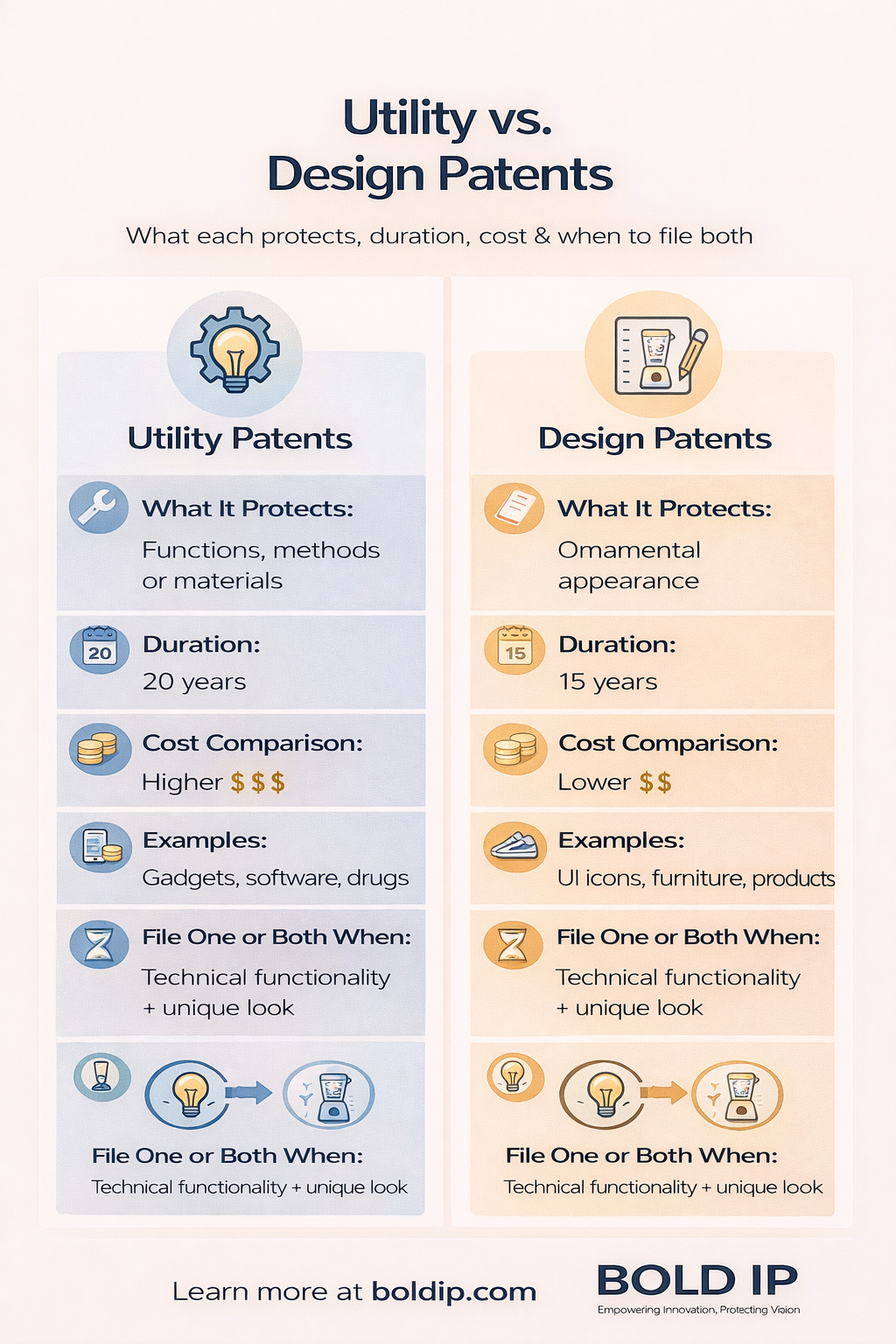
If you want to protect how something looks, you’re talking about a design patent.
That’s the shape. The surface. The visual style.
If you want to protect what it does or how it works, that’s a utility patent.
That covers function. Movement. Systems. Results.
So the real question is this:
What’s new about your idea?
Is it the look?
Or is it the performance?
Sometimes it’s obvious. Sometimes it’s not.
Take a door handle.
At first glance, it feels like a design issue.
Curves. Finish. The way it fits your hand.
But pause for a second.
What if the handle reduces wrist strain?
What if it unlocks with a fingerprint?
What if it senses proximity and opens on its own?
Now we’re no longer just talking about looks.
That’s function. That’s utility.
And yes, you can protect both.
Here’s how I usually guide clients.
Start with the utility patent.
Why?
Because when you file a utility application, you already submit drawings and written details. Later, before that utility patent is granted, you can still file design patents based on those same visuals.
That buys you time.
Time to test versions.
Time to see what sells.
Time to learn what customers actually like.
Once the market speaks, then you lock in the design patent for the version that wins.
Just one rule to remember:
You must file the design patent before the utility patent is granted.
Miss that window, and it closes.
Design is how it looks.
Utility is how it works.
Smart strategy is knowing when to file each one.