

Patent Attorney and Founder
Introduction: When a Giant Gets Pushed Back
Apple is one of the most powerful companies in the world. It dominates markets, shapes industries, and rarely – if ever – gets forced to change course by a smaller competitor.
And yet, in one of the most fascinating patent battles in recent years, that’s exactly what happened.
A relatively lesser-known medical technology company – Masimo – went head-to-head with Apple over the Apple Watch’s blood oxygen feature… and won.
Not just symbolically. Not just partially.
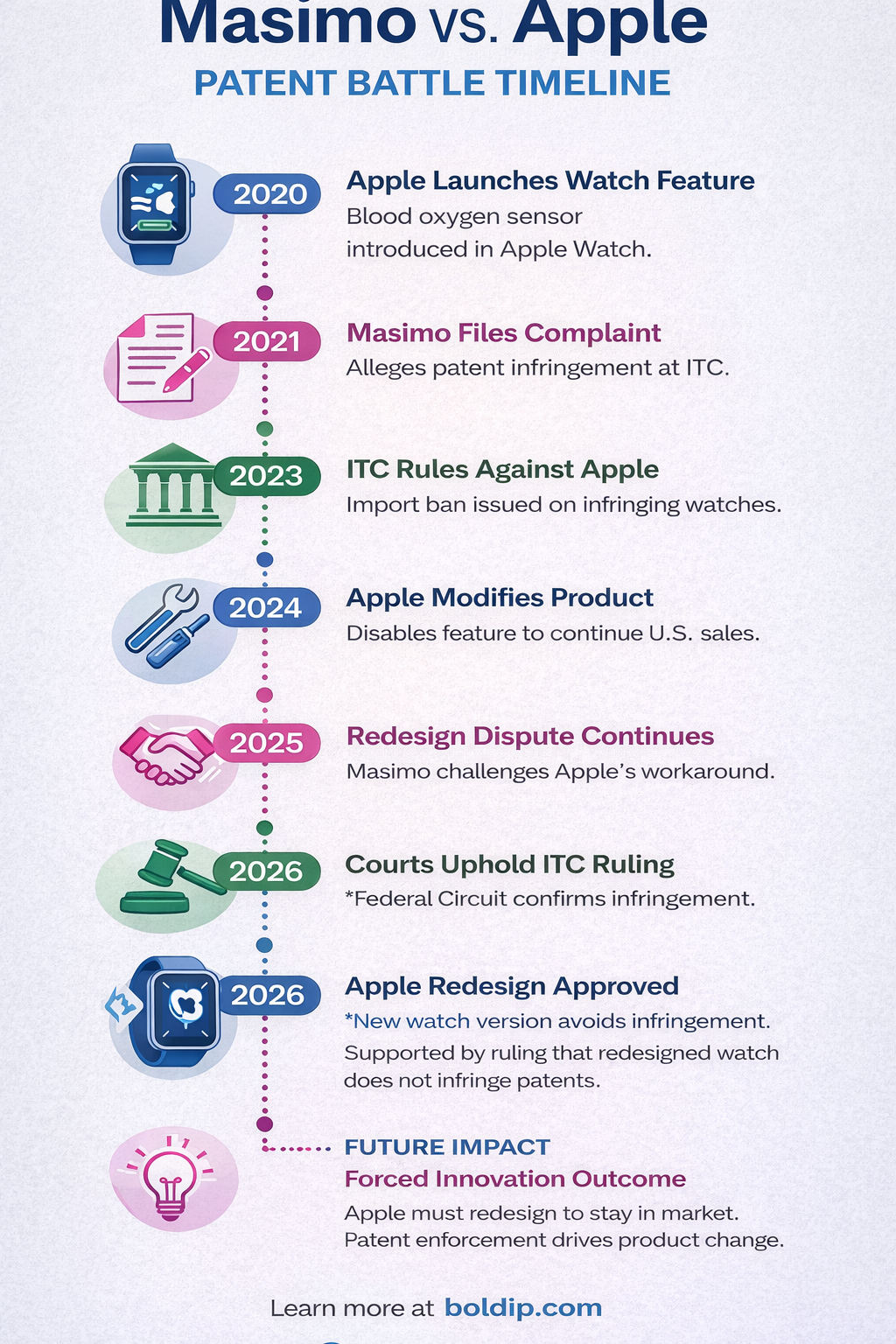
Masimo forced Apple to:
- Lose a major patent case
- Face an import ban on a flagship product
- Disable a core health feature in the U.S.
- Redesign its technology to avoid infringement
This wasn’t luck. It wasn’t a fluke.
It was the result of years of patent strategy, technical depth, and relentless enforcement.
And if you’re an inventor, entrepreneur, or business owner, this story matters more than you might think.
Because buried inside this battle are some of the most important lessons in modern patent law:
- How smaller companies can beat giants
- Why patents are only as valuable as your willingness to enforce them
- How trade secrets and patents intersect in real-world disputes
- And why litigation, messy as it is, can absolutely pay off
Let’s start at the beginning.
Part I: The Technology War Before the Lawsuit
Masimo: The Quiet Leader Nobody Was Talking About
Before this case, Masimo wasn’t a household name.
But in the medical device world, it was a powerhouse.
Founded in 1989, Masimo focused on one very specific—but incredibly important—problem:
Accurately measuring blood oxygen levels in real-world conditions.
Traditional pulse oximeters struggled with:
- Patient movement
- Low blood flow
- Noisy environments
- False alarms
Masimo changed that.
They developed something called Signal Extraction Technology (SET)—a method for isolating true physiological signals from noise. This wasn’t just an incremental improvement. It was a fundamental leap in reliability.
And over time, Masimo did something even more important:
👉 They built a deep patent portfolio around that innovation.
These weren’t vague, theoretical patents. They covered:
- Light-based physiological measurement
- Wearable implementations
- Specific sensor configurations
- Signal processing approaches
In other words, Masimo wasn’t just innovating.
It was protecting the future of wearable health tech before the market fully existed.
Apple Enters the Arena
Fast forward to 2020.
Apple releases the Apple Watch Series 6 – a product already dominating the smartwatch market—and introduces a new feature:
👉 Blood oxygen monitoring
On the surface, this looked like just another Apple innovation.
But technically, it worked like this:
- LEDs shine light into the skin
- Blood absorbs light differently depending on oxygen levels
- Photodiodes measure reflected light
- Algorithms calculate oxygen saturation
If that sounds familiar, it should.
Because that’s the same general approach Masimo had been refining -and patenting -for decades.
And this is where things get interesting.
The Collision Was Almost Inevitable
When Apple entered the health monitoring space, it didn’t just step into a new market.
It stepped into a patent minefield.
Companies like Masimo had spent years:
- Solving the hard problems
- Developing clinical-grade solutions
- Filing patents that extended into wearable applications
So when Apple launched a consumer-friendly version of similar technology, Masimo saw something very different than innovation.
It saw infringement.
But the story doesn’t stop there.
The Trade Secret Dimension: More Than Just Patents
What made this case especially compelling was that Masimo didn’t just allege patent infringement.
It also raised concerns about something more subtle, and often more dangerous:
👉 Trade secrets
Masimo claimed that:
- Apple had recruited key Masimo employees
- Gained access to confidential technical knowledge
- Used that information to accelerate development of its own health features
This is a pattern we see often in high-stakes tech disputes.
Patents protect what you disclose.
Trade secrets protect what you don’t disclose.
And when employees move between companies, especially in cutting-edge fields, those lines can blur fast.
Whether intentional or not, the combination of:
- Overlapping technology
- Employee movement
- Similar product features
created the perfect storm.
Masimo wasn’t just defending its patents.
It was defending its entire innovation ecosystem.
Part II: The Strategic Move That Changed Everything
Why Masimo Didn’t Just Sue in Federal Court
When companies think about patent litigation, they usually think about federal court:
- File a lawsuit
- Seek damages
- Wait years for resolution
Masimo took a different path.
Instead of relying solely on traditional litigation, it filed a complaint with the:
👉 U.S. International Trade Commission (ITC)
This was not an accident.
It was a strategic masterstroke.
What Makes the ITC So Powerful
The ITC is not a typical court.
It doesn’t award damages.
Instead, it offers something arguably more powerful:
👉 The ability to block products from entering the United States
That’s called an exclusion order.
And for a company like Apple -whose devices are manufactured overseas – that’s a serious threat.
Let’s break down why this matters.
1. Speed
ITC cases move faster than federal court cases.
- Federal court: often 2 – 4 years
- ITC: typically 12 – 18 months
2. Leverage
Instead of asking for money, you’re asking for:
- Market access restrictions
- Supply chain disruption
3. Pressure
An import ban doesn’t just hurt legally.
It hurts:
- Sales
- Product launches
- Brand perception
Masimo understood this.
And it used the ITC exactly as it was designed:
👉 As a high-impact enforcement tool.
The Legal Framework: Section 337
Masimo’s complaint was based on Section 337 of the Tariff Act.
To win, Masimo had to prove three key things:
- Importation
Apple was bringing products into the U.S. - Infringement
Those products violated valid U.S. patents - Domestic Industry
Masimo had a U.S.-based business practicing those patents
Each of these elements matters.
But the third – domestic industry – became one of the most important battlegrounds in the case.
The “Domestic Industry” Hurdle
Apple’s defense strategy focused heavily on this argument:
👉 Masimo didn’t have a real product.
Apple essentially claimed:
- Masimo’s technology was theoretical
- Its products were not fully commercialized
- Therefore, it didn’t qualify for ITC protection
If Apple had won this argument, the case could have collapsed.
Because without a domestic industry, there is no Section 337 violation.
Masimo’s Counter: Innovation Still Counts
Masimo responded with a powerful, and ultimately successful, argument:
👉 You don’t need a mass-market product to have a domestic industry.
Instead, Masimo showed:
- Prototype devices
- Iterative development models
- Testing data
- Engineering investment
- U.S.-based R&D efforts
In other words, Masimo demonstrated that:
👉 Innovation in progress is still protected.
This is a critical takeaway.
Many companies assume they can’t enforce patents until they have:
- A finished product
- Market traction
- Revenue
That’s not true.
If you can show:
- Real development
- Real investment
- Real technical implementation
You can meet the domestic industry requirement.
Masimo proved that.
Part III: The Evidence Battle
Why This Case Wasn’t Just About Legal Arguments
Patent cases aren’t won with clever arguments alone.
They’re won with evidence.
And Masimo came prepared.
The Power of Prototypes
One of the most fascinating aspects of this case was how Masimo used prototypes.
Not polished products.
Not retail-ready devices.
Prototypes.
These included:
- Early sensor designs
- Iterative versions of wearable devices
- Development-stage hardware
Apple tried to dismiss these as:
- Incomplete
- Hypothetical
- Not representative
But the court saw them differently.
Iteration as Proof of Innovation
Masimo showed that these prototypes were part of an iterative design process:
- Version A leads to Version B
- Version B leads to Version C
- Each iteration incorporates improvements
- Each step reflects real engineering work
This wasn’t guesswork.
It was documented development.
And that mattered.
Because it demonstrated:
- Technical feasibility
- Real-world application
- Continuous innovation
Circumstantial Evidence Matters
Another key aspect of the case was the use of circumstantial evidence.
Apple argued:
- If Masimo had a real product, it should be able to show it directly
But the court rejected that narrow view.
Instead, it accepted:
- Test results
- Witness testimony
- Development records
- Engineering documentation
As sufficient proof.
This is a big deal.
👉 You don’t always need a perfect, final product to prove your case.
If the totality of evidence tells a coherent story, that can be enough.
The Human Element: Witnesses and Experts
Masimo also relied heavily on:
- Engineers
- Technical experts
- Internal witnesses
They testified about:
- How the devices worked
- When testing occurred
- What features were implemented
This added credibility.
Because in patent litigation, it’s not just what you show.
It’s who explains it – and how convincingly they do it.
Part IV: The Stakes Become Real
This Was Never Just About Legal Theory
At this point, the case had moved beyond abstract arguments.
The stakes were now very real:
- A global tech giant
- A flagship consumer product
- A critical health feature
- Millions of users
And one question:
👉 Would Apple be allowed to keep selling its watch as-is?
Why This Case Matters to You
Even if you’re not building wearable tech, this case has direct implications.
Because it answers a fundamental question:
👉 Can a smaller company actually enforce its patents against a giant?
The answer is:
👉 Yes – but only if you’re willing to fight strategically, persistently, and intelligently.
Masimo did all three.
And in Part 2, we’ll walk through:
- The ITC’s ruling and the import ban
- Apple’s appeal, and why it failed
- The forced redesign of the Apple Watch
- And the long-term implications for innovators
Part V: The ITC Decision That Shook Apple
By the time the case reached its conclusion at the International Trade Commission, this was no longer just a dispute between two companies.
It had become a referendum on something much bigger:
👉 Do patents still have teeth in the modern tech world?
For Masimo, everything hinged on that answer.
For Apple, the stakes were equally high, because losing wouldn’t just mean paying money.
It would mean losing access to the U.S. market for a key product.
The ITC’s Final Determination
After a full investigation – including extensive discovery, expert testimony, and a multi-day hearing – the ITC reached its decision.
And it was decisive.
The Commission found that:
- Apple’s Apple Watch infringed Masimo’s patents
- The patents were valid and enforceable
- Masimo had established a domestic industry
- Apple had therefore violated Section 337
This wasn’t a split decision or a technical win.
It was a clear validation of Masimo’s position.
The Most Powerful Remedy in Patent Law
Then came the part that truly changed the game:
👉 The ITC issued a Limited Exclusion Order (LEO)
This meant:
- Apple could not import infringing Apple Watches into the United States
- Any affected models were effectively blocked at the border
For most companies, that would be catastrophic.
For Apple, it was still incredibly disruptive.
Because even a company of Apple’s scale cannot easily:
- Shift global manufacturing overnight
- Reengineer complex hardware instantly
- Ignore the U.S. market
This is what makes the ITC so powerful.
It doesn’t just penalize.
It forces action.
Why Apple Couldn’t Just Ignore the Ruling
In many patent cases, a losing company can:
- Appeal
- Delay
- Continue operating while litigation drags on
But an ITC exclusion order is different.
It creates immediate pressure.
Apple had two options:
Option 1: Stop Selling the Feature
Remove the infringing functionality and continue importing the device.
Option 2: Redesign the Product
Change the underlying technology to avoid infringement.
Apple chose… both.
Part VI: Apple’s First Response – Disable the Feature
A Rare Public Retreat
In 2024, Apple made a surprising move.
It disabled the blood oxygen feature in certain Apple Watch models sold in the United States.
Let’s pause on that.
This wasn’t:
- A minor bug fix
- A software tweak
- A quiet backend change
This was a headline feature, marketed as a health innovation, being turned off.
Why?
Because of Masimo’s patents.
What This Signals to the Market
This moment sent a powerful message:
👉 Patent enforcement can directly impact product functionality, even for the biggest companies.
It also signaled something else:
Apple wasn’t done fighting.
Disabling the feature was a temporary solution.
A stopgap.
Because Apple immediately began working on something more permanent.
Part VII: The Redesign – Engineering Around the Patent
The Classic Move in Patent Warfare
When a company loses a patent case, one common response is:
👉 Design around the patent
Instead of licensing or abandoning the feature entirely, the company modifies its technology to avoid the specific claims of the patent.
This is not easy.
It requires:
- Deep technical understanding of the patent claims
- Careful engineering changes
- Legal analysis to ensure non-infringement
Apple did exactly that.
What Apple Changed
The key shift in Apple’s redesign was architectural.
Originally:
- The Apple Watch handled blood oxygen processing directly
In the redesigned version:
- The paired iPhone handled part of the processing instead
This might sound like a subtle change.
But in patent law, subtle differences can matter enormously.
Because infringement isn’t about:
- Whether two products seem similar
It’s about:
- Whether they fall within the specific language of the patent claims
By moving functionality off the watch and onto the iPhone, Apple aimed to:
👉 Step outside the boundaries of Masimo’s patents.
Approval to Re-Enter the Market
After the redesign, Apple sought approval to resume imports.
And initially, it succeeded.
Regulators determined that:
- The redesigned product did not infringe the patents
This allowed Apple to:
- Bring the feature back (in modified form)
- Continue selling the Apple Watch in the U.S.
But Masimo wasn’t satisfied.
Part VIII: The Second Battle – Is the Redesign Still Infringing?
Enforcement Never Really Ends
One of the most overlooked aspects of patent litigation is this:
👉 Winning once doesn’t end the fight.
Because if the losing party redesigns, the question becomes:
👉 Does the new version still infringe?
Masimo challenged Apple’s redesign, arguing that:
- The changes were superficial
- The underlying functionality still violated its patents
This triggered a new phase of the case.
The ITC Takes Another Look
The ITC initiated a modification and enforcement proceeding to evaluate the redesigned Apple Watch.
This is essentially a second investigation focused on one question:
👉 Does the redesigned product comply with the exclusion order?
The Initial Finding
In early 2026, an administrative law judge issued an initial determination:
- The redesigned Apple Watch does not directly infringe
- It also does not induce infringement
In other words:
👉 Apple’s workaround, at least for now, was successful.
Why This Matters
This outcome highlights a key reality:
👉 Patent victories don’t always eliminate competition.
Instead, they often:
- Force competitors to adapt
- Shift how products are designed
- Create new technical boundaries
Masimo didn’t remove Apple from the market.
But it did something arguably just as important:
👉 It forced Apple to change how it innovates.
Part IX: The Appeal – Apple’s Last Big Push
Taking the Fight to the Federal Circuit
After losing at the ITC, Apple appealed to the U.S. Court of Appeals for the Federal Circuit.
This was its opportunity to:
- Reverse the ruling
- Restore its original product functionality
- Avoid long-term disruption
Apple threw everything at the appeal.
Apple’s Core Arguments
Apple challenged the ITC’s decision on multiple fronts:
1. No Domestic Industry
Apple argued that Masimo didn’t have a qualifying product.
2. No Infringement
It claimed the Apple Watch didn’t fall within the patent claims.
3. Invalid Patents
Apple argued the patents:
- Lacked sufficient description
- Were obvious based on prior art
4. Procedural Issues
It also raised arguments about:
- Patent prosecution delays
- Legal standards applied by the ITC
This was a comprehensive attack.
If any one of these arguments succeeded, Apple could have won.
The Federal Circuit’s Response
The court rejected them all.
Across the board.
Let’s break down why.
1. Domestic Industry: Confirmed
The court affirmed that:
- Masimo’s prototypes were real
- Its development efforts were substantial
- Its investments were significant
This reinforced a crucial principle:
👉 You don’t need a finished commercial product to enforce a patent.
2. Infringement: Upheld
The court agreed that:
- Apple’s technology fell within the patent claims
- The ITC’s claim interpretations were correct
This validated Masimo’s technical arguments.
3. Patent Validity: Preserved
Apple’s attempts to invalidate the patents failed.
The court found:
- The patents were sufficiently detailed
- Prior art did not disclose the same functionality
This is critical.
Because many patent cases turn on invalidity.
Masimo’s patents held strong.
4. No Evidence of “Patent Gamesmanship”
Apple suggested Masimo had manipulated the patent process.
The court disagreed.
It found:
- Continuous development activity
- No improper delay
- No evidence of targeting Apple specifically
Final Result
👉 The ITC’s decision was fully affirmed.
For Masimo, this was the ultimate validation.
For Apple, it meant:
👉 The loss was real and lasting.
Part X: Trade Secrets – The Shadow Battle
A Parallel Legal War
While the ITC case focused on patents, another case was unfolding in parallel.
This one centered on:
👉 Trade secrets
Masimo alleged that Apple:
- Hired away key employees
- Gained access to confidential information
- Used that knowledge in developing its products
The Jury’s Finding
In district court:
- A jury found that Apple infringed additional Masimo patents
- Damages were awarded in the hundreds of millions
Separately:
- The court found that Apple had misappropriated trade secrets
However:
- No remedy was imposed for the trade secret claim
Why Trade Secrets Still Matter
Even without a remedy, this finding is significant.
Because it shows:
👉 Patent disputes often overlap with trade secret issues.
For companies, this creates a dual responsibility:
- Protect what you patent
- Protect what you don’t patent
And for employees moving between companies, it’s a reminder:
👉 Knowledge transfer can have serious legal consequences.
Part XI: Lessons for Inventors, Founders, and Businesses
Lesson 1: Patents Are Only as Strong as Your Willingness to Enforce Them
Masimo didn’t just file patents.
It:
- Monitored the market
- Identified infringement
- Took action
Many companies stop at filing.
Masimo went further.
Lesson 2: Strategy Matters More Than Size
Masimo didn’t outspend Apple.
It out-strategized Apple.
Key decisions included:
- Filing at the ITC
- Building a strong evidentiary record
- Leveraging multiple legal theories
Lesson 3: Iteration Is Not a Weakness
Masimo’s use of prototypes was critical.
It showed:
- Continuous innovation
- Real technical progress
You don’t need perfection.
You need proof.
Lesson 4: Litigation Is Messy – But It Works
This case involved:
- Multiple forums
- Years of litigation
- Complex technical arguments
It wasn’t clean.
It wasn’t fast.
But it was effective.
Lesson 5: Winning Doesn’t Mean Eliminating Competition
Masimo didn’t shut Apple down.
But it:
- Forced a redesign
- Changed product behavior
- Asserted control over its technology space
That’s a win.
Conclusion: The Power of Persistence
The Masimo vs. Apple battle is one of the clearest modern examples of something many inventors hope – but few truly believe:
👉 A smaller company can win against a giant.
Not because the system is easy.
Not because the odds are even.
But because:
- Strong patents matter
- Smart strategy matters
- Persistence matters
Apple is still Apple.
But even Apple had to adapt.
And that’s the real takeaway:
👉 When intellectual property is enforced correctly, it commands respect – no matter who’s on the other side.
Want Help Protecting Your Innovation?
If you’re building something valuable, the question isn’t whether you’ll face competition.
It’s whether you’ll be ready when you do.
Because as this case shows:
👉 The difference between getting copied and getting paid is often one thing:
Action.
The Masimo story didn’t start in a courtroom – it started with an inventor who believed their technology was worth protecting, and then had the courage to prove it. That’s the same decision every inventor and entrepreneur faces.
Bold Patents was built for exactly this moment: to help you build a patent portfolio that holds up when it matters, and to stand with you when it’s time to enforce it. Whether you’re at the idea stage or ready to go on offense, let’s talk strategy. Schedule a free discovery call today – because your innovation deserves more than a piece of paper.
References & Sources:
This article is based on publicly available reporting and court decisions related to the Masimo v. Apple litigation, including:
- Davis, Ryan. “Apple Watch Redesign Gets Early OK As Patent Loss Upheld.” Law360, March 19, 2026.
- Law360 coverage of Masimo Corp. v. Apple Inc. and related International Trade Commission proceedings (Investigation No. 337-TA-1276).
- Federal Circuit opinion in Apple Inc. v. International Trade Commission, 2026.
- Public filings and decisions from the U.S. International Trade Commission regarding wearable blood oxygen monitoring technology disputes.