What Can Actually Be Patented?
Not every great idea qualifies for patent protection—but many more innovations do than people realize.
Every week, I hear inventors ask questions like:
- “Can I patent an app?”
- “Can I patent AI?”
- “Can I patent a business idea?”
- “Can I patent software?”
- “Can I patent an improvement?”
The answer almost always begins with…
“It depends.”
This chapter will help you understand what the patent system is designed to protect—and where the legal boundaries begin.
Reading Time: 11 minutes
Video: 3 minutes
Alex’s Story
Alex’s prototype was becoming real.
The redesigned electronics solved the overheating problem.
The light lasted longer.
Energy efficiency improved.
Investors were interested.
Then Alex wondered…
“Can I patent the whole thing?”
Or…
Was it only the circuit?
The software?
The housing?
The manufacturing process?
The answer surprised him.
The patent system isn’t limited to groundbreaking inventions.
It often protects improvements.
Sometimes the smallest improvement creates the biggest competitive advantage.
Patent Eligibility Starts with the Right Question
Many inventors ask:
“Is my invention patentable?”
A better first question is:
“Is this the type of innovation the patent system is designed to protect?”
Before discussing novelty, prior art, or obviousness, your invention must fit within one of the categories recognized by patent law. That threshold question comes before everything else.
Think of it this way.
Imagine arriving at the airport.
Before security checks your luggage…
Before your passport is examined…
Before boarding begins…
You first have to be in the correct terminal.
Patent eligibility works the same way.
The Four Categories of Patentable Subject Matter
United States patent law generally recognizes four categories of inventions.
⚙️ Processes
Methods.
Algorithms.
Manufacturing techniques.
Control systems.
Business processes (sometimes).
Examples:
- AI image processing
- Manufacturing automation
- Medical treatment methods
- Software workflows
🖥 Machines
Physical systems with moving or interacting components.
Examples:
- Robots
- Engines
- Drones
- Medical devices
- Industrial equipment
Alex’s improved lighting controller fit comfortably into this category.
📦 Articles of Manufacture
Products that are made.
Examples:
- Consumer products
- Electronics
- Packaging
- Mechanical assemblies
- Wearable devices
Think of the finished product.
🧪 Compositions of Matter
Chemistry.
Materials.
Pharmaceuticals.
Food science.
Advanced materials.
Examples:
- Semiconductor materials
- Battery chemistry
- Drug formulations
- New plastics
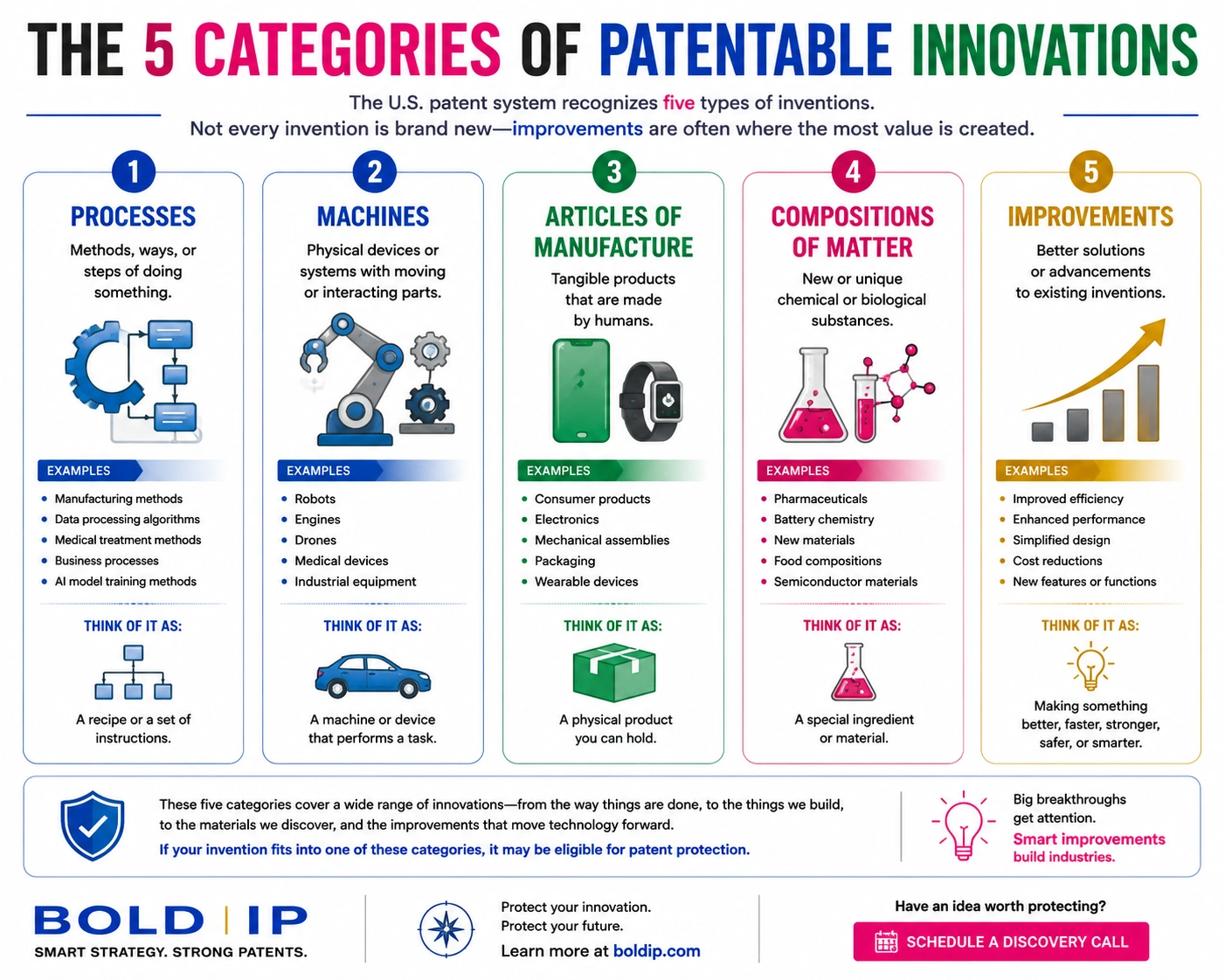
The Fifth Category Nobody Talks About
Here’s something many inventors don’t realize.
Most patents aren’t for entirely new products.
They’re for improvements.
An improved engine.
A smarter sensor.
A faster algorithm.
A better manufacturing method.
Alex didn’t invent the light bulb.
He invented a better way to drive and cool it.
That’s where enormous business value often lives. As the book notes, many modern patents are improvements to existing technologies rather than entirely new categories of inventions.
What Cannot Be Patented?
This surprises many people.
Generally speaking, you cannot patent:
❌ Laws of nature
❌ Natural phenomena
❌ Abstract ideas
❌ Mathematical formulas by themselves
❌ Pure mental processes
❌ Mere discoveries
Einstein couldn’t patent E = mc².
Newton couldn’t patent gravity.
Someone who discovers a naturally occurring mineral can’t patent the mineral itself.
But…
Applications of these discoveries often can be patented.
What About Software?
One of the most common questions I receive.
Can software be patented?
Yes.
Sometimes.
The better question is:
What technical problem does the software solve?
Patent law generally rewards software that produces a technical improvement—not simply software that automates a longstanding human activity.
Examples:
✔ Better cybersecurity
✔ Image processing
✔ Data compression
✔ Industrial automation
✔ Medical diagnostics
✔ Network optimization
Simply putting an existing business process onto a computer usually isn’t enough.
What About Artificial Intelligence?
AI itself isn’t automatically patentable.
But inventions involving AI often are.
Examples include:
- New model architectures
- AI-assisted manufacturing
- Medical diagnosis systems
- Robotics
- Autonomous navigation
- Computer vision
- Hardware acceleration
Again…
The patent isn’t protecting intelligence.
It’s protecting innovation.
(AI)dea
Don’t ask,
“Can I patent AI?”
Ask,
“What technical innovation did AI help create?”
That’s usually where the real patent opportunity exists.
The Patent Eligibility Test
When I first meet inventors, I usually ask three simple questions.
Does it solve a real technical problem?
Is there something objectively different?
Could you explain exactly how it works?
If the answer to all three is yes…
We’re probably asking the right questions.
Alex’s Discovery
Alex originally thought the invention was his light bulb.
It wasn’t.
The true invention was the interaction between:
- driver electronics
- thermal management
- feedback control
That combination created measurable improvements.
Those improvements became the patent strategy.
Real-World Examples
Some famous patents weren’t entirely new inventions.
They were improvements.
Dyson improved vacuums.
Tesla improved battery management.
Apple improved smartphone interaction.
Oura improved wearable health monitoring.
Innovation often happens one improvement at a time.
Common Mistakes
Many inventors assume:
“My invention already exists.”
Maybe.
But your improvement might not.
Others assume:
“It’s just software.”
Sometimes software contains the most valuable innovation.
Others believe:
“I only changed one small feature.”
That small feature may become the reason customers choose your product.
Never underestimate meaningful improvements.
Self-Assessment
Ask yourself:
✓ What problem does my invention solve?
✓ Is the improvement measurable?
✓ Could another engineer build it?
✓ Does it fit into one of the patent categories?
✓ Is the innovation technical rather than purely conceptual?
If you answered yes…
You may have something worth exploring.
Key Takeaways
Patent eligibility begins before patentability.
The patent system protects:
✓ Processes
✓ Machines
✓ Articles of Manufacture
✓ Compositions of Matter
Most successful patents protect improvements—not entirely new industries.
And in today’s AI-powered economy, meaningful technical improvements are being created faster than ever.
Understanding what qualifies is the first step toward protecting it.
Beyond the Book
AI Is Changing Who Can Invent
One of the biggest changes we’re seeing isn’t just that AI helps inventors—it’s that AI is expanding the pool of inventors.
A solo entrepreneur can now:
- Design a prototype with AI assistance.
- Generate embedded software.
- Simulate engineering performance.
- Draft technical documentation.
- Build a proof of concept in weeks instead of months.
That’s incredibly empowering. But it also raises the bar. If everyone can build faster, the competitive advantage increasingly comes from protecting the technical innovations that truly differentiate your product.
Watch
🎥 Video: What Can You Patent? Understanding Patent Eligibility in Plain English
Discovery Call CTA
Wondering if Your Innovation Is Patent Eligible?
Every invention is different. During a Discovery Call, we’ll evaluate your technology, identify what may be patentable, and discuss the best strategy for protecting your innovation before you invest significant time or money.