Last Modified on October 06, 2026

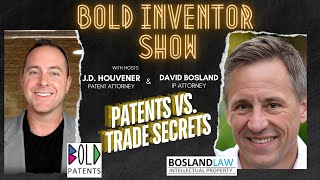
What’s better for protecting an invention: a patent, a trade secret, or both? On this episode of the Bold Inventor Show, J.D. Houvener and special co-host David Bosland dig into one of the most important, and often misunderstood, questions facing inventors and business owners.
The conversation covers everything from whether a 16-year-old can invent and sell a product to how patentability works, trademark confusion, copyright and patent exhaustion, the cost of enforcing patents, and the critical differences between patents and trade secrets.
Most importantly, J.D. and David explain why choosing between patent protection and trade secret protection isn’t always an either-or decision. In some businesses, the strongest intellectual property strategy may involve using both.
Welcome to the Bold Inventor Show
J.D. Houvener:
Hey everybody, welcome to the Bold Inventor Show. I’m J.D. Houvener, your host and the owner and founder of Bold Patents Law Firm.
Today, I’ve got our special co-host, David Bosland. David, welcome.
David Bosland:
Thank you. Thank you. Extra-special co-host. I did pay you that $20, remember?
J.D. Houvener:
He’s really covering some ground. He survived the hunting, and we’ll see if he survives Italy.
I love how you just said, “And I found out he’s in Italy.”
David Bosland:
Well, yeah. He did respond. He has a lot going on. He’s doing some responses to me, maybe just to me.
J.D. Houvener:
I feel special.
David Bosland:
Yeah. To his clients, I think he’s still unavailable.
J.D. Houvener:
Yeah, with a whole other topic. But it’s like, should you retire?
The classic concept of retiring is: work your butt off until you’re some age and then quit.
I’m not doing that. My head’s going to bounce off my desk, but I’m going to take big chunks of time off during the year. I’m just going to keep doing this because I enjoy the work.
David Bosland:
Yeah, this is what you’re good at.
J.D. Houvener:
You’re perfect.
We have a good show today. I’m glad we have you helping me keep things moving along, keep expanding, and keep me focused.
We have, I think, seven questions we’re going to get through, and then we’re going to talk about our main topic today: patents versus trade secrets.
David Bosland:
When I logged in just a few minutes ago, I totally read that as “Patents vs. Trade Secrets Unveiled.”
And then I went, “Hang on a second.”
J.D. Houvener:
Yeah, versus trade secrets unveiled.
David Bosland:
Being dyslexic is a never-ending source of joy and amusement.
J.D. Houvener:
I think someone could totally see it that way. We almost need a hyphen, “trade-secrets”, to keep those words connected.
David Bosland:
Partly it’s because patents are something people recognize. They recognize the word even if they don’t have a lot of detail about what it is.
Trade secrets? Walk up to most of the attorneys that you know and say, “Hey, what’s a trade secret?” They’ll be like, “What?”
So if people watching this are thinking, “I’m not really sure what a trade secret is,” don’t feel bad. I’m sure we’ll get to that.
J.D. Houvener:
Exactly.
There are so many areas of law that attorneys spend their entire careers working within one specific niche. There’s so much going on and so many different fields within the industry.
Before we get too far along, one quick disclaimer: we’re both attorneys here, but we’re not offering legal advice.
This is our fun time. We get to talk about legal information, answer hypothetical questions, and address some real questions from our audience.
If you’re watching live, you’re welcome to ask a question. But please don’t share anything confidential. This is not the place to do that.
We’ll provide a link before we end the show to get ahold of us. I’ve also got a brand-new Inventor Kit that I’m promoting. It’s a quick downloadable PDF, and it’s an easy way for people to get some education before scheduling time with an attorney.
So look for that link later.
We’re going to start with some questions and then get into our patents-versus-trade-secrets discussion. We’ll wrap up with a Bold Bite featuring a Shark Tank pitch for a unique, environmentally friendly product.
We’re live every week, every Wednesday. Come check us out, participate, ask a question, and get involved.
All right. That’s my spiel. Let’s get to some questions.
Question 1: Can a 16-Year-Old Invent and Sell a Product?
J.D. Houvener:
We found this never-ending bucket of questions in our Reddit patents and trademarks communities.
You mentioned you’ve got the Trademark Watchdog group on Facebook. Maybe we should bring some of those questions here if you have any next time we have you on.
David Bosland:
Absolutely. It’s cool. A lot of people in there are crafters and creators or people producing things and trying to sell them.
That’s one of those places where copyright and trademark come up a lot. It’s a little over 40,000 people trying to keep themselves on the straight path with respect to their IP.
It’s great to see people that interested in this very important part of their business.
J.D. Houvener:
Love it.
All right. It’s live Q&A time.
Here’s our first question:
“I’m only 16 and have never done anything related to selling an idea, similar to satin-lined beanies, and I wanted to create a product for it. Where do I go? How do I go about building a prototype? How would I market selling it? Is it possible for someone under 16 to create and sell a product, or only for adults age 18 and up?”
Lots of questions there.
David Bosland:
There are so many questions.
I’m going to find an easy question in there.
Can somebody who’s 16 create something? Absolutely.
But the other questions get more complicated.
You can be an inventor at any age. But when you start selling the product, entering contracts, or dealing with certain businesses, that’s where you can run into issues related to age and the age of majority.
It also depends on where you are because the age of majority isn’t necessarily the same everywhere.
So if you’re 16 and you’ve got an idea and you’d like to pursue it, absolutely. But there may be some practical and legal issues you’ll need to work through.
J.D. Houvener:
What about prototypes?
Let’s say you’ve got a great idea for a product and you want to make a prototype.
David Bosland:
I can barely make my own TV cabinet that we were just talking about.
J.D. Houvener:
Exactly.
David Bosland:
For me, the age issue is a classic case of this: you don’t need to be an adult to be an inventor.
You can be any age and be named as an inventor on a patent application.
The later questions are more about how you’re going to transact and enter contracts.
Ownership can also become an interesting question. You might be able to open a bank account, access money, and sell things, but executing contracts can become more complicated.
For example, if you’re listing something online through a platform like Amazon, you’re entering into legal contracts. Your ability to do that as a minor may be limited.
So it might be wise to consider bringing on a partner, perhaps a parent or another adult who can work with you and be part of the business.
J.D. Houvener:
Set up an entity.
It’s also a common recommendation when you’re going to engage with a third-party prototyper or designer. It’s usually wise to have a contract in place to maintain confidentiality.
Again, you’re probably going to want someone on your team who’s an adult who can sign that contract and make sure it’s binding and enforceable if someone breaches it.
As for the satin-lined beanie idea, if you think it’s unique and there’s a big enough market, it’s worth investigating whether it’s patentable.
You could potentially be looking at design patent protection if the novelty is primarily visual.
But if there’s a functional benefit, say, reduced friction, additional warmth, or some other functional advantage, you may also want to investigate utility patent protection.
There are a lot of directions we could take that question, but we’ll stop there for now.
Question 2: How Do I Know if My Idea Is Patentable?
J.D. Houvener:
Here’s one from Quora. I like this one because it’s simple:
How do I figure out if my idea is patentable?
I usually explain patentability in terms of two major hurdles.
The first is eligibility.
Do you have an invention that is even eligible for patent protection?
Most inventions and innovations are eligible, but certain things are excluded. Natural phenomena, laws of nature, and abstract ideas can fall outside the scope of patent eligibility.
For example, discovering a new principle of physics might be fascinating and incredibly valuable, but the discovery itself isn’t something you can simply own with a patent.
Once you clear that hurdle, you get into patentability itself.
For a functional invention, you generally need to consider requirements including novelty, non-obviousness, and utility.
Novelty means it has to be new. And that’s not limited to what has previously been patented. Published information and other forms of prior art can matter.
Then there’s non-obviousness.
Even if your invention is brand new, the question becomes whether someone skilled in the field would have found it obvious based on existing developments, technologies, or combinations of prior art.
Finally, it needs to have utility.
If you clear those hurdles, you may have an invention worth pursuing with a patent application.
David Bosland:
The non-obviousness requirement is one of the trickier things to evaluate.
Take a doorknob. They’re often shiny and brass-looking.
Suppose you come in from the rain and your hand slips on it. You think, “I’m going to put some texture on the doorknob to give people more grip.”
That might not be obvious.
J.D. Houvener:
Or it might be.
That’s the tricky part.
Sometimes it depends on how you describe the invention and what the prior art shows.
You might initially think, “Okay, that isn’t patentable.”
But perhaps you can improve it or change it in a meaningful way, and now you’re dealing with something that is non-obvious.
David Bosland:
That’s my point.
Recognize that obviousness is difficult even for people who really understand it.
Don’t just stop there.
J.D. Houvener:
Absolutely.
Work with someone who has experience evaluating these situations.
When you’re dealing with an invention that combines multiple pieces of prior art, that’s often where having someone experienced evaluate the patentability question can be especially valuable.
Question 3: Can I Add “Supra” to an Existing Trademark?
David Bosland:
This next one is on the trademark side.
Someone has a registered trademark for Shaver Shebang, which is a Class 3 cleaner for electric shavers.
They’re launching a new version and want to call it Shaver Shebang Supra.
There’s already an active trademark for “Supra” in Class 3 for liquid soap.
So the question is whether adding “Supra” creates a problem.
J.D. Houvener:
It’s a very specific question.
Class 003 is the way the trademark classification is typically listed, but the goods within a class can still be fairly broad.
You can’t necessarily look at the class number and assume you know everything that’s included.
You’ve already got a registered trademark. Now you’re considering adding another component, and that component already exists in the same class for something slightly different.
David Bosland:
Here’s the key point:
Trademarks are considered in their entirety.
You have to look at the overall commercial impression of the mark.
J.D. Houvener:
What the heck is a “commercial impression,” David? You’re confusing me even more.
David Bosland:
Think about a bottle of wine called “Elephant” and another bottle of wine with a picture of an elephant on it.
The word and the picture are vastly different things.
If we look at them side by side, they’re obviously different.
But trademark analysis isn’t simply a side-by-side comparison.
You have to consider how consumers would perceive the marks.
So in this case, you’ve got the existing words and then you’re adding “Supra.”
The question becomes whether consumers are likely to be confused if both marks are used with sufficiently related goods.
J.D. Houvener:
Even though the marks are considered in their entirety, there can still be a dominant or primary component.
For example, if you take a word and simply add an “S” to make it plural, you haven’t necessarily created a completely different commercial impression.
David Bosland:
Exactly.
If you had “Patent” versus “Patents,” they’re technically different marks, but you would expect the analysis to recognize that “Patent” is the dominant portion.
In this case, “Shaver Shebang” seems to be the primary component, while “Supra” may simply suggest something better, superior, or upgraded.
Of course, if “Supra” were extremely famous in that marketplace, the analysis could be different.
I wouldn’t be terribly worried based solely on the facts in the question, but if we were actually giving legal advice, we’d want to do a much deeper analysis.
J.D. Houvener:
So the takeaway is: probably not terribly worried, but hire counsel to dig into it.
Great question.
Question 4: Can I Be Sued for Selling a Copyrighted or Patented Product?
J.D. Houvener:
Here’s an interesting one. It kind of brings us back to law school.
“Can I be sued for selling a copyrighted or patented product if I purchased it?”
David Bosland:
Absolutely. I can sue you for any ridiculous reason I want to.
J.D. Houvener:
The real question is whether the lawsuit would be successful.
David Bosland:
Exactly.
Copyright and patents are different things.
Copyright generally protects original works of authorship that are fixed in a tangible medium.
Patents protect qualifying inventions that meet the requirements we’ve been discussing.
They’re also handled through different systems.
Copyright registration is administered through the U.S. Copyright Office, while patents are handled through the U.S. Patent and Trademark Office.
J.D. Houvener:
Let’s talk about patents.
If you sell a patented product, that can potentially constitute infringement if the patent is enforceable and the activity falls within the scope of the patent claims.
A patent gives the patent owner the right to exclude others from making, using, selling, offering for sale, or importing the patented invention, subject to the scope of the claims and applicable law.
But there’s an important concept here: patent exhaustion.
David Bosland:
Right.
And there’s a similar concept in copyright called the first sale doctrine.
Let’s say I go to a bookstore and buy a book.
I own that physical copy of the book. I can sell that physical copy to J.D.
The copyright owner generally can’t stop me from reselling the copy I lawfully purchased.
But that doesn’t mean I can take the book, reproduce hundreds of copies, and sell those.
J.D. Houvener:
Same general concept with a patented physical product.
If I invent a water bottle and patent it, then sell you one actual water bottle, you can generally resell that particular bottle.
But you can’t turn around and manufacture thousands of copies of my patented invention and sell those.
David Bosland:
Software makes this more interesting.
You don’t typically “buy” software in the traditional sense anymore.
You might be purchasing a license through an end-user license agreement or subscribing to software as a service.
Microsoft Word used to come on a physical CD. Anyone remember CDs?
J.D. Houvener:
I remember.
David Bosland:
If I bought that physical CD, I could potentially sell that physical copy to J.D.
But now software is commonly distributed through subscriptions and licenses, which changes the legal framework.
Question 5: Is a Patent Worth It If I Can’t Afford to Sue?
J.D. Houvener:
Here’s another great question, especially from bootstrapped inventors:
Is it worth getting a patent if you cannot afford to sue for infringement?
I’m a little biased, but it’s a great question.
The first question I would ask is: How big is the market?
If you’re considering investing significant money in developing a patent or even building a portfolio of several patents, you need to understand the commercial opportunity.
Do your research.
Conduct market research. Consider a patent search. Ask yourself whether there is enough opportunity to justify the investment.
That’s the initial question.
Because it can take years to acquire a patent, a lot can happen in the meantime.
You might bring on investors. You might bring on a partner. Your financial situation can change. Your business can grow.
The ability to enforce your rights may look very different several years down the road.
David Bosland:
I want to flip the question around.
When I read, “Is it worth getting a patent if you cannot afford to sue for infringement?” I hear the second part first.
If you can’t afford to sue, you’re assuming that the only reason to have a patent is to sue somebody.
That’s not necessarily true.
If the patent is valuable for other reasons, you shouldn’t automatically dismiss it because you can’t personally fund litigation.
There are ways cases can be financed.
In some circumstances, attorneys may take cases on a contingency basis, where their compensation is tied to the recovery.
Of course, whether that’s available depends on the facts and circumstances of the case.
J.D. Houvener:
And most patent disputes don’t necessarily end with a full trial.
A significant number of disputes settle before reaching trial.
There can also be other enforcement mechanisms and strategies.
For example, certain patent disputes can involve the International Trade Commission and potentially exclusionary remedies affecting imported products.
There are also situations involving litigation financing.
So don’t assume that because you can’t personally write a massive check for litigation that a patent has no value.
David Bosland:
Exactly.
I’d go back to the original question:
Is the patent worth getting in the first place?
If the answer is yes, I wouldn’t necessarily let the fear of future litigation stop you.
Patents vs. Trade Secrets: What’s the Difference?
J.D. Houvener:
We’ve waited long enough.
We’ve got people joining us, and we’re going to spend some time on our big topic:
Patents versus trade secrets.
Where should we start?
David Bosland:
Let’s start with definitions.
We’ve talked about patents and described them in some detail.
But who’s going to know what a trade secret is?
J.D. mentioned common law.
For a long time, trade secrets were primarily protected through state common law.
I’m in Washington. It might be different in California or Idaho.
There is also federal law governing trade secrets now, but the state-law history is important.
So what the heck is a trade secret in the first place?
J.D. Houvener:
Let’s start with the definition.
There are some very specific legal definitions, and there are legal hurdles you have to clear to establish that something qualifies as a trade secret.
We don’t have time to unpack every nuance, but I would boil it down to three major concepts.
First, it’s information that is not generally known.
And that can include a huge range of information.
In fact, patents themselves contain information, so you can see how broad the category could become.
Second, the information has economic value, either actual or potential, because it isn’t generally known.
You don’t necessarily have to have made money from it yet.
Third, you’ve taken reasonable steps to keep it secret.
Put those three things together:
It’s not generally known.
It has economic value.
And you’ve taken reasonable measures to keep it secret.
That’s the basic framework of a trade secret.
David Bosland:
That’s enough to get us into the rest of the discussion.
When Should You Choose a Patent vs. a Trade Secret?
J.D. Houvener:
When someone has a creation or invention, one of the key questions is:
Should I seek patent protection or trade secret protection?
What’s best for me?
That’s a case-by-case analysis.
One factor I like to consider is reverse engineering.
If someone buys your product, can they take it apart and figure out how you made it?
David Bosland:
That’s a great place to start.
J.D. Houvener:
Before we get there, let’s talk about the policy behind patents.
The patent system is designed to encourage the sharing of knowledge.
The basic idea is that we’re willing to give an inventor a limited period of exclusive rights in exchange for publicly disclosing how the invention works.
The patent system essentially says:
“We’ll give you a period of exclusivity, but you have to tell everyone how to make and use the invention.”
Trade secrets work differently.
Instead of sharing the information publicly, you keep valuable information secret.
So the systems are pulling in somewhat different directions.
David Bosland:
Exactly.
A trade secret can provide a competitive advantage precisely because the information isn’t available to everyone else.
The Reverse-Engineering Test
J.D. Houvener:
Let’s say you’re making a widget.
There’s some secret knowledge, process, or material involved in manufacturing it.
Once you sell that widget to a customer, ask yourself:
If that customer is just as smart as you are, perhaps they’re an engineer, could they take apart the product and figure out how you made it?
If they can reverse engineer it, you should seriously consider patent protection.
Because if your competitor can figure out how you made it simply by buying and examining your product, you’re taking a major risk by relying exclusively on trade secret protection.
David Bosland:
That’s the key threshold question.
When you sell your product, can someone look at it and say:
“I see what this is. I can reproduce it.”
If so, you’re probably looking toward patent protection.
J.D. Houvener:
Exactly.
Boeing, for example, has discussed sophisticated manufacturing processes involving composite aircraft components.
Some of the specific manufacturing details—temperatures, curing times, fiber arrangements, and other processes—may be difficult for an outsider to determine simply by looking at the finished product.
That’s the type of information that could potentially be more appropriate for trade secret protection.
The question becomes whether someone can actually reverse engineer it.
The Risks of Keeping an Invention as a Trade Secret
David Bosland:
There is another major risk.
Someone else could independently develop the same or a very similar invention and file a patent application.
J.D. Houvener:
And potentially publish it.
At that point, the information may no longer be secret in the same way.
David Bosland:
And it could get even worse.
You could potentially find yourself dealing with a patent owned by somebody else.
You may have been making your product for years, but if someone else independently developed and patented a similar invention, you could have a serious problem depending on the circumstances.
J.D. Houvener:
Exactly.
That’s one of the risks you’re taking when you choose trade secret protection instead of patent protection.
What Actually Makes Something a Trade Secret?
David Bosland:
One of the fascinating things about trade secrets is that novelty isn’t one of the three basic legs of the stool.
It’s right there in the name:
Trade secret.
The information has to be secret in the relevant sense.
For example, let’s talk about plumbing.
There’s a certain order in which plumbers connect pipes, couplers, reducers, and other components.
Maybe everyone in the trade knows the basic process.
But suppose JD’s plumbing company can perform the same job in one-third the time because they’ve developed a particular process that nobody else knows.
That could potentially have economic value because it’s secret.
J.D. Houvener:
Exactly.
David Bosland:
Now compare that to something completely meaningless.
Nobody knows what size pants I’m wearing.
That’s a secret.
But there’s no economic value associated with knowing my pants size.
So one of the three legs falls off.
It’s not a trade secret simply because something is unknown.
J.D. Houvener:
Right.
There has to be economic value associated with the information being secret.
David Bosland:
And the third piece is critical:
You have to take reasonable steps to keep it secret.
A secret isn’t a secret if you don’t keep it a secret.
You can’t have your confidential documents scattered around the office, invite everyone in, tell everyone the process, and then claim that you protected the information as a trade secret.
You have to take reasonable steps under the circumstances.
How Do You Keep a Trade Secret Secret?
J.D. Houvener:
Let’s say I have a plumbing company and we’ve figured out how to do something in one-third of the time.
How do I keep it secret?
What happens if one of my top plumbers leaves and starts a competing company and takes that trade secret with them?
David Bosland:
Historically, one of the ways businesses tried to address this was through non-compete agreements and employment contracts.
Think of the employee as the carrier and the trade secret as the thing you’re trying to prevent from reaching a competitor.
But the law surrounding non-competes is changing.
There have been significant legal developments and challenges involving the use and enforceability of non-compete agreements.
So businesses shouldn’t simply assume a non-compete will solve their trade secret problem.
J.D. Houvener:
Exactly.
You need to identify your trade secrets and determine what reasonable steps make sense for protecting them.
Don’t wait until someone leaves the company to figure out what your secrets were.
What About Prototypes and Outside Contractors?
J.D. Houvener:
Let’s connect this back to inventors.
Suppose I have a great idea, but I don’t know how to manufacture it.
I need a prototype.
I have to work with someone who has the machines, expertise, or manufacturing process necessary to make it.
Maybe the manufacturing process itself contains trade secret information.
I’ve now shared the information with another company.
Does that mean it’s no longer a trade secret?
David Bosland:
Not necessarily.
It’s still possible for information to remain a trade secret even though you’ve shared it with another party, provided the information remains not generally known, retains economic value, and you’ve taken reasonable steps to protect it.
That could include appropriate confidentiality agreements and contracts.
You had to share the information to create your prototype.
The way you protected it may still have been reasonable under the circumstances.
J.D. Houvener:
And if that company runs off, starts manufacturing your invention, and uses your confidential process without permission, you’ve potentially got a serious trade secret problem on your hands.
Can You Use Both Patents and Trade Secrets?
David Bosland:
There’s one other thing I was thinking about.
We’re talking about patents versus trade secrets, but there’s really another possibility:
Patents and trade secrets.
J.D. Houvener:
Absolutely.
David Bosland:
Let’s say I’m an oral surgeon.
She has a particular problem that she deals with regularly.
She creates a tool with a unique hook or shape that allows her to achieve a particular result.
The tool itself may be something she can protect with a patent.
But she also has a specific process for using that tool.
Maybe the process involves a series of steps that aren’t apparent simply by looking at the tool.
That process could potentially be maintained as a trade secret.
J.D. Houvener:
Exactly.
You might have a patented product and a trade secret process.
Someone can see the tool. They know what problem it addresses. They can see the result.
But they may not be able to reproduce the result without knowing the specific process.
That’s a great example of how patents and trade secrets can work together.
David Bosland:
So it’s not always an either-or question.
J.D. Houvener:
I love it.
I want to talk for another hour because this is getting into the best-mode requirement within patent law.
But I think that’s for another day.
We started with patents versus trade secrets, and I think that’s the right result:
If you’re doing it right, you may have both.
Bold Bite: What Can Inventors Learn From a Shark Tank Pitch?
J.D. Houvener:
Let’s do our Bold Bite.
We’re going to take a quick look at a Shark Tank pitch for an environmentally friendly product.
This one is called the Final Straw.
The entrepreneurs are pitching a reusable, collapsible drinking straw designed to reduce plastic waste.
David Bosland:
The sharks brought up some interesting points.
There are already multiple solutions to the plastic straw problem.
You’ve got paper straws, metal straws, biodegradable materials, and other alternatives.
The interesting question is whether a product like this is really positioned for industrial use or whether it’s primarily a consumer product.
J.D. Houvener:
Exactly.
And that’s an important lesson for inventors.
You can have a really cool invention and still face challenges with market adoption.
In this case, consumers have to change their behavior.
They have to remember to carry the straw, want to use it, and be willing to pay for it.
That’s a very different challenge from simply creating a technically interesting product.
David Bosland:
The other lesson is about pitching to investors.
Don’t be afraid to walk away from an offer that doesn’t fit your criteria.
Do your math first.
Know what your company is worth, or at least have a defensible valuation strategy, and understand what you’re willing to give up.
J.D. Houvener:
Absolutely.
Know your numbers.
Know your market.
Know what you’re protecting.
And know what you’re willing to give up to get the investment.
Final Thoughts
David Bosland:
Today’s conversation covered a lot of ground.
We talked about inventors who are minors, patentability, trademarks, copyright, patent exhaustion, enforcement, patents, and trade secrets.
But the biggest takeaway for me is that intellectual property protection isn’t always about choosing one box.
Sometimes the right strategy is a combination.
J.D. Houvener:
Exactly.
For inventors and entrepreneurs, the question isn’t simply:
“Should I get a patent?”
It may be:
What parts of my business should be patented, and what parts should remain confidential?
If your product can easily be reverse engineered, patent protection may deserve serious consideration.
If your competitive advantage comes from a process that’s difficult to discover, trade secret protection may be valuable.
And sometimes you can use both.
The important thing is to think strategically before you disclose, sell, manufacture, or launch.
Thanks again, David, for joining me.
David Bosland:
Always a pleasure.
J.D. Houvener:
And thanks to everyone for joining us.
Remember, this show is for general educational and informational purposes and isn’t a substitute for advice from a qualified attorney about your specific situation.
And please don’t share confidential information during a public broadcast.
We’ll see you next week on the Bold Inventor Show.
Go Big. Go Bold.