Last Modified on September 25, 2026

How a Serial Inventor Turned Medical Problems Into New Devices, Companies, and Innovation Platforms
What happens when an inventor sees a serious problem in healthcare and decides, “There has to be a better way”?
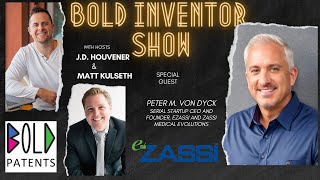
On this episode of the Bold Inventor Show, J.D. Houvener and Matt Kulseth talk with serial inventor and entrepreneur Peter von Dyck, whose career began with medical devices designed to help patients in intensive-care environments.
Peter shares how working directly with doctors helped him identify problems worth solving, how he validated his inventions with physicians and medical researchers, and how some of those inventions eventually made their way through FDA processes and into the marketplace.
He also talks about building companies around his inventions, protecting intellectual property, connecting inventors with potential corporate partners, and his current work involving healthcare data and AI.
For inventors and entrepreneurs, Peter’s story offers a practical look at what can happen when you combine a real-world problem, persistence, technical learning, validation, intellectual property, and a willingness to pursue the people who can help make an idea real.
The Bold Inventor Show
J.D. Houvener:
Alright, we’re live. Hi, I’m J.D. Houvener, and that’s Matt Kulseth. We’re live at the Bold Inventor Show, and you made it.
This is your weekly broadcast talking about intellectual property, patents, trademarks, copyrights, you name it. We’ve got a special guest today, so it should be a good show.
Matt, it’s good to see you again.
Matt:
Yeah, man. How’ve you been?
J.D. Houvener:
I’m pretty good. Got my jacket on.
Before we bring our guest on, we always like to remind everyone that this isn’t the place for confidential discussions. We’re not giving legal advice today. We’re sharing general legal information and having a conversation with our guest.
If you’re watching and have questions, feel free to ask them, but remember there’s no attorney-client privilege here.
A Quick Trademark Question
J.D. Houvener:
Let’s start with a trademark question to warm things up.
This question comes out of Spring Valley, New York:
“What class do I qualify in for my goods when I’m applying for trademark registration? I’m selling electrical goods.”
Matt:
It depends on what types of products you’re looking to sell.
For example, light bulbs would be in Class 11. Hand tools would be Class 9. Electrical sockets can also fall into Class 9.
J.D. Houvener:
Let’s say we’re talking about battery chargers or something like that.
Matt:
That’s probably going to be Class 9. Class 9 covers a lot of electrical products and miscellaneous electrical goods.
But you really need more specific product descriptions. The USPTO isn’t going to let you simply register “electrical goods.” You have to be much more specific about what you’re actually selling.
J.D. Houvener:
So the bottom line is that you really need to get specific.
Matt:
Exactly. It depends on the actual product. Without knowing more, I might guess Class 9, but I’d want to know exactly what the product is before saying that for sure.
J.D. Houvener:
And what happens if somebody files under the wrong class?
Matt:
If you have a somewhat friendly examining attorney, they might give you the benefit of the doubt and suggest the appropriate classification.
But if you have a whole list of different products in your application, you could potentially end up with multiple classes. The examiner might require different applications or ask you to revise the identification of goods.
You may have to accept their recommendations or go back and provide different descriptions.
It’s probably best to talk to an attorney and get it filed correctly the first time.
Can Two People Apply for the Same Patent?
J.D. Houvener:
We’ve also got some questions from our Reddit community.
Here’s one: Two people apply for the same patent.
There are a couple of ways to interpret that question.
Matt:
The first way I read it is that you have co-inventors who came up with the same invention. Can you both apply for it?
The easiest way is to have both people listed as inventors and use the same attorney so everybody is working together.
In many cases, if you’re going into business together, you may eventually want to assign your rights to a company. Each inventor can assign their rights to the business so the IP is governed and controlled by the entity.
J.D. Houvener:
And if two people independently invent the same thing and apply for the same invention?
Matt:
Yes, that can happen. The filing date becomes extremely important.
That’s why there’s urgency to get an application filed once you’ve developed the invention enough to actually file.
J.D. Houvener:
That’s an important point.
When I talk with inventors, I always want them to understand when they’ve gone from the idea or conception phase to an actual invention.
Does it have enough meat on the bone? Have you explained the invention in enough detail that someone in your industry could understand how to make and use it?
Once you’ve reached that point, you’re at a stage where you can potentially file.
We also recommend doing a patentability search before filing, especially if it’s something outside your industry or something you haven’t worked on day in and day out.
Then, after that search, you want to move toward filing.
Matt:
From a trademark standpoint, you can have co-owners of a trademark application as well.
We’re actually dealing with a situation like that right now. We represent a company that has a co-owned trademark with another individual, and nobody really knows how that happened because the original attorney is gone.
The other party doesn’t really know what’s going on either. It’s become a mess.
So, while you can have dual ownership of a trademark, I generally try to steer clear of it because it can create problems later.
Searching for Foreign Prior Art
J.D. Houvener:
Another question asks about translation services and foreign patents.
It raises an interesting question: when patent examiners search for prior art, are they looking around the world?
Matt:
Yes. When you’re applying for a U.S. patent, the question of novelty isn’t limited to whether something is new in the United States. Foreign prior art can matter too.
J.D. Houvener:
And if you’re dealing with a patent from another country, there can also be questions about whether those foreign rights affect you in the United States.
Matt:
Right. If you’re doing business in the U.S., you’re generally concerned about U.S. patent rights. A foreign company would need U.S. patent rights for a U.S. patent infringement issue.
J.D. Houvener:
It’s a great question, and we’ll have to dig into exactly how examiners handle translations of foreign-language prior art.
Alright, we’ve reached the end of our question bucket.
Let’s bring on our guest.
Meet Peter von Dyck
J.D. Houvener:
Peter, welcome to the show.
I want to make sure I get your last name right. Peter von Dyck?
We’re excited to have you here because you’re a serial inventor and CEO. You’ve done a lot of innovation in healthcare, particularly around critical-care environments and ostomy care.
Tell us about some of those innovations and where they came from.
Peter:
Sure.
Generally, the category where I got my start was medical devices. It’s a big category, and specifically within that I was focused on gastrointestinal products.
A lot of the care sites were unfortunately very tough environments, the intensive care unit, where people are seriously traumatized or injured, or recovering from major surgery.
They can’t eat, they can’t walk, and things are pretty serious.
I started out selling products in those environments around the world. You see these families and these patients who never expected to be there that day.
I became passionate about figuring out how I could help in a better way than just selling medical devices.
I’d talk with doctors, and they would tell me things like, “We can’t feed this patient this way.” Maybe the patient could aspirate, or they couldn’t swallow their own nutrition. It could go into their lungs and cause serious harm.
I started thinking, “That can be solved.”
I thought I could invent a new device that could get around some of those anatomical roadblocks or use a new approach to getting a catheter inside the body, even in somebody who was high-risk in an intensive-care environment.
So I started inventing in my early 20s.
I was reading a lot of medical books on the side, listening to doctors talk about what they were using, what they didn’t like, and what they wished they had.
I had these ideas and started figuring out ways to get deeper into the body while safely navigating anatomical roadblocks.
I invented around 10 or 15 different medical devices for feeding intensive-care patients, burn patients, and other critically ill patients.
Then I had to travel around the world teaching doctors how to use these new products because they involved new processes and techniques.
The intellectual property wasn’t just about the design. It was also about how the devices were applied and used to treat the body.
When Innovation Becomes Personal
Peter:
Then something much bigger happened in my life.
My older sister was in a terrible accident in her 20s and ended up in a coma for many years.
Her name was part of the inspiration for one of my companies.
That’s when I went from entrepreneurial innovation to purpose-driven innovation.
I thought, “Now she’s the one who needs these products. They’re going to save her.”
Seeing my own products being used on my sister for life support was difficult.
But it also kicked off a whole new generation of inventions and eventually led me into another area of innovation.
Matt:
Your story is fascinating.
You started working on medical devices in your 20s. Did you have to go to medical school? Did you have to be an MD?
Peter:
No.
I was lucky enough to get into a medical-device company when I was 18. It was a small company, maybe around 50 people, so I could see how all the different departments worked, R&D, manufacturing, quality assurance, and everything else.
Then I got out into the field early and started interacting with physicians.
They were trying to solve problems and complaining about products that weren’t working the way they wanted.
As a young person, you can’t help but be creative.
I didn’t have formal medical training, but I realized early that I needed to educate myself.
I’d go home from my community college classes at night and read medical books and study procedures.
I got completely absorbed in it.
Before I knew it, I became pretty fluent in the subject. I could sit down with physicians and discuss my designs with them.
Sometimes they would actually co-design with me.
Doctors and researchers at places including Duke University, MIT, and the University of Pennsylvania worked with me on inventions, and we brought a series of devices to market together and through FDA processes.
Learning Through Experience
J.D. Houvener:
Where did that drive to innovate come from?
Was the company encouraging it?
Peter:
I’d say two things.
First was what I jokingly call reverse nepotism.
The small company I worked for at age 18 was founded by my father.
I knew I had to prove myself. I was surrounded by MBAs and PhDs while I was taking classes at a community college at night.
I felt like I had to become really good at invention because otherwise people might think, “He’s just the boss’s son.”
That gave me a lot of drive.
Then, of course, when my sister was injured, that created another tremendous source of motivation.
J.D. Houvener:
So you were basically working with other people on most of these projects?
Peter:
It takes a village to get medical devices through a one-to-seven-year product-development timeline.
That’s one reason patents are so important. You need that time to protect the idea while you’re going through the development process.
I’d say I was inventing alone in most cases, but then I would have my inventions validated by top surgeons and doctors around the world.
Then engineers and other technical people would build them.
I’d start with what I jokingly call “chicken scratch” designs, and the engineers would take those designs to the CAD level.
How Peter Validated His Inventions
J.D. Houvener:
I’d love to spend some time on that validation process.
We have clients who have developed prototypes—or sometimes haven’t even been able to build a prototype because it’s too expensive or difficult.
We’re often trying to point them toward universities, research institutes, or potential funding sources.
How did you make those connections?
Peter:
It depended on what my specific device did.
I’d look at medical journals, especially peer-reviewed journals, and identify the doctors who were publishing in that specific area.
I’d find the top 10 or 15 doctors in the United States working in that particular field.
Then I’d go to the conferences where they were speaking.
I’d literally wait in line for them to come off the podium.
I’d have my pad with me, and I’d plead with them to give me two minutes.
Sometimes they’d look at what I was doing and say, “This could work.”
Then they’d start talking with me. They might endorse the concept, help refine it, and help with testing.
That could include synthetic testing, animal laboratory testing, cadaver testing, and eventually human testing.
J.D. Houvener:
Let me break that down.
You researched who cared the most about the problem you were trying to solve.
Then you physically found those people, presented your solution, and started working with them.
That’s an important lesson for inventors.
Peter:
I had a major fire in my belly because I knew people were suffering without these solutions.
My market was easier to understand because if you know your device can improve an important medical problem—even by 10%, 15%, or 20%—you’re motivated to keep going.
You want to get it to market.
Turning Inventions Into Businesses
J.D. Houvener:
You’re a serial inventor, so you’ve presumably had some financial wins along the way.
How did you make money from your inventions?
Peter:
With my first inventions, they were owned by my employer.
That was the case with the family-owned company and later with another company that acquired products I had invented.
They owned the IP, so I received very little directly from those inventions.
But I had also created some IP before those employments, and I had reserved those rights in writing.
After working with some larger companies, I went back and found distributors who had previously sold my products.
I asked them, “Would you back me if I formed my own company?”
A couple of them said yes.
They put up around half a million dollars over about a year and a half, and we moved forward together.
I left the larger company and started my own medical company, which I named after my sister.
From there, we were off and running.
I made sure the designs were validated by doctors. We pursued patent protection, built strong claims, and eventually worked with large companies that licensed the patents.
In some cases, those companies eventually acquired the businesses.
I did that a few times.
Building a Way to Connect Inventors With Companies
Peter:
One of the things I think you’ll find interesting is that one of my ventures isn’t really about patents.
I created it around 2002.
The idea was to allow inventors to disclose information about their IP without immediately revealing the confidential “secret sauce.”
A large pharmaceutical or medical-device company could look at the attributes and characteristics of an invention without necessarily requiring the inventor to disclose everything.
The system would then match the invention with companies based on those characteristics.
I built a matching engine using early AI and natural-language processing.
The goal was to create a safer way for inventors to disclose their ideas and potentially connect with business-development people at large companies.
J.D. Houvener:
Wait. How do you disclose an invention without giving away the secret sauce?
Peter:
You put your business-development hat on.
Think about how companies evaluate potential deals.
They look at things like:
What stage of development is it?
Is it a 510(k)? Is it a drug? Is it a PMA?
What level of risk is involved?
What testing has been completed?
Has it been tested in humans, animals, or synthetically?
Is there revenue?
Companies have a checklist of potentially hundreds of things they want to know.
If enough of those boxes are checked, they’ll take the invention inside the company, sign an NDA, and take a serious look at the opportunity.
The problem is that getting to that point can be a lot of work.
Doctors may know their inventions extremely well, but they don’t necessarily know how to turn that information into a business-development package.
So I built a software system that used a question-and-answer process to extract the information.
It could produce something like a pitch book or patent-landscape-style report.
It wasn’t giving away the claims or telling the company exactly what was novel.
Instead, it focused on characteristics.
Is there a life-saving aspect?
Is there a durability aspect?
Is there a manufacturing aspect?
Those are the kinds of characteristics companies can use to determine whether they want to take the next step.
The Challenge of Patents and Fast-Moving AI
J.D. Houvener:
Now you’re working in AI.
Peter:
Yes.
I’m working with healthcare data and AI in my newer venture.
We’re all trying to understand how quickly the technology is moving.
I’m considering some patents, but there’s also some hesitation because by the time a patent issues, you have to consider how much the technology might have changed.
J.D. Houvener:
Have you always worked with counsel, or have you been comfortable filing things yourself?
Peter:
I’ve never filed completely on my own.
I’ll do some provisional work, but I always use outside expertise.
You’ve got to get it right.
Person Analytics and Personalized Healthcare
J.D. Houvener:
Tell us about what you’re working on now.
Peter:
Currently, I’m involved with a company called Person Analytics in Jacksonville, Florida.
We’re working on a platform designed to bring together disparate healthcare data.
Think about your healthcare information from 10 years ago. You might have records with a pediatrician, a hospital, a nursing home, specialists, and other providers.
That information can exist in separate places and isn’t necessarily aligned.
AI can’t personalize medicine effectively if it doesn’t understand what happened to you five or ten years ago.
So we’ve built a system that can ingest different types of healthcare data and create a platform around personalized medicine and an individual’s healthcare journey.
J.D. Houvener:
That sounds somewhat like having all your medical records in one place, but with another layer of technical capability on top of it.
What are the biggest hurdles?
Peter:
Healthcare data creates some very serious challenges.
HIPAA is a major issue.
Privacy and cybersecurity are huge.
You can’t simply build the AI and analytics capability. You also have to build strong layers of cybersecurity and protection around the data.
Healthcare data is incredibly sensitive.
Imagine having someone’s DNA in a database and knowing what makes that person sick.
That’s the kind of information that has to be extremely well protected.
We’re dealing with a difficult balance.
People don’t want to share their data, but that data may need to be shared appropriately so we can develop more personalized medicine and better care.
Using Innovation to Speed Up Medical-Device Development
Matt:
Peter, one thing I really like about your story is the idea of using technology to connect company needs with potential solutions without necessarily disclosing the entire invention.
Peter:
Exactly.
If I know a doctor’s device has a particular type of balloon for anchoring, or it’s made from a certain material, I can use those attributes to match the inventor with the right manufacturer or prototype company.
The same thing can apply to venture capital.
If I know it’s a urological catheter and a particular venture firm invests in urological technologies, I can make those connections.
The goal was to create an automated recommendation engine that could match people faster and speed up innovation.
And there was a very personal reason behind that goal.
My sister was the reason I was racing to get one particular catheter product to market. It was designed to address infections she was experiencing.
I raced to get it through the FDA process.
Unfortunately, it was approved two months after it could have helped her.
I couldn’t experiment on her, of course. That wouldn’t have been appropriate.
Other patients eventually benefited from it during the testing process, but I got the product to market two months too late for my sister.
That’s when I realized I really needed to build a software-as-a-service company that could help speed up innovation in medical devices.
Understanding FDA Requirements
J.D. Houvener:
Let’s talk about the FDA.
For a first-time inventor working on a medical device, how do they figure out whether they need something like a 510(k)?
What resources would you recommend?
Peter:
One of the things my software did was help with that.
An inventor could answer around 20 questions about the invention, and the system would help determine the FDA classification.
It also looked at classifications for Europe and Japan.
That was 15 or 20 years ago, so I’m sure there are many more resources available today.
The FDA also makes resources available to inventors and can help them understand the regulatory process.
It’s especially complicated now because we’re seeing convergence between things like the Internet of Things and drug-device combinations.
The lines can become blurred.
You need to understand which classification applies to your particular technology because getting that wrong can create major problems later.
External Innovation
J.D. Houvener:
Let’s talk about the company and how an inventor could use the platform.
Peter:
Big companies often need to look outside their own walls for breakthroughs.
They’re usually pretty good at incremental innovation, but breakthrough or “blue sky” innovation can be more difficult.
They may also have internal manufacturing or design problems they can’t solve with their existing resources.
That’s where an open-innovation company can help.
The company can go out into the world and look for inventors who have potential solutions to those technical challenges.
Those inventors can submit potential solutions, and the companies can evaluate them and potentially work together on deals.
J.D. Houvener:
So it’s almost like finding problems that people don’t have answers to and then finding the problem solvers.
Peter:
Exactly.
I started building that open-innovation company around 2000, developed it through 2006, and eventually spun it out of the medical company I was working with at the time.
Final Thoughts From Peter
J.D. Houvener:
Peter, this has been incredible.
If someone watching is inspired by your story and wants to reach out, would you be willing to share your contact information?
Peter:
Sure.
J.D. Houvener:
Thank you for joining us on the Bold Inventor Show.
Peter:
Thank you, gentlemen. It’s been fun.
Matt:
Thanks, Peter. We really appreciate you coming on.
J.D. and Matt’s Takeaway
J.D. Houvener:
Wow. That was really cool.
I loved his tenacity and the fact that he went directly to the people who were going to use the products, and then found people who were willing to help finance the business.
He went to the doctors.
Matt:
Yeah.
J.D. Houvener:
That’s something inventors can learn from.
If you have a medical or healthcare innovation, or really any type of innovation, you need to find the people who understand the problem you’re trying to solve.
Peter didn’t just sit around waiting for someone to discover his invention.
He researched the field, found the doctors working in that area, went to conferences, approached them directly, and asked for their feedback.
That kind of persistence can be a huge part of the invention process.
A Quick Bold Bite: Protecting Your Business While Raising Money
The show wrapped up with a discussion about a consumer product featured on Shark Tank and the importance of thinking about intellectual property and business agreements when raising money.
Even when you’re bringing in an investor, it’s important to have a clear written agreement explaining who gets what, how the investment works, and what happens in future rounds of funding.
For inventors seeking investment, patent protection can also become part of the conversation. Some investors may be willing to help fund the legal work needed to protect an invention as the business moves toward commercialization.
The larger lesson is simple: don’t wait until the money arrives to start thinking about how your IP and business relationships are structured.
Final Takeaway for Inventors
Peter’s story is a great reminder that successful innovation isn’t always about having the perfect technical background on day one.
He started young, learned by immersing himself in medical literature, listened carefully to doctors, identified problems, developed solutions, sought validation, worked with engineers and researchers, and built businesses around his inventions.
For inventors, one of the biggest lessons is to get out of your own bubble.
Find the people who understand the problem.
Find the people who would actually use your solution.
Listen to them.
Test your assumptions.
And when the invention starts becoming real, think about intellectual property, development, funding, regulatory requirements, and commercialization as pieces of the same larger journey.
As always, the Bold Inventor Show is about helping inventors think bigger, protect their ideas, and move them toward the marketplace.
Go big. Go bold.