Last Modified on July 08, 2026

Can You Patent Game Mechanics or Game Design?
Hi everyone! Let’s tackle a question I hear often: Can you patent game mechanics or design?
I’m JD Houvener, a patent attorney and owner of Bold Patents. Over the past decade, I’ve helped inventors secure nearly 500 patents. If you’re working on a game, this is a topic you’ll want to understand.
Gaming is a massive industry—whether we’re talking about board games, card games, or digital apps. So, can you patent the mechanics or the design? The short answer: Yes, you can patent both. But there’s more to it. Let’s break it down.
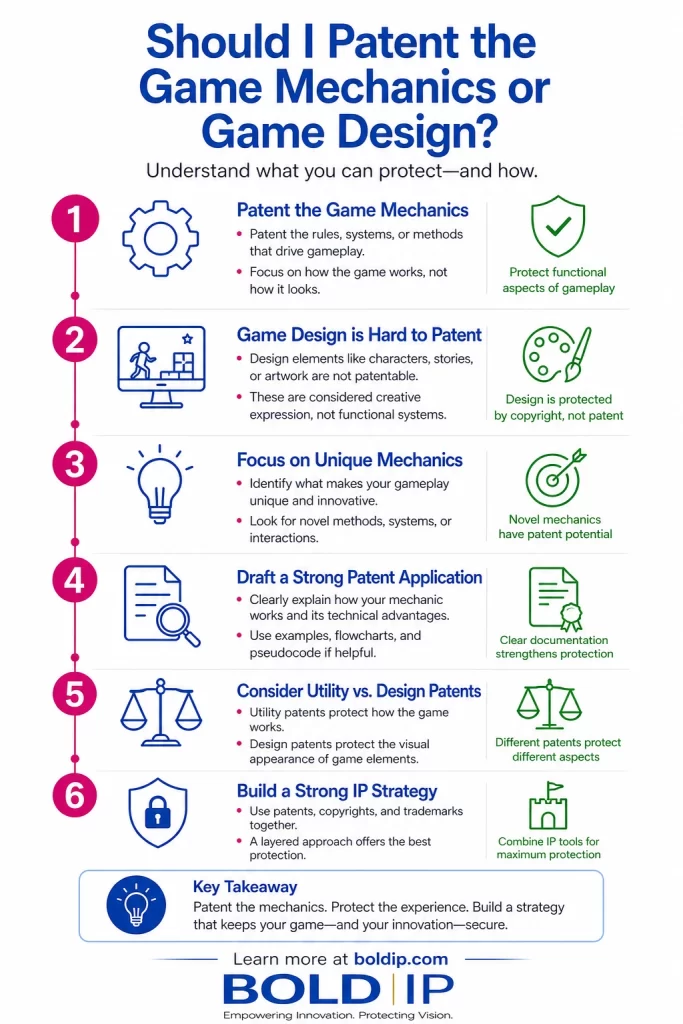
What Are Game Mechanics?
Game mechanics refer to the rules and processes behind how a game works. This applies to:
- Board games (think Monopoly or Sorry).
- Video games (think mobile apps or online multiplayer games).
Essentially, game mechanics cover how players interact with the game and each other. For example, it might involve:
- Steps players follow.
- Tokens, cards, or pieces involved.
- The way rules create flow and structure.
If your mechanics are unique and no one else has done something similar, they could be patentable. But before you dive into a patent application, ask yourself:
- Is it detectable?
You need to prove someone is using your mechanics without permission. If your rules or processes happen in the background (e.g., coded gameplay not visible to users), it’s hard to detect infringement. - Will it hold up?
If your mechanics are too broad or vague, enforcement becomes tricky. Be specific about what makes your game unique.
What About Game Design?
Game design covers the physical or graphical elements of a game. This includes:
- Shapes and layouts of game boards or pieces.
- Visual designs in digital games, like character models and interfaces.
Design patents can be easier to enforce because they focus on things you can see. For example:
- A uniquely shaped game piece.
- A distinct graphical interface in an app.
When someone copies these visual elements, it’s much easier to spot and prove infringement.
Which Should You Patent?
It depends on what’s most valuable in your game. If your mechanics are groundbreaking and easy to detect, go for a utility patent. If your design stands out and drives engagement, a design patent might be the better route.
Final Thoughts
Patenting a game is no small feat, but it can protect your hard work and give you a competitive edge. Want to learn more? Download our Inventor’s Kit, which includes a full PDF of my book, tips on patent searching, and guidance for drafting applications.
Good luck with your games, and remember: Go big. Go bold.