Last Modified on October 16, 2026

Bold Inventor Show: How One Everyday Frustration Inspired a Pet Product Business
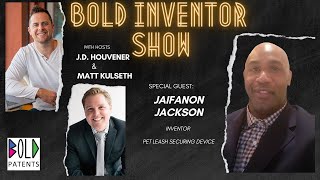
A frustrating dog walk led Jaifanon Jackson to create Tail and Paws, a pet-accessory company built around a simple idea: making it easier for people to secure their dogs while staying on the go. On this episode of the Bold Inventor Show, hosts J.D. Houvener and Matt Kulseth talk with Jaifanon about developing the Paws Leash, testing prototypes, navigating manufacturing challenges, and building a brand. His journey offers practical lessons for inventors and entrepreneurs about researching the market, listening to customers, protecting intellectual property, and turning an everyday problem into a business opportunity.
Welcome to the Bold Inventor Show
J.D.:
Hey, everybody! Welcome to the Bold Inventor Show. This is our last show of the season, and I’m excited to have a bold guest joining us.
I’m J.D. Houvener, founder of Bold Patents Law Firm, and I’m here with my trusty co-host, Matt Kulseth.
Matt:
Well, hi there! Good afternoon. It’s great to be here. I’ve actually seen you twice today already!
J.D.:
I know! It’s the Christmas season, so thanks for sharing Matt with our audience.
For anyone new to the show, we’re a patent law firm. We’re lawyers, but we’re not here to give legal advice or discuss confidential matters today. We’re keeping things high-level and having a fun interview. We can share general legal information, though, so please keep your questions hypothetical. Don’t post anything confidential. We don’t want you to get into trouble or accidentally start the clock on an important deadline.
For our podcast listeners, we also have a Bold Inventor Kit available. Check the description on Apple Podcasts, Spotify, or wherever you listen.
We have a great guest joining us today in the pet-product space. We’ll introduce him in just a moment.
Matt:
You got to talk with him before we went live. I haven’t met him yet.
J.D.:
That’s right! He’s got a really neat pet leash, so hang tight. If you’re watching live, feel free to ask questions and participate. We’ll also cover some questions that came in throughout the week.
Answering Questions From the Inventor Community
Can You Charge Royalties for a Logo?
J.D.:
It’s been a little quieter for us on the patent side. How about you, Matt?
Matt:
We’re still rocking on the trademark side!
J.D.:
Great. We have a few questions from Quora. Let’s start with one about logos.
The question is: If I make a logo for someone’s business and they put it on the clothes they sell, should I charge a one-time fee or take a percentage of every piece of clothing sold? If I can charge royalties, what percentage would be fair?
Matt:
I typically represent trademark owners, so my perspective is that the client should own the trademark they paid for.
This is more of a contract question than a trademark question. The parties can negotiate different arrangements, including royalties. In theory, you could ask for 10%, 5%, or 1% of every sale.
However, that arrangement could become difficult to manage. You’d have to monitor sales, track payments, and remain involved in the business relationship.
I’d consider the industry-standard approach: a work-made-for-hire agreement or another properly drafted agreement that clearly addresses ownership and transfers the appropriate rights to the client.
The client pays you to create the logo, and the agreement establishes who owns the resulting work. That’s generally cleaner than trying to collect a percentage of every product sold.
J.D.:
Very good, Matt! Perfect answer. One for one.
What Is a Patent Registration Service?
J.D.:
Here’s another question: What is a patent registration service, and why is it important?
I don’t have a great answer off the top of my head, so maybe you can help with this one, Matt.
Matt:
The phrase makes me think of spam. Some services send official-sounding notices offering to add your trademark to a private directory or registry for a fee.
They might have a fancy name, a professional-looking logo, and an impressive acronym. But that doesn’t necessarily mean the service has any legal significance.
A patent professional can help with patent research, preparing and filing applications, and communicating with the patent office. A patent attorney can also provide legal advice and opinions.
If someone advertises a vague “patent registration service,” I’d want to understand exactly what they’re offering before paying anything. The name alone doesn’t tell you whether the service is legitimate or useful.
J.D.:
That’s a good point. We see similar things on the trademark side, too, with organizations that have official-sounding names and logos.
It’s worth asking what you’re actually getting and whether the service provides meaningful legal protection.
My Patent Was Granted. How Do I Fund Manufacturing?
J.D.:
Here’s a great question: My patent has been granted. How do I get the money to manufacture my product?
I like to start with the basics. If you have savings, access to a line of credit, or the ability to obtain a bank loan, those may be the first options to explore.
From there, you could approach friends and family. If you’re passionate about your invention and can explain why it matters, you may find people willing to support you.
As you move toward larger-scale manufacturing, you may need more substantial funding. That could mean working with partners or approaching investors through seed funding or Series A financing.
Even when you’re raising money from friends and family, I recommend speaking with a business attorney. You want agreements that clearly establish ownership, responsibilities, and expectations.
Matt:
There are other options, too, such as inventor competitions. Getting your name out there can help people discover your product.
The question is really, “I’ve got the patent. Now what?”
Now you need to market the product and find the money to move forward. That means communicating what your invention does, who needs it, and why someone should invest in it.
J.D.:
Exactly. You need a business plan. How are you going to sell the product? How are you going to make money?
Getting a patent takes an investment of time and money. You need a plan for getting a return on that investment.
Do you want to start a company? That’s a significant undertaking, with substantial risks and potentially substantial rewards.
Or would you rather find a partner and license your invention? That’s a different business model, with different financial considerations.
Manufacturing decisions matter, too. If you’re starting with a small batch, keeping production local may make it easier to work closely with the people involved. Manufacturing overseas may offer lower costs, but you’ll need to evaluate the additional risks and logistics.
Matt:
You can also look for pitching events and forums where you can present your product. Practice explaining the invention, its benefits, and the problem it solves.
Once you’re making and selling the product, customer feedback can be incredibly useful. People will tell you what they like, what they don’t like, and what they think could be improved.
J.D.:
That’s right. You can use that feedback to make the product even better.
How Do I Patent an AI-Based Idea and Find Investors?
J.D.:
One more question before we bring on our guest: How do I file a patent for an AI-related idea, and where can I pitch it to investors as soon as possible?
First, you need to determine whether you’ve developed an actual invention. Can you describe it in enough detail that someone with the relevant technical knowledge could understand how to build or implement it?
You also need to consider whether the invention qualifies for patent protection. Novelty and non-obviousness are important parts of that analysis, and the details of the invention matter.
Researching existing technology and prior art is an important early step. AI is a huge field, so that research can be extensive.
Before publicly presenting your invention, consider your filing strategy. Depending on the circumstances, filing a patent application before disclosure may help protect your options. A provisional application may be appropriate in some cases, but it needs to describe the invention adequately, and it doesn’t automatically become a granted patent.
For an AI-related invention, the potentially inventive part might involve a new way of transferring data, processing information, presenting results, or collecting data. The important thing is to identify and describe the actual technical contribution rather than relying on the broad label of “AI.”
When preparing an application, you want enough detail to support the invention you’re seeking to protect. That groundwork can also help when preparing a later non-provisional application and defining the claims.
As for finding investors, look at startup organizations, university events, local business groups, and pitch competitions.
You can also come on the Bold Inventor Show and tell people about your journey!
Matt:
I was thinking about a couple of younger inventors we had on recently who won a national competition. That kind of exposure can help people discover an invention and potentially attract investment.
I also have an artist friend who grew his business by entering national art competitions. Those events helped build his brand, attract customers, and get his work in front of galleries.
Inventors might be able to use a similar strategy. Look for competitions relevant to your industry. The organization hosting the event may promote the participants, giving you exposure you might not otherwise get.
J.D.:
Trade shows are another option. If your product fits a particular industry, attend relevant trade shows, meet people, and build relationships.
Matt:
Absolutely. Let’s bring on our guest!
Meet Jaifanon Jackson, the Inventor Behind Tail and Paws
J.D.:
Jaifanon, welcome to the Bold Inventor Show!
Jaifanon:
Hey, everyone! How are you?
J.D.:
I’m doing great. Thanks for joining us. I see you’ve got your branding on your shirt and hat. Show us what you’ve got there!
Jaifanon:
Tail and Paws! Everything with a tail deserves paws.
My invention is a pet-securing device called the Paws Leash. This is the large version, designed for medium to large dogs.
It allows you to attach the leash to a pole or another suitable object with a simple three-step click. It’s designed for people who love being outdoors with their pets and are always on the go.
You can briefly secure your dog while you take care of something, then unclip the leash and keep moving.
J.D.:
For those listening, imagine a dog leash with a carabiner-style attachment. You can wrap it around a suitable pole or object and connect it so your dog can be secured temporarily.
It looks practical and easy to use.
Jaifanon:
It’s versatile, too. You can attach it to a belt clip or wrap it around your waist, depending on what you’re doing. It can be useful during everyday walks, travel, cookouts, and other outings.
We also have a smaller version for smaller dogs. It’s lightweight, not bulky, and comes in stylish colors.
Our products are available through our Tail and Paws website. We’re offering a holiday promotion on our first product line.
Matt:
That’s great. I adopted a dog this year, Cal, a black Goldendoodle. He’s getting bigger every day, and I could definitely use something like this when he wants to stop and greet everybody!
J.D.:
Matt has some experience in the pet-product industry, too. He previously owned a dog-gear business called Tiger Tail that manufactured American-made leashes and collars.
Matt:
Yes, and it looks like you’re aiming for the premium market.
Jaifanon:
Definitely. We offer a lifetime warranty because we believe in our product.
Matt:
I love that. The product looks high-quality, and I can tell you’ve put thought into it. There must have been a lot of prototyping.
Jaifanon:
Absolutely. A lot of prototyping!
The Everyday Problem That Inspired the Paws Leash
J.D.:
Jaifanon, tell us the backstory. What inspired you to develop this product?
Jaifanon:
It started with my neighbor’s Shih Tzu, Louis.
I would get home from work around 5:30 p.m., but my neighbor didn’t get home until around 7:30 p.m. I really liked Louis, so I started walking him until my neighbor returned.
At the time, I worked as an electrician during the day and ran a catering business as a second job. I would receive a lot of catering orders and phone calls around five o’clock.
That created a problem. I’d be holding the phone in one hand and the leash in the other. When a call came in, I’d try to talk, take notes, and walk Louis at the same time.
I’d be looking around for somewhere to sit down and write something. Louis would move one way, I’d move the other way, and I felt like I was all over the place.
Eventually, I got home and thought, “How can I fix this?”
That’s what inventors naturally do. We look at a problem and try to figure out a way to solve it.
I pulled out a notepad and drew what I thought I needed. At that point, I wasn’t necessarily thinking, “I’m going to invent a product.” I assumed something like it might already exist.
I just wanted a way to multitask: take phone calls, write things down, and walk Louis without struggling to manage everything at once.
So I started searching. I looked on Amazon, went to Walmart in person, visited pet stores like PetSmart, and searched other platforms that sold pet products.
I couldn’t find anything that met my needs.
That’s when I went to my mom and told her I thought I was going to try to invent something.
J.D.:
What did she say?
Jaifanon:
She told me that when she was younger, she’d tried to invent something herself. She wanted to create a toothbrush that dispensed toothpaste from the other end, which would be useful for camping.
I asked her what happened, and she said she never pursued it.
I told her, “You know what, Mom? I’m going to pursue this one.”
She encouraged me to go for it if I believed in it.
That was a big moment for me. I decided to move forward and educate myself about the product, the market, and what it would take to develop a business from start to finish.
I took a class that helped me understand the process. I also want to give a shout-out to Chris Bellingberg, who was a great inspiration and helped me along the way.
J.D.:
That’s an incredible story. You’re carrying on that inventive spirit from your mother, even though she never pursued her own idea.
Jaifanon:
Exactly. It’s a little multigenerational.
Once my mother saw how serious I was, she supported me financially. She sold our grandparents’ house and put the money in my hands so I could pursue the business.
J.D.:
Wow. That’s a major commitment. It shows how much she believed in you and your idea.
Learning the Business Before Building the Product
J.D.:
After you received that initial support, what did you do next?
Jaifanon:
The next step was contacting people who could help me understand what it would take to bring the product to market. I had an interview with someone who could help me assess the process, and then I needed to develop a budget.
Before that, I had spent time educating myself about three things: the product, the market, and the competition.
You need to understand what you’re building, who might buy it, and what else is already available. Once I had worked through those areas, I could move forward with prototypes.
Chris helped me learn how to use a 3D printer and develop prototypes. That was an important part of the process.
J.D.:
So you weren’t just making something and hoping it worked. You were learning, planning, and building toward a specific goal.
Jaifanon:
Exactly. And then came testing.
Testing isn’t something you should rush. It’s an expensive process, and you need to give it time. You also need a group of people you trust to help evaluate the product. Confidentiality matters, so you should consider appropriate agreements, including nondisclosure agreements, where needed.
I tested the product for a year with more than 20 dog owners. I developed about 20 prototypes and had people with small and large dogs try them.
I prepared a list of questions. How much would you pay for this? Do you like the way it looks? If you could change one thing, what would it be? How do you normally use your leash? What would make this product better?
I wanted useful feedback instead of simply asking people whether they liked my idea.
Matt:
That level of planning is impressive. A lot of inventors want to rush straight to the finish line, but you’ve taken the time to test the product and gather feedback.
Jaifanon:
I wanted to do it right. I also learned a lot from YouTube and other online resources.
Remember, I’m an electrician and a chef. I didn’t start out knowing how to develop a product or run this kind of business.
I had to educate myself. I listened to podcasts, watched videos, and learned from people who had experience in the areas I needed to understand.
My knowledge came from the internet and from being willing to learn.
For anyone out there thinking, “I can’t do this,” I’m telling you that you can. You have to take chances, keep learning, and move forward.
Don’t let self-inflicted wounds hold you back. Don’t talk yourself out of pursuing something before you’ve even given it a chance.
Educate yourself, get into the game, and keep moving.
When the Original Manufacturing Plan Didn’t Work
Matt:
Let’s talk about challenges. Was there anything that didn’t go the way you expected? Maybe a customer gave you feedback you didn’t want to hear, or something about the business didn’t work out.
Jaifanon:
Thankfully, the customers who’ve purchased the product have been very happy with it. They’ve appreciated the product and the lifetime warranty. If something happens to their leash, they can send it back, and I’ll get another one out to them.
But I did run into a manufacturing challenge.
I initially started making the product myself here in Raleigh, North Carolina. I really wanted to be able to put “Made in America” on it.
Unfortunately, manufacturing the product here was simply too expensive for a new business. I wanted to give customers a fair price, but the cost made that difficult.
I had to recognize that the original plan wasn’t going to work the way I’d hoped.
Fortunately, someone who was supplying parts from China introduced me to a manufacturer there. The manufacturer believed in me and appreciated the way I treated people. They went out of their way to help me, including providing lifetime tooling, which was a major benefit for my business.
The shipping arrangements were also great.
Making the product by hand hadn’t worked out because the costs were too high. The price would have needed to be more than $150, which wasn’t realistic for the product I wanted to offer.
By changing the manufacturing approach, I was able to reduce the price while continuing to offer the lifetime warranty.
J.D.:
That’s an important lesson for inventors. You may have a vision for how you want to manufacture something, but you still need to make the numbers work.
Jaifanon:
Exactly. You have to be willing to adjust your plan.
We’re also working on expanding the product line. People who see us at pop-up shows ask for more colors and smaller versions. They want stylish leashes that match their shoes, purses, and other accessories.
We’re listening to that feedback and working on new options.
Why Meeting Customers in Person Matters
J.D.:
You’ve mentioned pop-up events and trade shows. You’re also selling online and using social media. Which has been the most effective way to reach customers?
Jaifanon:
Honestly, in-person events have been the most impactful.
When people meet me, they can talk to me directly. I can demonstrate how the product works. They can hold it, feel it, and see how it functions.
You can post funny commercials and short videos on Instagram, Facebook, and TikTok, and I love those platforms. They help people discover your product.
But you also have to get out there.
Go to pet shows, trade shows, and events related to your industry. Whatever field you’re in, find the events where your potential customers gather and become part of that community.
When people meet you in person, they have a better understanding of what you’re selling. Even if they don’t buy immediately, they may visit your website later because they already know you and have seen the product in action.
That personal connection has been one of the best ways for me to build awareness.
Matt:
That’s consistent with what we were discussing earlier about inventor competitions. Sometimes, getting in front of people is what helps you move to the next stage.
J.D.:
Absolutely. Online marketing is valuable, but you shouldn’t overlook opportunities to demonstrate your invention in person.
Working With a Patent Attorney
J.D.:
Let’s talk about the patent process. You’ve been working with Benita Singh on your patent application. Tell us about that experience and what you’ve been doing to pursue protection internationally.
Jaifanon:
Benita has been great to work with.
One thing I really appreciated was that she was straightforward with me. She didn’t just tell me what I wanted to hear.
She told me that there were things she wasn’t sure we could accomplish. She was honest about the possibilities and the risks.
A lot of people might want to hear that everything will work out, but I didn’t want someone simply selling me a dream. I wanted someone who would give me an honest assessment.
That was what convinced me she was the right person to work with.
And she was able to get the work done faster than I expected. I remember being on vacation in Tampa when she called to tell me that everything had gone through. She congratulated me, and I couldn’t believe it.
It felt incredible to hear that we’d accomplished what we’d been working toward.
Another thing I appreciated was the education she provided throughout the process. She didn’t just handle the paperwork and move on. She explained what was happening, what the different steps meant, and what I needed to understand along the way.
She was there to answer questions and help me understand the process. That made a big difference.
J.D.:
That’s great to hear. A patent process involves a lot of details, and understanding what’s happening can help inventors make more informed decisions.
You also mentioned international patent protection. What’s happening there?
Jaifanon:
We’re looking at several countries because we want to expand the business internationally.
I recently sent an email about pursuing Australia because I met an influencer there who loves the product.
We’re also looking at Japan, China, Canada, Brazil, and other countries. We want to take the brand around the world.
J.D.:
That’s exciting. One important consideration for inventors is that patent protection is territorial. A U.S. patent doesn’t automatically give you patent rights in every other country.
Thinking about international protection early can help you evaluate where your markets might be and what steps make sense for your business.
It’s also important to coordinate your filing strategy and public disclosures with a qualified patent professional, because timing can affect your options.
You’ve reached an important milestone with your U.S. patent work, and now you’re evaluating where else protection might make business sense.
Building a Brand and Getting Ready for the Big Stage
J.D.:
Let’s talk about your plans for taking the product to market. What are you focusing on this year and into next year?
Jaifanon:
Live shows and trade shows are my biggest assets right now.
One major event I’m preparing for is the American Pet Products Association trade show, scheduled for March 26–28. My product is expected to be nominated for Product of the Year.
For anyone working in any industry, I recommend finding out what the biggest event in your field is. What’s the equivalent of the Super Bowl for your industry?
Find that event and work toward participating.
Matt:
That’s a great way to think about it. You want to be where the important conversations and opportunities in your industry are happening.
Jaifanon:
Exactly. We’re preparing commercials and interviews, and we’re arranging coverage around the event.
I want to provide content for online shoppers and people following us on social media. I’ll be sharing videos and livestreaming from events so people can see the product in action.
That’s my approach to marketing: show up, participate, and make sure people can see what we’re doing.
It’s not just about buying a commercial and repeatedly showing the same advertisement. You need to be visible and give people opportunities to connect with you and your product.
J.D.:
I love that you’ve got a plan. As Matt mentioned earlier, you’re thinking strategically about the next steps.
Inventors sometimes make progress by accident, but more often, it takes planning and persistence to accomplish a goal.
Jaifanon:
Thank you. That’s what I’m trying to do.
What’s Next for Tail and Paws?
J.D.:
Inventors tend to keep inventing. What else are you working on? You don’t have to reveal any secrets, but what can you tell us about what’s coming next?
Jaifanon:
We have the large Paws Leash and the small Paws Leash, and we’re working on a wider range of colors.
At events, people ask whether we have orange, pink, or other colors. We’re working on providing more options.
We’re also exploring ways to customize the leashes, including adding a dog’s name or a customer’s favorite sports team.
I recently met with the Carolina Hurricanes, and we’re working on something special. I can’t share all the details yet, but the goal is to explore opportunities that could extend to other NHL teams and potentially NFL teams, too.
We also have a retractable leash line in development. I can’t show that one just yet, but it’s something we’re working on.
J.D.:
That’s exciting. It sounds like you’re taking customer feedback and looking for ways to build on the original invention.
Jaifanon:
Absolutely. We’re listening to what people want and working toward new products that fit those needs.
Choosing a Name and Protecting the Brand
J.D.:
Matt is our trademark attorney, so let’s talk about branding for a moment.
You’ve got the Tail and Paws name and the logo. How did you decide on that branding, and how have you used it in your marketing?
Jaifanon:
It took some time because the product had a few different names in the beginning. We had to work through different ideas and make sure we weren’t choosing a name that was already being used for another product.
Eventually, I wanted something compact and easy to apply to the product.
I developed the logo with a circle representing the globe because I want the company to grow internationally. The design brings the elements together in a simple way.
The paw symbol is part of the branding, and the name connects with the idea that anything with a tail deserves paws. The bold lettering also represents the strength of the leash.
That was the thinking behind the design.
J.D.:
And you’ve taken steps to protect the branding, too?
Jaifanon:
Yes. Both the logo and the name have been trademarked.
Before I met J.D., I actually tried handling my trademark application myself. I learned what I could from YouTube and other online resources.
J.D.:
It’s great that you’ve been proactive about protecting your brand. I was just looking at one of the trademark applications, and it looks like the logo you showed us was registered on December 3.
Congratulations!
Jaifanon:
Thank you! I appreciate that.
Matt:
That’s a big milestone. It’s great to see the branding and the product coming together as you build the business.
Final Advice for Inventors: Don’t Let Fear Stop You
J.D.:
Jaifanon, you’ve shared a lot of great lessons today. Before we wrap up, I’d like to ask the question I ask all our guests.
For someone listening who is at the beginning of their invention journey, what advice would you give them?
Jaifanon:
I may have said this earlier, but I’ll say it again: no fear.
If there’s something you’re thinking about pursuing, you have to be prepared to go all in. Don’t be afraid to fail.
For everyone listening, never let the fear of failure stop you from trying.
Matt:
I love that advice. Listening to your story, it’s clear that you’ve committed yourself to this business. You’ve educated yourself, tested your product, adjusted your manufacturing strategy, and continued moving forward.
Entrepreneurship isn’t easy, but your story shows what can happen when you keep working toward something you believe in.
J.D.:
Exactly. If you see a little bit of yourself in Jaifanon’s story, maybe it’s time to take that next step.
You don’t need to know everything on day one. You need to be willing to learn, ask questions, and keep moving forward.
Jaifanon, thank you for sharing your story with us. We’d love to have you back so we can hear how things are going with the big trade show and the next stage of Tail and Paws.
Jaifanon:
Thank you! Hopefully, you’ll both be joining me on that private plane one day!
J.D.:
We’ll hold you to that!
For Matt, Jaifanon, and everyone here at Bold Patents, thank you for joining us on the Bold Inventor Show. We wish you a wonderful rest of the week, a Merry Christmas, and happy holidays.
Until next time, go big, go bold!