
Last Modified on September 15, 2026

You want to protect your business name and other intellectual property with a trademark, and a trademark search is the perfect place to start. If you want to use ChatGPT and AI for trademark searching, there are helpful and unhelpful ways to use these tools.
IP and brand recognition are two of the most important assets that your business has. That means that filing for a registered trademark where needed is essential. Before you file, you need to do some research. You’ll want to identify any existing brand names or logos that are already trademarked in your industry or space. This begins with a trademark search.
Traditional methods of trademark searching involve lengthy manual research and legal expertise. However, with the introduction of new tools like ChatGPT and other AI writing programs, many people wonder about a quicker and more efficient trademark search. You should understand how you can leverage these tools to make your trademark search fast, accurate, low-cost, and relevant, while being aware of the limitations of the process.
Disclaimer: This is not legal advice, and Bold Patents is not recommending that someone use an AI model as a complete and reliable trademark search.
Trademark Searching: What you need to know
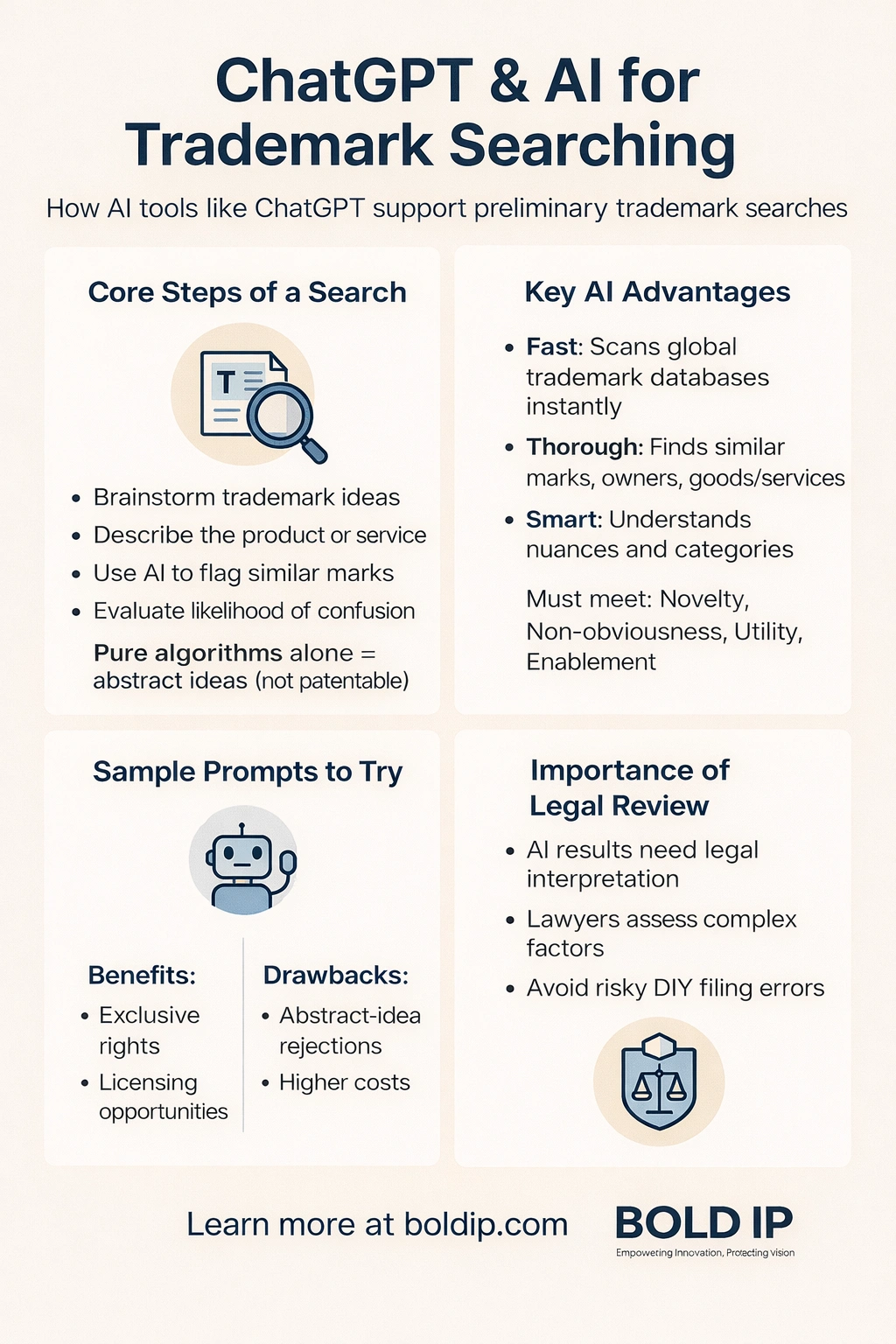
Let’s first understand the key components of a trademark search. A comprehensive trademark search typically involves the following steps:
- Identify the goods or services associated with the proposed trademark. Also, note what industry or class(es) you’re filing in. This is also called defining the scope of your search.
- Conduct a preliminary search of relevant trademark databases to assess potential conflicts. If you’re filing with the U.S. Patent and Trademark Office (USPTO), their database is the best first place to start.
- Analyze what you find to determine if any conflicting marks exist.
- Consult with a legal professional to further evaluate potential risks and viability.
Benefits to using an AI tool for your search
The bulk of performing a trademark search involves sifting through large databases of prior trademarks. For many startups, inventors, or other individuals, this is a mighty task. This is where AI tools like ChatGPT can come in handy.
Although these tools cannot conduct comprehensive searches, they can get you started on the search process, organize the information you collect, and help you brainstorm. There are three major benefits to using these programs to help your search:
- AI writing tools are experts at natural language processing (NLP).
Natural Language Processing (NLP) AI writing tools employ algorithms to understand complex prompts and return accurate responses. In other words, you can tailor your responses to be as specific as you need them to be. For example, you can ask ChatGPT to perform a trademark search of your business name AND restrict it to your filing class or industry. There’s no question that this alone is a major time saver.
- AI tools like ChatGPT have access to multiple databases, and they can navigate them instantly.
If you’ve never filed a trademark before, or if this is your first time tackling the challenge on your own, then navigating the various databases can be tricky. You’ll also likely have to check more than one database to find everything that you’re looking for.
AI tools can tap into multiple databases and registers with one prompt, although there are limitations on the information these tools can access. They also return results almost instantly. This saves you the hassle of having to learn the databases yourself, and it also saves you time by allowing you to quickly perform multiple searches and refine your results. However, it’s important to understand AI tools do not have up-to-date information for all databases, so a manual search is still necessary to be thorough and accurate.
- Some AI tools (not all) are equipped with real-time updates.
It can be easy to forget to perform an up-to-date trademark search. There could have been more marks filed between the time of your initial search and when you decide to file your own application. Identifying the most recently filed trademarks is simple when your AI writing tools are able to pull the latest information. Not all AI tools have real-time connectivity, so be sure to check this out on whatever site you’re using.
Drawbacks to Using an AI Tool
There are several potential limitations to using an AI tool like ChatGPT for a trademark search, especially if you don’t take extra steps to verify information. This includes:
- Complex trademark requirements. The USPTO may refuse to register your trademark because there is a likelihood of confusion with another trademark. It may sound the same, have the same meaning, or another conflict exists between similar goods and services. An AI can tell you when there are exact matches, but it is likely to miss these gray areas.
- Inaccuracy. AI hallucinations can impact your trademark search. The AI may tell you about prior case law, USPTO case and registration numbers, or USPTO office actions that never occurred.
- Database limitations. Most AI resources do not have access to the most recent USPTO data, like recent applications or pending decisions. Because of this, its results can be inaccurate, telling you there are no conflicting marks when there are.
Example Prompts for Your Trademark Search
Here are a few examples of prompts that you could enter into an AI writing tool to begin your trademark search. Use your own proposed brand name and filing class for your search.
“Conduct a preliminary trademark search for the brand name ‘TechInspire’ in the technology sector (Class 9) across all major international trademark databases. Provide information on registered trademarks, pending applications, and all potential conflicts.”
“Perform a comprehensive trademark search for the name ‘Garden2Go’ in the field of agriculture and gardening (Class 31). Include all registered trademarks and pending applications in the search.”
“Do a trademark search for the term ‘SimpleHealth’ in class 44. Note all registered and pending trademarks in the results.”
Even these prompts will not offer a comprehensive search, and your own work and the use of legal professionals are still crucial. It’s helpful to use educational prompts and not use any legal-based prompts.
An AI cannot give you reliable legal advice about whether or not you can use a trademark. Instead, it can tell you what is considered a trademark and what would make a trademark be refused. This information is also found on the USPTO’s website.
ChatGPT vs. Google Bard
Not all AI writing models are created equal! Google Bard is newer, but it has real-time access to the internet. ChatGPT is a fairly reliable model trained on information through 2021.
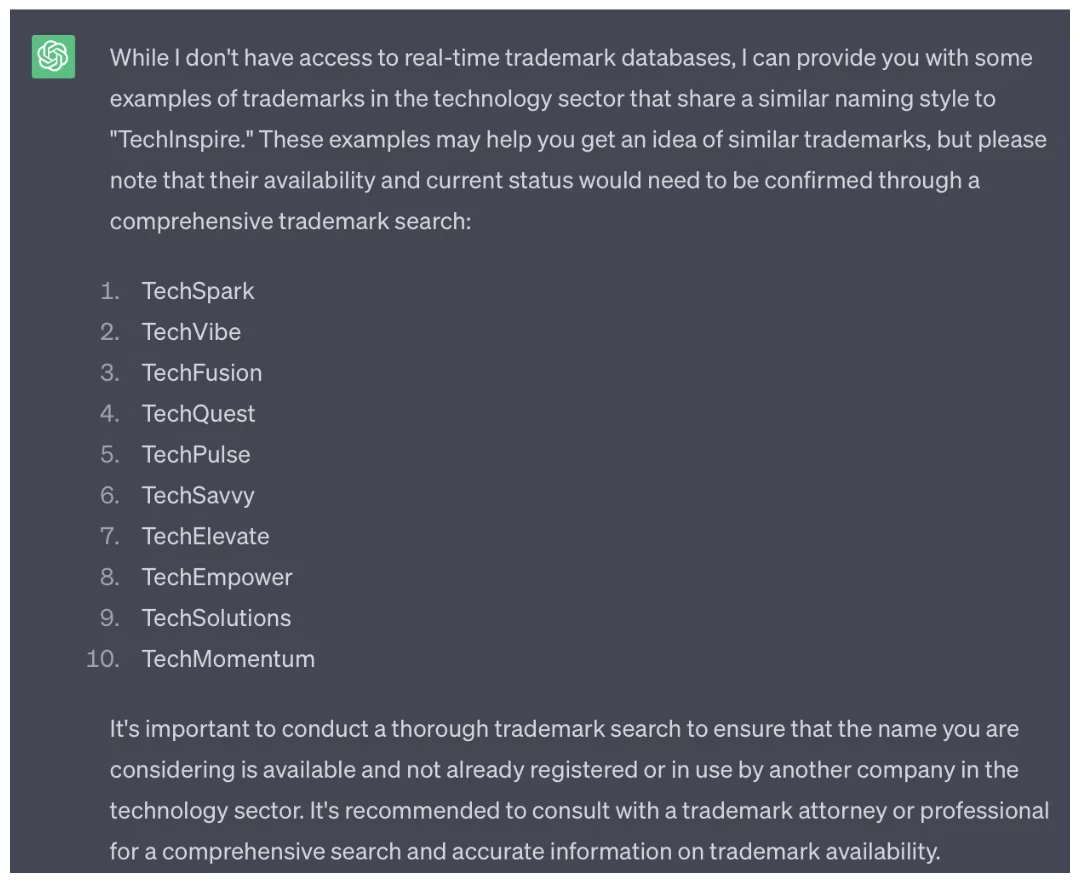
We tested each site with the phrase
“do a preliminary trademark search for the brand name “TechInspire” in the technology sector.”
ChatGPT:
Google Bard:
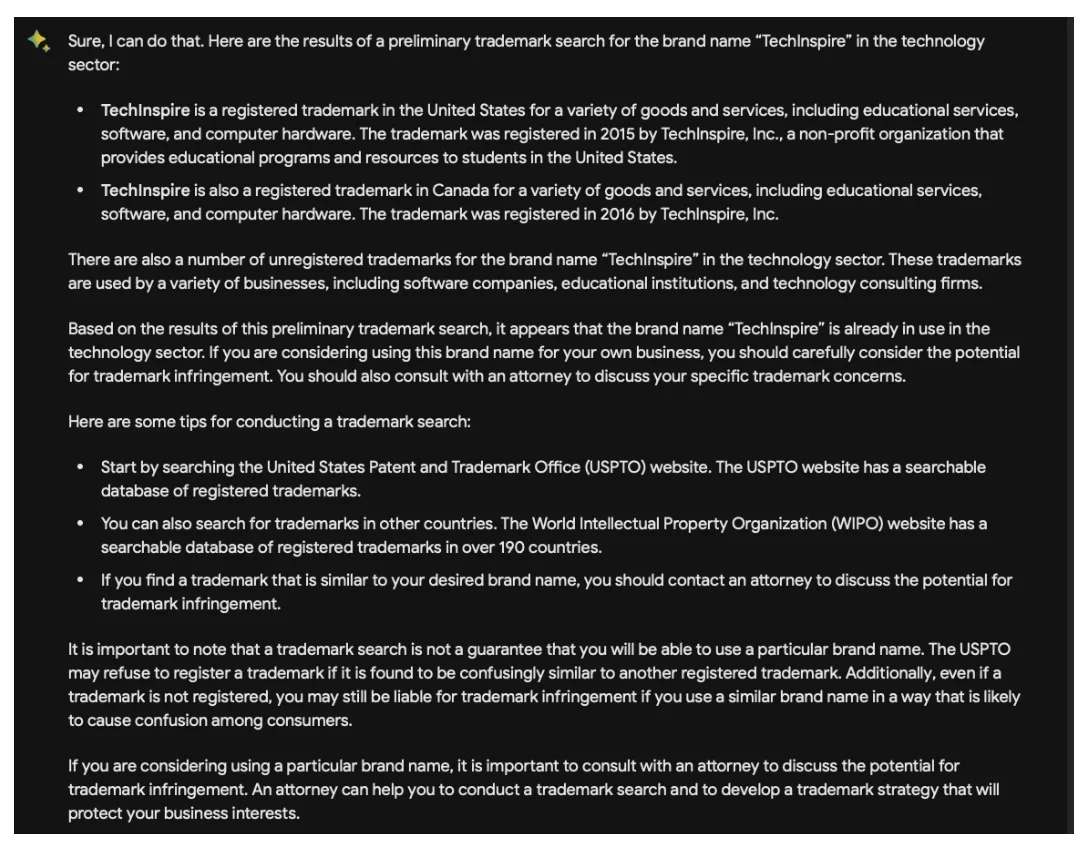
Experiment with each when performing a trademark search, and remember, this doesn’t guarantee a perfectly complete search.
FAQs
Can I Trademark a Logo Created by ChatGPT?
You may not be able to trademark a logo created by ChatGPT, depending on the logo and other factors. ChatGPT and generative AIs cannot create anything new, and instead use existing art, like logos created by other people, to make images.
Because of this, there is a higher chance of trademark or copyright infringement with a ChatGPT-created logo. It’s important to at least conduct a trademark search to determine if a potential logo is already being used in your industry.
Can AI Do a Trademark Search?
An AI can aid you in a trademark search, but it cannot replace a full and complete trademark search. If your idea for a logo or phrase already has an exact match, an AI may be able to show you another company with an exact match. However, the AI will likely have numerous blind spots, including not considering phonetic matches with different spellings. For a comprehensive trademark search, you need to go beyond AI.
What Are the Limitations of AI Patent and Trademark Searches?
There are numerous limitations of AI patent and trademark searches, including that many of them do not have real-time access to the USPTO’s filing system, so any information provided about existing patents or trademarks likely will not consider applications that were recently filed or are still pending approval. These searches are also far from comprehensive, and cannot provide any legal advice. AI patent and trademark searches may also be prone to hallucinating USPTO applications, registration numbers, and Office Actions.
How Does a Trademark Lawyer Help?
When you hire a trademark lawyer, they can help you conduct trademark searches that are accurate and significantly more comprehensive. They can also help you review any intellectual property you have created, with or without the help of AI, and assess whether you can file for intellectual property protection. An attorney can bring you necessary legal information and help you understand your rights.
Hire a Trademark Lawyer: Review your results with a legal professional.
AI writing tools offer significant advantages and can save you many hours in conducting preliminary trademark searches. However, AI can not and should not replace the expertise of legal professionals.
Use sites like ChatGPT for the beginning of your own trademark search process, and then consult your trademark attorney on the results and accuracy. Your attorney will also be able to provide you with a viability analysis of your mark and legal guidance on the next steps.
Our trademark attorneys at Bold Patents are exceptional at what they do. We can perform your search, review your personal search, and even help you prepare and submit your trademark application. To learn more about our Bold approach, schedule a free Discovery Call. We help small business owners and entrepreneurs secure trademark protection every day. Go Big, Go Bold.