Last Modified on October 06, 2026

Bold Inventor Show: Post-Registration Patent & Trademark Strategy, Ownership, Enforcement, and the Zugo Pet Case Study
Getting a patent or trademark registration is a major milestone, but it isn’t the end of the journey.
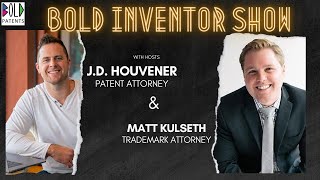
On this episode of the Bold Inventor Show, J.D. Houvener and co-host Matt Kulseth catch up after Matt’s travels, answer questions from inventors and entrepreneurs, and dive into what happens after you receive a patent or trademark registration.
They discuss trademark maintenance, Amazon Brand Registry, Customs enforcement, Section 15 filings, patent maintenance fees, licensing, infringement monitoring, ownership of employee inventions, and what inventors should consider once their intellectual property is officially protected.
The episode also features a Bold Bite discussion of a pet-safety product featured on Shark Tank, leading to an interesting lesson about expired patents, patent maintenance, and freedom-to-operate considerations.
Bold Inventor Show
J.D.: Hey, everybody! Welcome to the Bold Inventor Show. I’m J.D. Houvener, your host, with Matt Kulseth, my trusty co-host.
Matt: Hello! Welcome back to the States.
J.D.: Thanks, man. Yeah, it’s been a month. You’ve been out of town in Montana and then in Italy with your wife for your 15-year anniversary.
Matt: Yeah. It was a great trip.
J.D.: That’s awesome. It’s good to have you back.
Matt: How are you doing?
J.D.: I’m doing great. I’ve been good. I appreciate it.
Matt: I noticed J.D. is wearing a sports coat today.
J.D.: Yes, I am. I’m looking a little sharper. Feeling a little more sophisticated.
Matt: You put the jacket on.
J.D.: It’s a whole mental thing. It’s game time.
Matt: Bold Inventor Show shorts or pajamas?
J.D.: Oh, I’m definitely wearing shorts.
Matt: I figured.
J.D.: I can have this buttoned comfortably, but that’s okay. No one can tell. It’s chest up.
Matt: J.D. likes to party.
J.D.: Exactly. I’ve got the microphone here, too. I upgraded my mic. My coach has been working with me on video, so I’m trying to step things up.
Matt: I think if you have a business coach, you should ask your business coach if they have a business coach.
J.D.: Absolutely.
Matt: You want at least three layers of coaches.
J.D.: The grand coach, the coach, and the coach’s coach.
Catching Up, and Coaching Soccer
Matt: Speaking of coaching, I’ve been coaching soccer. I’m trying to harness the Ted Lasso in me.
J.D.: We need it.
Matt: We need it badly. This is recreational soccer, and we’re surrounded by some really amazing soccer players here in Central Washington.
J.D.: The recreational league is competitive.
Matt: It is. And as a new coach coming in, I basically got the leftovers.
J.D.: The land of misfit toys.
Matt: Exactly.
J.D.: The Island of Misfit Toys!
Matt: Yes! That’s the one.
J.D.: Rudolph the Red-Nosed Reindeer and the Island of Misfit Toys.
Matt: Somebody in the comments can help us out if we’re getting that wrong.
J.D.: Either way, good for you for coaching.
Matt: My daughter isn’t complaining, so I must be doing a decent enough job.
J.D.: The one time I coached my daughter’s soccer team did not go well.
Matt: Oh, yeah?
J.D.: Yeah. I was Dad, and she was constantly giving me that “You’re my dad, not my coach” look.
Matt: I understand.
J.D.: But you and I both love soccer. It’s a great sport for kids.
Matt: Absolutely.
J.D.: And you played pretty competitively.
Matt: Yeah, throughout my teens and early twenties.
J.D.: My experience was much more limited. I played one year in second grade. I think I’ve still got the trophy somewhere. It says “Bigfoot.” My job was defender. I just ran around and tried to stop people.
Today’s Topic: What Happens After You Get the Patent or Trademark?
J.D.: Today we’re talking about more than soccer and catching up about our travels. We’re talking patents and trademarks, which we always do here on the show.
And if you’re watching live, we encourage you to participate. We’re not going to discuss anything confidential, so please don’t share confidential information. But ask a hypothetical question. If you’re somewhere in the process, maybe you’ve started your own application, we’d love to help if we can.
Our main topic today is what happens after you get the patent or trademark registered.
There’s sort of a second life, a second half of the journey, that we want to talk about.
And then we’ve got a Bold Bite in store.
Matt: We’ve got a good one.
J.D.: We’re going to critique a Shark Tank pitch related to pets. It’s a pretty interesting product.
But first, let’s get into some questions.
Trademark Question: Can You Use “Barbie” in a Podcast Name?
J.D.: I’ve got five questions that have come in from our lovely Amira, who has been kind enough to scour the internet for questions.
Matt: We don’t always have live questions, but if we do, we’re happy to take them.
J.D.: The first one is a trademark question. Here’s the question:
“I’ve got a podcast called the Barbie Life 2.0 Podcast. Do you think Mattel will sue me for trademark infringement?”
Matt: Probably.
J.D.: Walk us through the analysis.
Matt: You’re probably not going to get a letter immediately, but let’s talk about the legal analysis.
Mattel owns Barbie, which is an incredibly famous trademark in the United States and abroad.
Famous trademarks receive a heightened level of protection. Companies with famous brands can have broader rights than an ordinary trademark owner.
Think about brands like Nike, Apple, or Facebook. These are famous brands that receive significant protection.
With something like Barbie, you have to think beyond just the traditional product category. Barbie is associated with dolls, movies, television shows, apparel, accessories, e-commerce, and more.
J.D.: And this isn’t just the name of a company. This is the name of a product that has become a massive brand.
Matt: Exactly.
The individual asking the question wants to call their podcast the “Barbie Life 2.0 Podcast.” Podcasts generally fall under Class 41, which is also where entertainment services such as shows and similar content can fall.
If I were examining a trademark application like that at the USPTO, I’d immediately ask: Is this actually affiliated with Barbie?
And if it isn’t, I’d ask whether the services are related closely enough to what Mattel is doing with the Barbie brand.
Because Barbie is famous, you also have to consider whether the brand deserves protection outside of its traditional product categories.
J.D.: And I would expect Mattel to have attorneys watching for this.
Matt: Absolutely. Large brands have significant resources devoted to trademark enforcement.
J.D.: That’s an important point. Big companies can have attorneys and watch services monitoring new trademark applications and even common-law uses of their brands.
Matt: Exactly. Trademark attorneys can subscribe to watch services that monitor new applications and other uses of a brand.
J.D.: So what about fair use? What if the podcast was actually reviewing or critiquing Barbie?
Matt: That could create a different legal analysis, but it doesn’t necessarily solve the trademark registration issue.
If you’re trying to register a name containing “Barbie,” you still have to deal with the existing rights and the likelihood of confusion.
The rest of the phrase, “Life 2.0 Podcast”, doesn’t give you a lot of room to get around the potential issue.
J.D.: Good answer. We knocked that one out of the park.
Can You Patent a Plant-Based Treatment?
J.D.: Let’s move over to patents.
The next question comes from someone in France who wants to know whether they can patent a simple mixture involving a plant and water that is intended to treat a specific condition.
Matt: I’m going to have to Google the word they used because I’m not familiar with it.
J.D.: Same here.
Matt: Let’s talk about the basic patent categories.
There are three types of patents in the United States: design patents, utility patents, and plant patents.
A design patent generally protects the ornamental appearance of an article.
A utility patent protects how an invention works or what it does.
And a plant patent can protect certain new and distinct plant varieties that meet the applicable requirements.
J.D.: So if this particular plant was created or modified through human intervention, there might potentially be a plant-patent issue.
Matt: Correct, assuming the applicable requirements are satisfied.
J.D.: But if you’re simply combining a plant with water to treat a condition, I immediately start thinking about obviousness.
Matt: Exactly.
If the combination is essentially something natural and predictable, you may have an obviousness problem.
But if there’s something else happening, something technically novel or unexpected, it could be worth investigating.
J.D.: And because this person is in France, we also have to remember that patent rights are territorial.
If you’re seeking protection in France, French law applies. If you’re seeking protection in the United States, U.S. patent law applies.
There are international mechanisms, such as the Patent Cooperation Treaty, that can help applicants pursue protection in multiple countries.
The key is to talk with an attorney who understands the countries where you actually want protection.
Trademark Costs: Do You Need Three Applications?
J.D.: Here’s another question.
Someone formed an LLC and wants to trademark two logos and the company name. They’re confused about classes, trademark IDs, logos, and the overall cost.
They’re asking whether three trademarks could potentially cost thousands of dollars.
Matt: There’s a lot to unpack there.
It sounds like they have three different things they want to protect: two logos and one word mark.
Those are generally three separate trademark applications.
Then each application can potentially cover multiple international classes, depending on the goods or services being offered.
J.D.: So three trademarks could potentially mean multiple classes for each one.
Matt: Correct.
And the government filing fees are only part of the cost. Attorney fees, if you hire an attorney, would be separate.
J.D.: If someone is bootstrapping a new company, should they necessarily file everything immediately?
Matt: Not necessarily.
Even when clients have plenty of money, we typically look at what they’re actually doing, where they’re making money, and which applications and classes provide the most meaningful protection.
If you have three different trademarks, it may make sense to focus on the most important ones and the most important classes first.
There may also be opportunities to consolidate certain branding elements into a single design mark rather than filing multiple separate applications.
The value of working with an experienced trademark attorney is having someone help you determine what’s actually important rather than simply filing everything possible.
Should an Employee Patent a Safety Device They Invented at Work?
J.D.: Here’s another interesting one from Reddit.
Someone created a safety device after discovering that their entire company was violating an OSHA regulation.
They created a simple 3D-printed device that fixes the problem. Their corporate headquarters loved it and wanted them to make a bunch of them for company locations.
The person asks, “Should I patent it?”
Matt: I know where you’re going with this.
J.D.: Employment situation.
Matt: Exactly.
J.D.: The first thing I’d do is look at the employment agreement.
If your employer hired you to develop devices or solutions like this, there’s a good chance your agreement requires you to assign inventions to the company.
Matt: That’s the first question: Who actually owns the invention?
J.D.: Exactly.
If you’re an independent contractor or otherwise aren’t bound by an invention-assignment agreement, you may have a different situation.
And if you’re going to spend your own money on patent research, filing fees, or an attorney, you want to know that you actually have the right to own the patent before making that investment.
Matt: There could also be a third option.
If it’s a smaller company, perhaps they would be willing to waive or modify their assignment rights and allow the inventor to own the invention.
J.D.: And then you have the second question: Is this something worth protecting?
If this is a problem your company has and you believe other companies have the same problem, that’s potentially significant.
If it’s a simple device that solves an important safety issue, it could potentially be valuable beyond your current employer.
Matt: And that’s a great example of the old saying: necessity is the mother of invention.
J.D.: Exactly. There was a problem. Someone needed to solve it. An invention resulted.
Can You Sell a T-Shirt With Jesus Wearing a Mets Hat?
J.D.: Here’s another question:
“Can I create and sell a T-shirt with an image of Jesus wearing a New York Mets cap?”
Matt: You can create whatever you want. You can sue anyone you want. But can you register whatever you want? That’s a different question.
J.D.: What about the Mets logo?
Matt: You’d want to be careful about copying the actual trademarked logo.
If you’re using something inspired by the logo but sufficiently different, the analysis could be different. But you don’t want to assume that changing one small element automatically makes something safe.
And there’s another important trademark issue here.
Just because you sell T-shirts doesn’t mean every image printed on a T-shirt functions as a trademark.
J.D.: Explain that.
Matt: To have trademark rights in apparel, the branding needs to function as a source identifier.
If you put a picture of Jesus wearing a Mets hat on the front of a shirt, that may simply be decorative artwork.
For trademark purposes, you generally want the consumer to look at the branding and recognize it as identifying the source of the goods.
That’s why trademark placement can matter. A brand may be placed in the upper-left chest area, on a label, or on a hangtag, for example.
J.D.: So the key distinction is decoration versus branding.
Matt: Exactly.
What About Profanity in a Trademark?
J.D.: We also got a question involving a coffee company with a somewhat provocative name that resembles the title of a song.
Matt: A song itself generally isn’t functioning as a trademark simply because it’s a song.
An album or series of works can potentially raise trademark issues, but copyright and trademark are different areas of intellectual property.
And if the proposed trademark is for coffee, we’d also look at the relevant goods and services.
J.D.: There’s also a misconception that profanity automatically prevents a trademark from being registered.
Matt: That’s no longer the rule.
The USPTO used to refuse certain marks as scandalous or immoral, but the law changed.
Today, profanity by itself doesn’t automatically mean you can’t register a trademark.
J.D.: Although the mark still has to function as a trademark.
Matt: Correct.
The Main Topic: What Happens After Your Trademark Is Registered?
J.D.: All right. Let’s transition to our main topic: post-registration.
We talk a lot about researching and applying for patents and trademarks. But let’s say the champagne cork has been popped.
You’ve got the trademark registration certificate.
Or you’ve got your patent fully granted.
What comes next?
Matt, let’s start with trademarks.
1. Put the ® Symbol on Your Brand
Matt: The first thing I’d do after receiving a trademark registration is update your branding to reflect the registration.
Use the registered trademark symbol, ®, with your registered mark.
Put it in the most visible places, your website, products, marketing materials, and advertising.
At a minimum, use the symbol the first time you display the brand in an important piece of marketing.
J.D.: That’s an easy step, but an important one.
2. Consider Amazon Brand Registry
Matt: If you’re selling products online, I’d also recommend looking into Amazon Brand Registry.
Once you have a trademark registration, you can potentially participate in Amazon’s Brand Registry program.
That can provide additional tools and benefits for managing your brand and product listings.
For an online seller, that’s something worth investigating after getting a registration.
3. Protect Your Brand at the Border
Matt: If counterfeit products are entering the country, trademark owners can also look at working with U.S. Customs and Border Protection.
If you know where products are coming from or when they’re expected to arrive, there are procedures that may allow Customs to identify and potentially detain suspected infringing goods.
J.D.: Would you recommend that a typical trademark attorney handle that?
Matt: I’d want someone who specifically understands Customs, imports, and exports.
J.D.: That’s an important distinction. If someone needs help with that, we can potentially connect them with the appropriate type of attorney.
4. Monitor Your Trademark
Matt: Another simple step is to put your trademark renewal dates on your calendar.
If you work with an attorney who has a docketing system, they’ll generally track those deadlines for you.
I’d also recommend creating a Google Alert for your brand.
J.D.: That’s a great low-cost way to monitor your brand.
Matt: Exactly.
Most clients aren’t going to want to pay an attorney every month to monitor every possible use of their trademark.
A Google Alert can at least give you some visibility when new uses of your brand appear online.
5. Don’t Forget Trademark Maintenance
Matt: Here’s the boring but important part.
Trademark rights depend on continued use in commerce.
If you stop using a trademark, you can potentially abandon it.
You also have specific statutory maintenance and renewal periods.
For example, between years five and six after registration, you need to file the appropriate maintenance declaration. Then there are additional renewal requirements around years nine and ten and every ten years after that.
J.D.: So getting the registration doesn’t mean you’re finished forever.
Matt: Exactly.
What Is a Section 15 Trademark Filing?
Matt: One additional filing that can be valuable is a Section 15 declaration of incontestability when the requirements are met.
Essentially, after the required period of continuous use and registration, a trademark owner may be able to obtain additional protection against certain challenges to the trademark.
J.D.: So it’s more of a defensive tool.
Matt: Exactly.
I think of a Section 15 filing more as a defensive measure than an offensive one.
It can prevent certain challenges based on grounds that otherwise might remain available.
J.D.: That’s a pretty valuable piece of protection.
Can Bold Patents Help Inventors Outside the United States?
J.D.: We also got a question from someone asking whether we accept inventors outside the United States.
Matt: We do have clients outside the U.S.
We handle U.S. federal patent and trademark law. So if you’re seeking a U.S. patent or U.S. trademark, we can potentially help even if you’re located outside the United States.
Your Brand Can Change Over Time
J.D.: Here’s something else I was thinking about.
You don’t file a trademark and then lock your branding in forever.
Businesses evolve.
Maybe you change your logo. Maybe your brand shifts. Maybe your marketing changes.
Matt: Absolutely.
I have clients that have been in business for 40 or 50 years. Some have legacy trademarks going back decades.
They might have old logos from the 1980s that are still registered because they’re still using them in some way.
But eventually, if you’re no longer using an old brand and you’ve moved to a new brand, it may make sense to let some of those old registrations go.
J.D.: So the trademark portfolio should evolve with the business.
Matt: Exactly.
What Happens After a Patent Is Granted?
J.D.: Let’s move to patents.
One of the biggest things to understand after a patent is granted is this:
There is no USPTO police.
Nobody at the USPTO is going to monitor the marketplace for you.
Matt: That’s a big one.
J.D.: Once your patent is granted, you’re responsible for watching the market and identifying potential infringement.
You have to look for products, systems, methods, or processes that may fall within the scope of your patent claims.
That’s something inventors need to build into their business strategy.
Licensing or Enforcing Your Patent
J.D.: Generally, I see inventors take one of two paths.
One is more passive: hold the rights and monetize them through licensing or an outright sale.
The other is more active: build the business yourself and potentially enforce the patent against infringers.
With licensing, there are many possible arrangements.
You could negotiate royalties, payments based on units sold, net proceeds, or a flat payment.
There’s a lot of room for negotiation.
Matt: And you’ve recently added Cliff Schlecht to the team.
J.D.: Yes. Cliff joined Bold Patents as a patent licensing attorney. That’s his specialty.
There are also opportunities involving universities and technology-transfer programs.
The post-grant period is when you can really start thinking about how the patent becomes an asset.
You Can Start Commercializing Before the Patent Grants
J.D.: Of course, you don’t necessarily have to wait until the patent grants before commercializing.
Sometimes we encourage inventors to get into the market while the application is pending, where appropriate.
The benefit is that you can hit the ground running.
And if someone knows about your pending patent and deliberately continues infringing after the patent grants, that history can potentially become important in an enforcement situation.
Matt: And you don’t necessarily need a giant war chest to enforce a valuable patent.
J.D.: Exactly.
We’ve seen situations where smaller companies have successfully asserted their intellectual property against much larger companies.
The system isn’t automatically limited to the biggest companies.
Patent Maintenance Fees: Don’t Let Your Patent Expire Early
J.D.: Here’s another very important post-grant issue: maintenance fees.
Utility patents require maintenance fees at specific intervals.
If you don’t pay the required fees on time, the patent can expire before the end of its normal patent term.
Matt: So getting the patent granted isn’t the end of the process.
J.D.: Right.
At Bold Patents, we have clients who want to manage those deadlines themselves, and we have clients who want us to handle the docketing and maintenance process.
The important thing is to make sure someone is responsible for those deadlines.
Bold Bite: What Happened to the Zugo Pet Patent?
J.D.: All right, Matt. Are you ready for a Bold Bite?
Matt: Let’s do it.
J.D.: Let’s switch over and take a look.
The Shark Tank Pitch
J.D.: The pitch we’re looking at features a pet-safety product designed to secure small pets in a vehicle.
The entrepreneurs were seeking $100,000 for 10% of the company.
They explained that pets can be injured when they’re sitting loose in a vehicle or traveling in an unsecured carrier.
Their product was designed to hold the pet securely in place during an accident.
Matt: The product looked interesting.
J.D.: They demonstrated crash testing and showed their product performing well.
They were selling the product for around $160, with a much lower manufacturing cost.
They had generated approximately $180,000 in sales after launching.
Matt: And they were selling through their own website using organic and word-of-mouth marketing.
J.D.: Right.
They also explained that the inventor had developed the product after having difficulty finding a safe way to travel with a dog that had hip and knee injuries.
Ultimately, the Sharks didn’t make a deal.
Matt: But the product itself was interesting.
The Patent Lesson Hidden in the Pitch
J.D.: Here’s where it gets interesting from an intellectual property perspective.
I looked up the patent.
The patent was granted in 2016, but it eventually expired early because the required maintenance fees weren’t paid.
Matt: So instead of potentially having patent protection extending much longer, the patent expired early.
J.D.: Exactly.
That’s a major lesson for inventors.
A patent can be valuable, but you have to maintain it.
If required maintenance fees aren’t paid, the patent can expire before the end of its normal term.
Matt: And that potentially creates an opportunity for other businesses.
J.D.: Potentially, yes, but with an important caveat.
An expired patent may be in the public domain, but you shouldn’t simply assume that means you are completely free to commercialize the product.
There can be circumstances in which an expired patent may be eligible for revival.
And there could also be other patents covering related technology.
Matt: So do your homework.
J.D.: Exactly.
If you’re thinking about entering a market because you’ve found an expired patent, you should consider doing proper diligence.
A freedom-to-operate analysis, often called an FTO, can help identify other patents that could potentially create infringement concerns.
An expired patent doesn’t automatically mean there are no other intellectual-property issues.
Inventors Don’t Have to Build the Business Alone
Matt: There was another interesting lesson in that Shark Tank pitch.
The inventor partnered with someone who could help bring the product to market.
J.D.: That’s an important point.
Inventors aren’t always the best business operators.
Sometimes the inventor needs a partner, investor, licensee, manufacturer, or business person to help commercialize the technology.
In that pitch, one person had invested a significant amount of money into the business.
Matt: That’s a lot of capital.
J.D.: It is.
And that’s one possible path after getting patent protection.
You don’t necessarily have to build the company yourself.
You can find someone who has the skills, capital, connections, or experience that you don’t have.
But when money and ownership are involved, get the arrangement in writing.
Matt: Absolutely.
J.D.: Anytime you’re bringing in an investor or joining forces with another person, make sure the ownership, responsibilities, economics, and intellectual-property rights are properly documented.
Final Takeaways: Your Patent or Trademark Is Not the Finish Line
J.D.: So, Matt, let’s wrap this up.
The biggest message today is that getting a patent or trademark registration isn’t the finish line.
It’s really the beginning of another phase.
Matt: For trademarks, keep using the mark, monitor it, maintain the registration, and take advantage of tools like Amazon Brand Registry if they’re relevant to your business.
J.D.: And for patents, understand your maintenance obligations, monitor the marketplace, and think about whether your strategy is licensing, selling, commercialization, or enforcement.
Matt: And always know who actually owns the intellectual property.
J.D.: That’s a big one.
Whether you’re an employee, contractor, founder, or business partner, ownership should be addressed before you invest significant money into intellectual property.
Matt: And don’t forget those maintenance deadlines.
J.D.: Absolutely.
What’s Coming Up on the Bold Inventor Show
J.D.: We’ve got some great guests coming up over the next few weeks.
We’ve got a company working on a new way to grow mushrooms with some really interesting science behind it.
And we’ve got another client working on racing technology.
Matt: Some pretty cool stuff coming up.
J.D.: Absolutely.
Thanks, everybody, for joining us. Have a wonderful rest of your day and rest of your week.
We’ll be back next week.
Matt: Have a good one, everybody.
J.D.: Go big. Go bold.