Last Modified on October 06, 2026

From Patent Protection to Product Development
What happens after you have a great invention idea? Getting a patent is only one piece of the puzzle. Turning that idea into a working prototype, refining the design, finding manufacturing solutions, and ultimately bringing the product to market can be an entirely different challenge.
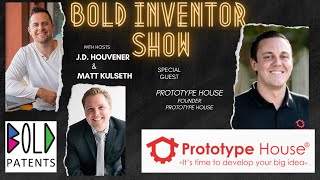
On this episode of the Bold Inventor Show, J.D. Houvener sits down with Matthew Bordy of Prototype House, a full-service product development firm that helps entrepreneurs and established companies turn concepts into real products. They discuss prototyping, confidentiality, intellectual property ownership, manufacturing, licensing, funding, and why persistence is often the difference between an idea that stays on paper and one that becomes a successful business.
The episode also features a Shark Tank example involving a young inventor, demonstrating that simple products can still become valuable businesses, and that you don’t have to be an adult to be an inventor.
Important: The discussion is for general legal and business information only and is not legal advice. Do not share confidential or proprietary information during the live broadcast.
Bold Inventor Show: The Conversation
Opening the Show
J.D.:
Hey everybody, welcome to the Bold Inventor Show. I’m your host, J.D. Houvener with Bold Patents Law Firm.
We’ve got a great show for you today. Usually my co-host Matt Kulseth is with me. He’s hopefully on the way and can give me some reprieve from some of the dead-air moments I might have.
This is a live broadcast across LinkedIn, YouTube, and Facebook, so we welcome everybody who’s joining us.
If you’re checking us out for the first time, click the subscribe button, give us some love, and feel free to comment as we go.
I’m an attorney, and Matt is also an attorney, but we’re not talking legal advice today. We’re talking general legal information.
Please don’t share anything confidential. This isn’t the place for that. If you have something super secret or something really valuable that you’d like to discuss, I’ll provide a link later so you can schedule a free discovery call with us.
We’ve also got a really cool guest I’m excited to bring on today: Matthew Bordy with Prototype House.
Before we bring him on, we’re going to go through some questions from our community.
Can You Patent Something Someone Else Already Created?
J.D.:
Let’s start with a patent question.
Is it possible to obtain a patent for something that’s already been done but hasn’t been patented yet?
Unfortunately, no.
To get a U.S. patent, an invention has to be novel. It has to be new, and you have to actually be the inventor.
If someone else came up with it, brought it to market, produced it, or showed it to you, you’re not the inventor just because you discovered it or were the first person in your family or community to see it.
There are really two important concepts here.
First, you have to be the inventor.
Second, the invention can’t already have been made available to the public in a way that defeats the requirements for patentability.
When a patent application is examined, the examiner is going to look at what’s already out there. That can include patents, but it can also include non-patent literature and other information available to people working in that particular field.
So, unfortunately, you can’t obtain a patent for something someone else already created simply because that person decided not to patent it.
How Do You Protect an Idea Without a Patent?
J.D.:
Here’s another question: How do you protect your idea without a patent? And what happens if you don’t patent your idea?
The truth is, you don’t necessarily need a patent to have a successful product.
You can go to market and be a first mover. You can test your product and see what happens. Or you can decide that investing in a patent isn’t worthwhile for your particular situation.
But you have to understand the tradeoff.
If you don’t have patent protection, competitors may see what you’re doing and enter the market without that same barrier.
There are some situations where keeping something as a trade secret can make sense.
For example, when I was at Boeing, there were manufacturing processes that could be kept as trade secrets. You could buy an airplane, take it apart, and look at the materials, but you still might not know exactly how those materials were manufactured or what process created the final characteristics.
That’s one situation where a trade secret can be valuable.
Another possibility is licensing.
You can transfer know-how and other valuable information contractually even when that information isn’t itself patented.
That happens sometimes with companies coming out of universities where there may be patent filings, but there is also valuable knowledge about exactly how to build or manufacture something.
What Does a Trademark Protect?
J.D.:
Let’s move over to a trademark question.
Someone asked: What does trademark mean in the context of a company’s name, and what is the purpose of registering a trademark?
One thing that’s important to understand is that your legal company name isn’t necessarily the same thing as your trademark.
Your company name is something you register with the state. Your trademark is about how you’re identifying your goods or services in the marketplace.
For example, our law firm is branded as Bold Patents, but the actual legal company name is Bold IP, PLLC. We’ve pursued protection for Bold Patents as a trademark because that’s how our customers interact with us.
Think about Google. The company behind Google has a different corporate name, but Google is the brand customers recognize.
Trademark protection is fundamentally about preventing consumer confusion and protecting the goodwill associated with a brand.
If you see a familiar brand on a product, you have expectations about where that product came from and what level of quality you can expect.
That’s the value of a strong trademark.
How Much Can You Change a Product and Avoid Patent Infringement?
J.D.:
Here’s a question from Reddit.
I’ve heard that in some cases, changing the length and thread of a screw or moving its position in a patented machine might make it immune to patent infringement. If material alterations constitute infringement, how can something as simple as changing a screw make a difference?
The basic question is: To what degree can I make or use something without infringing a patent?
When you’re concerned about patent infringement, you need to look at the patent claims.
The claims are at the end of the patent. They’re the numbered statements that define what the patent owner actually owns.
You generally want to start with the independent claims and break them down into their individual elements.
For example, a claim might describe a machine with several structural elements and then include additional limitations in dependent claims.
If you’re trying to avoid infringement, changing something that’s only in a dependent claim may not necessarily get you outside the scope of the independent claim.
The important question is whether your product contains all the elements required by the relevant claim.
This is where something called a freedom-to-operate analysis can become important.
You might tell a patent attorney, “I’m going to market with this product. I’m not necessarily trying to get a patent myself, but I’m worried about this existing patent. Am I infringing?”
An attorney can review the relevant patent claims and provide an opinion based on the specific circumstances.
That’s particularly important before you spend a lot of money manufacturing or launching a product.
Meet Matthew Bordy of Prototype House
J.D.:
Now we’re going to transition and bring on our guest.
Matthew Bordy, welcome to the show!
Matthew:
Thank you. Thank you for having me, and thanks for all of that great knowledge in the Q&A.
J.D.:
I appreciate it. It’s a little awkward by myself when Matt isn’t here, so I’m always wondering if the show is flowing.
But tell us about Prototype House.
Matthew:
We’re a full-service product development firm. We help entrepreneurs and inventors develop new consumer products, as well as working with large brands.
We help entrepreneurs go from an initial idea all the way through manufacturing.
That includes ideation, 3D CAD development, initial prototyping, electrical engineering, and building out different versions of prototypes.
We recently worked on a product where the entire unit was 3D printed, including the base and the clear top. We were able to test the PCB board and internal electronics inside the unit before moving forward.
We also help with packaging design, manufacturing, and fulfillment.
We work with manufacturing partners overseas as well as companies manufacturing here in the United States.
We also work with stock goods and a wide variety of consumer products.
We really like to think of ourselves as an entrepreneur-focused product development firm. We work with entrepreneurs from the grassroots level all the way up.
We’ve had clients who started with us eight years ago and still come back when they have a new concept.
I’m happy to answer questions from your clients as they go through the patent process. I really want to be a resource for people who have questions.
Where Is Prototype House Located?
J.D.:
I wanted to show off your new online presence. You’ve actually got a physical office now. What city and state are you in?
Matthew:
We’re in Fort Lauderdale, Florida.
We’ve just moved into a new facility right on State Road 7. It’s about 20,000 square feet.
We have a shop and a bunch of 3D printers. That’s where a lot of the magic happens.
The majority of our clients are out of state, so if you’re not in Florida, that’s okay. We work virtually with clients all over.
We’re even working with someone in Dubai right now.
We’ve also recently launched a new website and are starting to offer additional services, including software development.
J.D.:
I love it. I was looking at the website earlier, and one of the things that stood out was your video about launching a product.
It’s a great way for people to understand the process of working with a product development firm.
Should You Build a Prototype Before Filing a Patent?
J.D.:
This is something I talk about a lot.
Inventors often have this amazing idea that’s outside their day-to-day experience. They don’t know how to build it themselves.
They wonder, “Do I trust an engineer or a prototyping company? Or do I go to a patent attorney first?”
My usual advice is: Go make sure the thing works.
Build it. To some degree, prove the concept to yourself.
Of course, you also need to make sure you have appropriate confidentiality protections in place.
Do you have that conversation with inventors?
Matthew:
Absolutely. It happens all the time.
I always tell entrepreneurs not to share their new concept with just anybody. We have a standard non-disclosure agreement available through our website.
I also usually tell them to speak with an attorney first, so they can get legal advice and make sure they’re setting themselves up properly.
It may also be a good time to do a patent search.
We’ve had inventors who haven’t even done a basic Google search or searched online, and they discover that something similar is already out there.
As far as building a prototype, I encourage people to try to make an inexpensive prototype.
Go to Home Depot. Prove the concept.
There are also universities where you can find engineering students who may be interested in working on a project as part of their senior project.
That can help you build a prototype and give you something tangible to present to a company like Prototype House.
Then you can come to a firm like ours and we can help develop it further and get it ready for production.
If you’re very hands-off and want someone to handle the development, you can work with a product development firm from the beginning.
But I would caution people not to patent too early because the product can change significantly during development.
I’ve seen products change three or four times during prototyping, and those changes can affect the patent claims and the way the intellectual property strategy proceeds.
Sometimes the way we think something is going to work doesn’t translate into the final product.
Why Prototypes Change
J.D.:
That’s a great point.
Sometimes you can time things perfectly and file a patent application early enough that the design doesn’t change significantly.
But I think that’s rare.
What are some of the key things that tend to change when you start developing a product?
Matthew:
Take the medical centrifuge we discussed.
The goal was to separate plasma and blood as quickly as possible because the faster you can separate it, the faster you can use it with patients.
The initial thought might be, “Let’s just put a massive motor on it and make it spin really fast.”
But technically, that’s not necessarily what makes it work better.
We discovered that the angle of the separation system was important. We were able to get closer to 90 degrees, which allowed the separation to happen faster.
When we started, the first prototype was really just a bench test with electronic components, a motor, and spinning water.
As we continued developing the product, things got better.
Sometimes you even discover new features during development.
You might find something that works better than you originally imagined.
J.D.:
That’s one of the things I think inventors can be worried about.
They might think, “If I tell a product development company about my invention and they help improve it, are they going to own those new iterations?”
How does Prototype House handle that?
Matthew:
The client owns 100% of the intellectual property.
They’re able to list us or members of our team as inventors if appropriate, but the intellectual property belongs to the client.
J.D.:
Right.
And that’s an important distinction.
If someone actually contributes to the conception of an invention, they may need to be properly identified as an inventor. The rights can then be assigned to the appropriate individual or company.
The main point is that inventors shouldn’t be afraid of iteration.
If you hire a prototype company or engineer to help you develop your product, that doesn’t mean you should be afraid to improve the product.
You just need to make sure your agreements properly address intellectual property ownership.
Be Careful When Choosing a Product Development Company
Matthew:
I would caution people that there are companies out there that try to retain some of the ideas they’re working on.
So when you’re choosing someone, don’t jump in too quickly.
Get a couple of quotes. Talk to different companies. Make sure you have good communication and a good relationship with the people you’re going to work with.
It’s like dating. You don’t want to get into a relationship too quickly.
J.D.:
That’s really important.
I also recommend that inventors find a business attorney who understands the laws of their state and can become their general business attorney as the company grows.
Have that attorney review the contract.
Look for language where the product development company or another third party may be trying to take ownership of your intellectual property or obtain rights that you didn’t intend to give them.
Go in with your eyes wide open.
Don’t just sign up with the first designer or development company you talk to.
Can You Sell Your Patent to a Company Like Google?
J.D.:
We have another question from Muhammad.
The question is essentially: If you have a patent, can you sell your idea to a company like Google and potentially make millions, even if you don’t have programming experience?
The answer is yes, you can sell patents.
You can sell individual patents, but portfolios can often be more valuable.
A portfolio simply means you have more than one patent.
I encourage inventors to think about building a portfolio that covers a broad amount of technology.
One reason is that designs change over time.
You may have a patent granted on one version of your technology, but if competitors design around that patent by changing something, having additional pending applications can potentially give you more flexibility.
This is an advanced strategy, but larger companies sometimes build patent portfolios this way.
Can you sell a patent to a company as large as Google? Yes.
Is it likely to happen overnight? Probably not.
You need a strategy.
Matthew:
I would start by figuring out who you’re going to sell to.
One of my mentors said that if you’re starting a new online business or product company, figure out your top 20 potential customers and your top 20 competitors.
Break it down. Find the contact information.
Then start asking people to lunch and seeing if you can make something happen.
J.D.:
I love that.
Don’t just hope that the deal happens.
Make a list of your dream 20 and start working toward that exit if that’s your goal.
Licensing Requires Persistence
Matthew:
Another thing a lot of our clients ask about is licensing.
From my point of view, licensing is difficult because you need a very thick skin.
You might get 2,000 “no” responses before you get a “yes.”
It can be a big dream, but the clients I’ve seen successfully close licensing deals usually have more than just a concept.
They often have a product already selling.
J.D.:
That’s true.
We have an expert on our team who works on patent brokering. We can reach out on behalf of clients and try to make connections with decision-makers.
We can also put together a sales sheet that provides a compelling, simple breakdown of the opportunity.
If the product is already on the market, we can show what they’re selling, what the product looks like, and information about market penetration.
But if you’re pre-revenue, you’re right, it’s challenging.
You’re going to hear a lot of “no.”
The people I’ve seen succeed are hungry and persistent. They are dogged about making it happen.
I have one client who created a swim fin that helps swimmers move through the water more efficiently.
He goes directly to athletes. He finds collegiate athletes and trainers and asks them to try it.
He’s physically out there presenting the product.
It’s a matter of persistence.
Matthew:
Exactly.
It’s extremely rare for someone to sit back and have a licensing deal fall into their lap.
From Prototype to Sales: You Still Have to Market
Matthew:
Even when you get to production, you still have to market.
I had a client who is a federal agent by day. He wanted to develop a product to create another source of income.
The first year, he told me his sales weren’t very strong.
I asked what he was doing to promote it.
He had the product on Amazon and was doing a little advertising.
I suggested trade shows and taking the marketing side more seriously.
He got custom displays, attended a ton of shows, and eventually things started taking off.
A year later, he called me and said, “This is amazing.”
Now he’s developed three additional versions of the product.
That’s the reality of entrepreneurship.
You have peaks and troughs.
Sometimes you’ve invested in production, product development, and packaging, and then you’re waiting for sales.
You have to keep pushing.
J.D.:
That’s a really important lesson.
The people who succeed usually have that fire.
When you’re in the patent-pending stage, there’s often this moment of excitement.
You filed the application and you’re excited, but now what?
That’s the time to go to market.
Build the product.
Test it.
Get it into the hands of real customers, not just your mom, dad, or friends.
Get feedback from people who will actually use it and tell you what they think.
Why Provisional Patent Applications Can Be Useful During Development
J.D.:
This is one reason I advocate for provisional applications, especially for inventors who are new to the process.
If your provisional application is thoughtfully and broadly written, it can potentially encompass some of the iterations and versions you develop during that period.
Maybe a customer tells you, “This needs two attachments instead of one.”
You can incorporate that feedback.
The goal is for the eventual patent to match the product you’re actually selling.
Keep working on it, keep testing it, and hopefully you get there.
What If You Have a Billion-Dollar Idea but No Money to Patent It?
J.D.:
Here’s another question.
What if you have a multi-billion-dollar idea but don’t have the money to patent it?
What do you suggest?
Funding.
There’s a lot that goes into funding a patent and developing a product.
Some entrepreneurs use savings, credit cards, loans, or other traditional funding sources.
If you can’t fund it yourself, find a partner.
You might find a family member, business partner, or investor who’s willing to contribute capital.
If you bring other people into the business, work with a business attorney to make sure the arrangement is properly documented.
If you truly believe you’ve got a huge idea, you need to figure out how to convince someone else to believe in it, too.
Matthew:
I have a current client who I can’t name, but he’s an amazing guy.
We’ve been talking with him for almost three years.
He kept asking us if we would invest in his product in exchange for equity.
Prototype House doesn’t work that way, but I encouraged him to think about how he could raise the money.
He created a PowerPoint presentation and took his NDA with him.
Then he went directly to people in the industry his product was going into.
He set up meetings every week for six months.
Five weeks ago, he became fully funded.
He found one person who said, “I believe in you. Let’s do this.”
Then we went over our quote, the deliverables, the strategy, and how everything would work.
He got funded.
There are people out there who have money and may believe in your idea, especially if they’re already involved in the industry you’re trying to enter.
It’s definitely possible.
Again, it comes back to resilience.
He believed in the idea and never gave up.
J.D.:
I love that story.
You weren’t just asking someone for money.
You could say, “I’ve spoken with an attorney. I’ve spoken with Prototype House. These are the fees. These are the next steps. This is how much money I need.”
You’ve thought through the plan.
You’re not blindly asking someone to fund an idea.
You’re asking them to help execute a plan.
Shark Tank Spotlight: A 10-Year-Old Inventor
J.D.:
Now we’re going to move into our Bold Bite from Shark Tank.
Today’s example is Cassidy, a young inventor who appeared on Shark Tank with her baby feeding product.
She was only 10 years old.
Cassidy developed a product designed to make feeding easier and safer for babies. She was seeking $50,000 in exchange for 50% of her company.
The product had already generated sales, and she had developed the product herself.
One of the most impressive things about the pitch was her confidence and understanding of her business.
Matthew:
Ten years old!
J.D.:
Exactly.
She had her act together.
And there’s an important patent lesson here.
You do not have to be an adult to be listed as an inventor on a patent.
Cassidy was named as an inventor alongside her mother.
The patent was a design patent, which is focused on the ornamental design and three-dimensional appearance of the product.
A design patent is different from a utility patent. A design patent generally protects the ornamental design rather than the underlying function or mechanics.
Matthew:
I thought the manufacturing part was interesting, too.
J.D.:
Absolutely.
The product went through manufacturing changes, including changes involving the firmness of the silicone.
Matthew:
Right. We use different durometers of silicone.
Durometer is essentially a measurement of the firmness of the silicone.
A higher durometer means a firmer material, while a lower durometer means a softer and more flexible material.
J.D.:
And the story gets even better.
Cassidy eventually made a deal with Lori Greiner.
The company later licensed the patent to Munchkin, and the products became available through major retailers.
It’s a great example of how a relatively simple product can become a significant business.
Simple Products Can Still Have Complex Manufacturing Challenges
J.D.:
Let’s talk about simple products.
Is there ever a situation where a product looks extremely simple, maybe just one part with nothing moving, but manufacturing challenges make it more expensive or complicated than expected?
Matthew:
Absolutely.
There are a lot of variables.
For example, consider the thickness of plastic.
Someone may want a thicker, harder, denser plastic part, but depending on how it’s designed, you could run into sink marks during molding.
Sometimes you have to make part of the product hollow or change the design so it can actually be manufactured properly.
So even with a simple product, there can be design changes required to make manufacturing work.
J.D.:
What about tooling?
People always hear that tooling is extremely expensive.
Is that true in every case?
Matthew:
Not in every case.
It depends on what you’re making and where you’re manufacturing.
There are different options, including heat pressing and injection molding, as well as different molding processes for materials such as silicone.
But if you’re going into certain types of molding, yes, you can have a significant investment in manufacturing tooling.
There are also products that can be started with relatively minimal investment, such as certain cut-and-sew products.
The manufacturing process makes a big difference.
What’s Next for Product Development?
J.D.:
You work with everything from simple products to medical devices and electronics.
How much of what you see would you consider relatively simple?
Matthew:
Maybe around 20% are simple products, and then the complexity increases from there.
We work on medical devices, electronic products, IoT products, and more.
A lot of products are now connected to software.
For example, you might have a product where you want to monitor temperature and see the information on your phone.
Everything increasingly ties into software.
And right now, everybody is talking about AI.
But in 10 years, I think people are going to be talking a lot more about robots.
AI is advancing quickly, but robots are going to be another major phase.
We’re actually starting to build out more capabilities around robotics.
J.D.:
I love that.
If any of our clients want to build a robot, we’ll send them your way.
How to Connect With Prototype House
J.D.:
Matthew, if someone wants to get in touch with you, what’s the best way?
Matthew:
They can email me directly.
I’m happy for people to reach out. They can also text me. I’m very accessible.
We also have a general inbox, but I’m happy for people to contact me directly.
J.D.:
Perfect.
Matthew Bordy with Prototype House.
Thanks for joining us today and helping us dig into product development, manufacturing, prototyping, licensing, and everything in between.
Final Thoughts for Inventors
J.D.:
I think today’s conversation really brings together two sides of the invention process.
On one side, you’ve got intellectual property protection.
On the other, you’ve got product development.
Getting a patent is not the end of the journey.
You still have to develop the product, test it, manufacture it, market it, sell it, and build a business around it.
And as Matthew emphasized today, persistence matters.
You may hear a lot of “no” before you hear a “yes.”
You may go through multiple prototypes before finding the version that works.
You may have to raise funding, find manufacturing partners, attend trade shows, talk to customers, and keep refining your product.
That’s part of the journey.
So if you’ve got an invention, don’t just dream about it.
Start figuring out what the next step is.
Thanks for tuning in to the Bold Inventor Show.
Matthew, thanks for being a wonderful guest.
Matthew:
Thank you so much for having me. I’m happy to answer questions and help however I can.
J.D.:
Have a wonderful week.
Go big. Go bold.