
Last Modified on August 17, 2026

If you work in the dental industry, chances are you have—or know someone who has—an idea for a dental device. However, getting your product on the market can be a daunting prospect. After years spent tinkering on and perfecting it, you know you’ll need to patent your dental product. But where do you start?
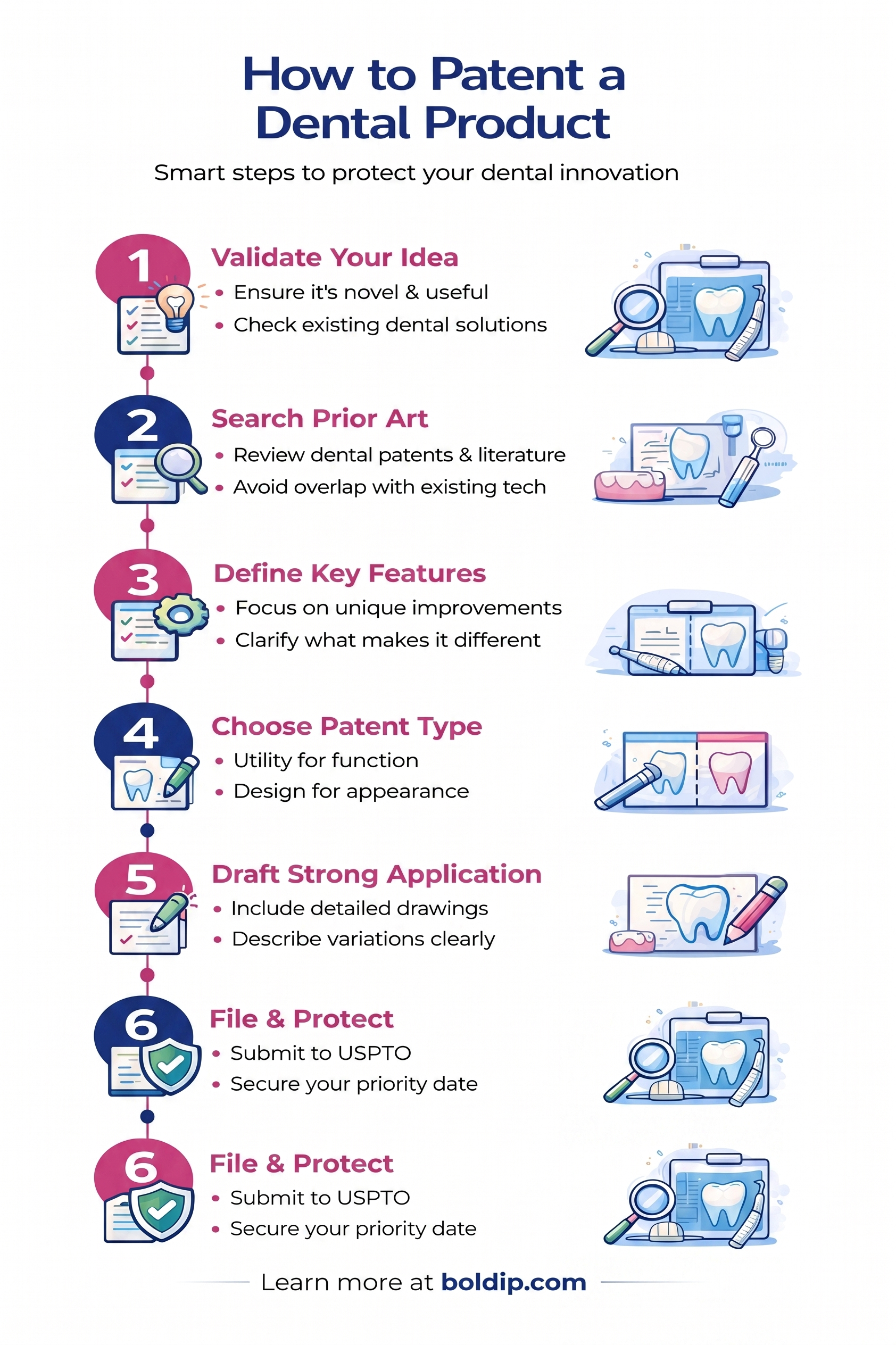
How to Patent a Dental Product
Obtaining any patent for an invention is a complex process, and this is particularly true for medical devices. When you patent a dental product, you’ll need to provide detailed documentation about every aspect of your invention—and that’s not all. As you follow these steps, we highly recommend working with a qualified patent attorney to ensure your patent is approved successfully.
- Research: Performing a comprehensive patent search before you file your application is essential. To avoid a rejection, you’ll need to understand what’s already available on the market. Does your product serve an unfulfilled need? Is it specific, credible, and substantial?
- Prove commercial viability: Understand what problem your invention solves. How great is the need? Put the findings in writing so that you can prove your idea can generate revenue and that it provides a purpose.
- Submit a provisional patent application: Consider this an extension that helps protect your idea from being copied during the formal filing process, which could take up to a year.
- Submit a detail-oriented, thoroughly reviewed patent application: There are many components to the application. Be sure there are no typos, grammatical errors and that you have a detailed explanation of what it is, how it works, and how and when it will go to market.
Because dental products are medical devices, you’ll need to be very careful—and accurate—about how you document yours.
Choosing a Patent
There are three main kinds of patents: design, utility, and plant. If you’re planning to patent a dental product, you’ll most likely need a utility patent. With a utility patent, you stop others from making, using, selling, and importing your invention, allowing you to create an exclusive revenue stream. A utility patent lasts for 20 years from the date that the patent application is filed.
However, it’s worth noting that in some cases, a design patent can also be a helpful tool. If your invention needs to look a certain way to serve its purpose—like, for example, a specially shaped toothbrush for people with braces—you may be able to use a design patent to gain some limited protection. In that case, you would get 15 years of protection. Although this usually costs less than a utility patent, it only covers how your device looks, so you wouldn’t gain the comprehensive protection offered by a utility patent.
For example, this patent for a new type of vibrating bite plate covers how the bite plate itself works, so a design patent wouldn’t provide the necessary protection. On the other hand, this patent for a restorative dental device relies mainly on appearance to serve its purpose, so it would be a good candidate for a design patent.
Dental patents are complex; to make sure your intellectual property is protected, you should work with an expert attorney with a wide range of experience. At Bold Patents, we regularly work with inventors of medical devices, and we look forward to guiding you through patenting your dental product. Contact us today for a free Discovery Call.