Last Modified on November 27, 2026

When the USPTO sends an Office Action, your patent application isn’t necessarily in trouble beyond repair. But ignoring that notice could cost you valuable intellectual property rights.
In this episode of the Bold Inventor Show, J.D. Houvener, founder of Bold Patents, and co-host Matt Kulseth break down what happens after you file a patent or trademark application. They explain the difference between rejections and objections, how to respond to USPTO Office Actions, and why even a final rejection doesn’t necessarily mean the end of the road.
The hosts also examine GeoOrbital, an innovative electric bicycle wheel featured on Shark Tank. Although the company secured trademark protection for its brand, its patent application was ultimately abandoned after an Office Action went unanswered.
For inventors, entrepreneurs, and business owners, this episode offers an important reminder: protecting an invention takes more than filing an application. You also need to understand what happens next.
Bold Inventor Show: Understanding Patent and Trademark Office Actions
J.D.: Afternoon, everybody! Welcome to the Bold Inventor Show. I’m J.D. Houvener, owner and founder of Bold Patents Law Firm, and we’ve got my co-host, Matt Kulseth.
Matt: Good morning, good afternoon! We’ve got an action-packed show for you today. Maybe you’re facing an Office Action. Have you filed your own application and received the wrath of a USPTO examiner? Now might be the time to seek counsel.
We’re broadcasting live on YouTube, LinkedIn, and Facebook. We’ll welcome live questions as they come in on any subject, although today’s main topic is Office Actions.
J.D.: And objections, right? We’re going to talk about the difference between rejections and objections, too.
Before we get started, a quick reminder: please don’t share confidential details about your invention in the live chat. Instead, schedule a conversation with us or speak with one of our advisors.
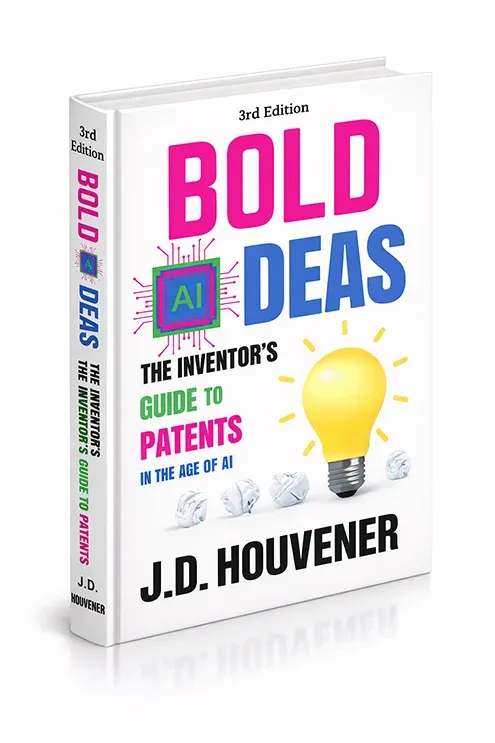
You can schedule a free 20-minute screening session with Dallas Richardson, one of our senior business advisors. We’ll also provide you with a free PDF copy of our inventor’s guide, Bold Ideas: The Inventor’s Guide to Patents. If you’d like a physical copy, send us an email. I’ll even sign it for you!
All right, let’s jump into today’s topic.
What Happens After You File a Patent Application?
J.D.: I’m going to walk everyone through a simple chart showing what can happen, and what often does happen, at the patent office.
Let’s start at the beginning.
You file your non-provisional patent application. Many inventors start by filing their own provisional application, which can happen up to a year before the formal application.
Once you file the non-provisional application, the examination process begins.
You’ll usually receive an electronic filing acknowledgment shortly after submitting the application. Then, approximately one to two months later, the USPTO sends an official filing receipt confirming the information you submitted.
Sometimes, there are minor formality issues. Maybe you submitted a document incorrectly or forgot to pay a required fee. These things can come up along the way.
Another possibility is a restriction requirement.
This is when the examiner essentially says, “Hold on. You’ve included more than one invention in this application. You need to choose which one you want to move forward with.”
You may have to elect one invention or species while reserving the others for potential future applications.
When Does a Patent Application Become Public?
J.D.: Another important thing inventors should understand is publication.
Generally, patent applications are published 18 months after their earliest applicable filing date.
For example, if you file a provisional application on January 1, 2020, and then file your non-provisional application one year later, your application may be published approximately six months after that non-provisional filing.
At that point, the application becomes publicly available.
Not everyone is reading the patent gazette every day, but you should understand that your invention may become part of the public record.
There is a process called a non-publication request. Under certain conditions, you can request that your application not be published. However, there are important tradeoffs, particularly regarding foreign patent protection.
That’s something to evaluate carefully before filing.
Understanding the First Office Action
J.D.: Eventually, the examiner completes their research and sends what’s called a non-final Office Action.
In most cases, this includes one or more rejections.
It’s actually pretty uncommon for a patent application to go straight to a Notice of Allowance without any substantive objections or rejections.
There are two major types of patentability rejections to understand:
- Novelty rejection (Section 102): The examiner believes your invention isn’t new because an earlier reference already describes the claimed invention.
- Obviousness rejection (Section 103): The examiner believes your invention would have been obvious based on one or more existing references.
Essentially, the examiner is saying, “Here’s something that already exists, and here’s why your invention isn’t sufficiently different.”
You generally have three months to respond without extension fees, although the statutory response period can be extended, up to a maximum of six months.
Now you’ve got to respond.
Hopefully, you have experienced patent counsel helping you prepare an Office Action response. You may need to make legal arguments, amend your claims, or even request an interview with the examiner.
An examiner interview can be helpful because sometimes the examiner simply isn’t seeing the invention the way you intended.
You can discuss the references they’ve found, explain your invention, and work through possible amendments.
What Happens If You Receive a Final Rejection?
J.D.: After you submit your response, the examiner may come back with a final rejection.
This is where a lot of inventors get discouraged.
They think, “Oh my gosh, I spent all this money, and now my application is rejected. Is it over?”
Not necessarily!
You can potentially file what’s called a Request for Continued Examination (RCE). You pay the required fee, and the application can go through another round of examination.
You may have another opportunity to revise your claims, make additional arguments, submit amendments, and potentially conduct another examiner interview.
Sometimes, a supervising examiner may also become involved.
It’s a process of going back and forth. You may need to make your claims more specific, add additional detail, or clarify certain aspects of the invention.
Eventually, the examiner may agree that the revised claims are allowable.
Once the claims are allowed and the required steps are completed, you can move toward patent issuance.
Matt: That’s a lot of back and forth!
J.D.: It certainly can be. The process can take two to three years or sometimes longer.
One additional point: before your first patent application grants, you may want to consider filing a continuation application.
A continuation can allow you to pursue additional claim scope based on the original disclosure while the earlier application is still pending.
It’s an important strategy to discuss with your patent attorney before your application issues.
Can You Trademark Common Phrases and Slogans?
J.D.: All right, let’s see if we have any questions.
We have a comment from Charlie: “I have several slogans and a colloquium that I need trademarked. What is the pathway for protection?”
Matt, let’s jump over to trademarks!
Matt: Thanks for the question, Charlie.
Yes, slogans, colloquialisms, and everyday sayings can potentially qualify for federal trademark registration, depending on how they’re used.
You don’t necessarily need to invent a completely new word to obtain trademark protection.
For example, let’s say you have a common phrase like “You Betcha.” If you put that phrase on a T-shirt and use it as a brand, it could potentially qualify for trademark protection.
Of course, we’d need to investigate whether that phrase is already registered and how it’s being used.
If a phrase is so commonplace that consumers don’t associate it with a particular brand, it may be difficult to register.
The important question is whether the phrase functions as a source identifier for the particular goods or services you’re offering.
J.D.: So, Charlie, what would the process look like if you wanted to get started?
Matt: You’d probably start by speaking with Dallas. He would connect you with me, and we’d have a conversation about your products and business goals.
We’d conduct an initial search through the USPTO database to see whether the mark appears available and whether we believe an application has a reasonable chance of success.
If the initial knockout search looks clean, we can move forward with a more comprehensive trademark search and legal opinion, followed by the application.
That’s how we get started.
How Do Companies Like Apple Keep Their Patents and Trademarks Secret?
J.D.: Excellent. Thanks, Matt.
We also have a follow-up question from Justin: “What does Apple do with its secretive patents?”
Well, I don’t work at Apple, and I don’t represent Apple. But there are some strategies companies can use to keep certain intellectual property developments confidential.
One possibility is a non-publication request.
An applicant can request that the USPTO not publish a patent application, provided the applicant meets the requirements.
However, there’s a significant tradeoff.
Generally, when you make that request, you’re limiting your ability to pursue patent protection in foreign countries. The non-publication request requires a certification that you aren’t filing, and don’t intend to file, corresponding foreign applications.
Why? Because other patent offices need access to the application to conduct their own examination.
So you’re essentially making a strategic decision about where you want protection.
If a company believes the United States is its primary market, it may consider that approach. But it needs to weigh the benefits against the loss of foreign filing opportunities.
Matt: I can jump in on the trademark side.
Large multinational companies sometimes use affiliated companies or subsidiaries to file trademark applications for products they’re developing.
For example, a company owned by Apple might file an application under a different company name.
That can make it more difficult for competitors to figure out who is behind a new product or what a company is preparing to launch.
Imagine Apple developing a new product called “iPhone Glaze.”
Instead of filing everything directly under Apple, an affiliated company might file the trademark application under a different name.
Another possible strategy involves filing in a foreign country first and then relying on applicable international filing procedures when seeking protection in the United States.
Under certain circumstances, a foreign trademark application can provide a priority basis for a U.S. application filed within six months.
The goal is to avoid revealing too much about a new product before the company is ready to launch.
J.D.: Interesting. So a company can strategically structure its filings to keep competitors from immediately recognizing what it’s developing.
Matt: Exactly. It’s another way companies think about protecting their intellectual property before a product hits the market.
GeoOrbital: An Electric Bicycle Wheel That Made It to Shark Tank
J.D.: All right, let’s move on to our Bold Bite!
We’re going to look at a company called GeoOrbital and its electric bicycle wheel.
This is a really interesting example because the company had an innovative product, received significant attention, and appeared on Shark Tank.
But what happened with its patent application is an important lesson for inventors.
Let’s take a look at the product.
GeoOrbital developed an electric wheel designed to turn an ordinary bicycle into an electric bike in under 60 seconds, without tools.
Instead of purchasing an entirely new electric bicycle, customers could remove their regular front wheel, install the GeoOrbital wheel, attach the throttle, and start riding.
The company demonstrated a wheel with a 500-watt motor, speeds of up to 20 miles per hour, and a claimed range of up to 20 miles on a single charge.
During its Shark Tank appearance, the founders explained that they had raised approximately $1.26 million through Kickstarter, followed by more than $200,000 in direct website sales.
They also discussed their electric bicycle offerings and the opportunity to make electric biking more accessible.
It was a fascinating product and an ambitious business idea.
Matt: That is cool. I really like the invention. But I have to say, the name is terrible!
I don’t even know what a GeoOrbital is. What does that have to do with bikes?
J.D.: Well, whether we like the name or not, they did secure federal trademark registration for GeoOrbital for powered bicycle wheels.
Matt: That’s right. And that’s important.
They have a registered trademark protecting their brand name, but I also noticed that they hadn’t registered their logo.
I’d recommend considering protection for the logo as well, along with the online store and other branding they’re using to sell the product.
J.D.: And that’s where things get particularly interesting from the patent side.
The GeoOrbital Patent Application: What Went Wrong?
J.D.: I started digging into their patent application because today’s topic is Office Actions.
One thing business owners sometimes do is get a little ahead of themselves when describing their products.
For example, you might see a company advertising a “patented GeoOrbital Wheel.”
But here’s the problem: the patent application we reviewed never actually resulted in an issued patent. It was abandoned.
If you visit the USPTO Patent Center and look up the application, you can review its status and prosecution history.
You don’t have to be a patent attorney to access this information. Much of it is publicly available.
You can go into the documents and transactions section and see what happened throughout the application process.
The company filed its original application in 2013. There were some initial paperwork issues, followed by a filing receipt and additional documents.
They also submitted additional specifications and claims as the product developed.
Eventually, in 2015, the examiner completed the review and issued a non-final rejection.
Let’s take a closer look at that Office Action.
The examiner identified several issues with the claims:
- Claims 1, 2, 7, and 9 were rejected.
- Other claims were objected to.
- The drawings were accepted.
The main issue involved patentability.
The examiner cited an earlier reference from 2005 involving an electric motor and powered wheel arrangement.
The examiner determined that the claimed invention was not sufficiently new in view of that reference under Section 102.
The examiner also raised an obviousness rejection under Section 103, relying on another reference from 2008.
In other words, even if the applicant could distinguish the invention from the first reference, the examiner believed that combining the teachings of the two references would still make the claimed invention obvious.
That’s a lot to work through.
But here’s what really surprised me: the applicant never responded to that Office Action.
They had an opportunity to respond, make arguments, and potentially amend the claims.
Instead, the application was ultimately abandoned.
Matt: That’s surprising, especially considering how much attention the company received.
J.D.: Exactly.
They had a product that attracted attention, raised money through crowdfunding, and generated interest in the market.
But having a great product doesn’t automatically mean you’ll get a patent.
And getting an Office Action doesn’t mean you should give up.
There may have been opportunities to distinguish the invention from the cited references. We can’t know whether those arguments would have succeeded, but the important thing is that the application didn’t move forward.
It’s possible the company made a business decision not to continue pursuing the patent. We don’t know all the circumstances.
But it’s a valuable lesson: Don’t ignore your Office Actions.
GeoOrbital’s Trademark Application: A Different Story
J.D.: Matt, you’ve looked into the trademark side. What did you find?
Matt: Right. J.D. just walked everyone through the patent application and how it eventually became abandoned.
Now let’s look at the trademark application.
GeoOrbital filed its trademark application in December 2014, and the mark registered in 2017.
But there was quite a bit of activity between those dates.
When you look at a trademark file history at the USPTO, you’ll generally see the original application, the drawing of the mark, the examiner’s search, and any Office Actions.
In this case, the trademark Office Action was relatively minor compared with the patent issues J.D. discussed.
The examiner wanted clarification about the actual product being offered. They asked the applicant to amend the application to better describe the goods.
The examiner then made an amendment, and the application continued through the process.
Eventually, there was publication and the submission of statements of use before registration.
Something else caught my attention: there were quite a few address changes and changes in attorneys throughout the file history.
J.D.: Why would that happen?
Matt: There could be several explanations.
The company might have changed locations, changed attorneys, or undergone some other business restructuring.
I didn’t see an assignment in the file history showing that the trademark had been transferred to another company.
It’s possible there was a private transaction or other business change, but we can’t determine that from the trademark file alone.
The interesting takeaway is that the trademark application ultimately succeeded, while the patent application did not.
J.D.: Exactly.
It’s a great example of why you need to look at each type of intellectual property separately.
A company can have a registered trademark and still have an abandoned patent application.
The fact that one form of protection succeeds doesn’t mean the others automatically will.
Can You Revive an Abandoned Patent Application?
J.D.: There’s one more important point I want to cover.
Even if your patent application has been abandoned, that doesn’t always mean the game is over.
Under certain circumstances, you may be able to petition the USPTO to revive an abandoned application.
There are specific requirements and deadlines, and the appropriate process depends on why the application became abandoned.
For example, if an applicant unintentionally missed a deadline because of financial hardship or another significant circumstance, there may be a path to request revival.
However, you can’t simply assume the USPTO will approve the request. You’ll need to satisfy the applicable requirements and submit the necessary documentation.
And there’s another important issue to understand.
If an application is abandoned, it generally doesn’t provide enforceable patent rights while it’s abandoned.
Even if the application is later revived and eventually results in an issued patent, there can be limitations regarding infringement liability during the abandonment period.
That’s why it’s important to understand the legal status of an application before making assumptions about your rights.
Matt: The same general concept applies on the trademark side.
There are procedures for certain abandoned trademark applications, and there are also situations involving excusable non-use for registered marks.
But deadlines matter. If you receive an Office Action, you need to respond within the applicable response period.
You can’t just let it sit indefinitely and expect everything to work out.
J.D.: Absolutely. Whether you’re dealing with a patent or a trademark, paying attention to your deadlines is critical.
Final Thoughts: Don’t Let an Office Action End Your Invention Journey
J.D.: Well, we’re getting toward the end of our time.
Thank you to Justin and Charlie for joining us live and asking questions.
Whether you’re watching this live or catching the replay, we hope you found this discussion helpful.
We’ll be live every week at 1:30 Pacific and 4:30 Eastern, discussing patents, trademarks, copyrights, and other intellectual property topics.
We’d love to have you join us and bring your questions.
If you’re dealing with an Office Action, thinking about filing a patent, or trying to protect your brand, reach out to our team.
You can schedule a free 20-minute screening session with one of our advisors to discuss your next steps.
Matt: Thanks, everybody!
J.D.: Thanks, Matt. I appreciate it.
Go big. Go bold!