
Last Modified on July 07, 2026

One of the threshold hurdles inventors must clear to receive a patent is that their idea or invention must be “nonobvious.” If you received a Section 103 rejection USPTO letter, the patent examiner believes one or more of your claims was an obvious variation of a prior work. This type of statutory rejection is, unfortunately, quite common. The prior art on which the examiner bases their determination does not need to be a single reference. Instead, obviousness can be inferred by combining multiple prior art references. This is a subjective determination, with the underlying statute using a reasonable person standard to define what constitutes obviousness.
Section 103 Rejection USPTO Requirements
While obviousness is subjective, USPTO examiners must meet statutory requirements in order to find that a claim is obvious.
First, the prior art reference must be analogous to the claimed invention under Section 2141.01(a). This means it must be from the same field or it must be reasonably pertinent to the problem the invention addresses. Next, there must be a suggestion or motivation to combine prior art references (Section 2143.01). Finally, there must be a reasonable expectation that combining the prior art references would be successful.
The absence of one of these elements can help bolster an argument that a Section 103 rejection USPTO assertion is wrong and that the invention or claim is nonobvious.
Overcoming a Patent 103 Rejection
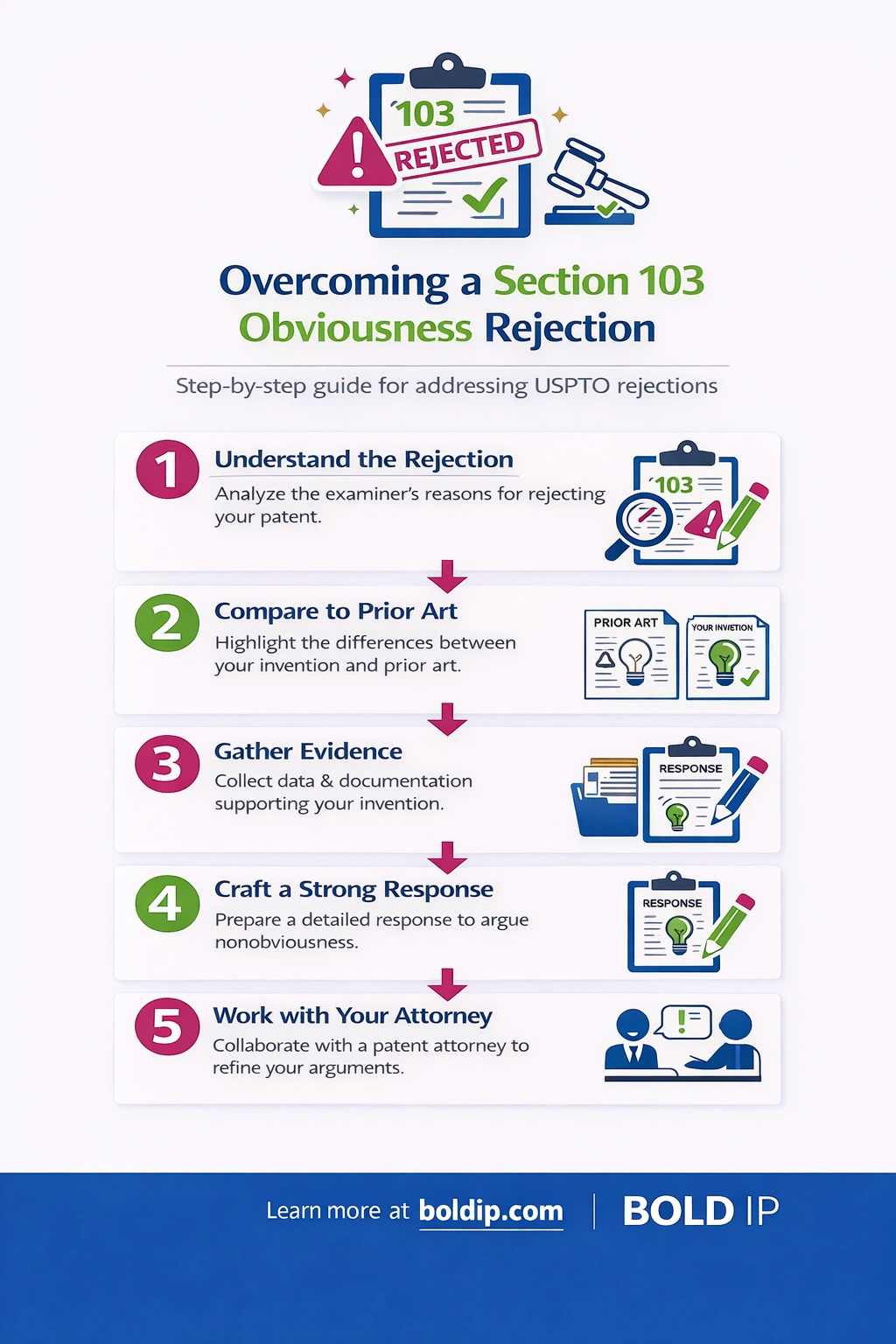
A patent 103 rejection may seem like a frustrating roadblock on your journey to patent protection, but it is not necessarily insurmountable. There are several tactics your patent attorney might suggest, depending on the circumstances.
- Provide documentation the invention is nonobvious. In some cases, there is available evidence that can be submitted with a written declaration documenting why the nonobvious rejection is incorrect.
- Attack the suggestion/motivation to combine. As previously mentioned, one of the requirements for a finding that a claim is obvious based on a combination of prior art references is that there must be a suggestion or motivation to combine the prior art. If combining those various references would go against the prior art’s intended purpose(s), you can argue there is no motivation to combine.
- Argue against a reasonable expectation of success of the combined prior art. Sometimes, an argument can be made that the examiner’s suggested combination of prior art wouldn’t make sense and that the result would be an inoperable product for which a reasonable person would have no expectation of success.
- Fight the rejection on the basis of impermissible hindsight. Examiners cannot rely on hindsight to reject an application on the basis that it is obvious when that rejection is based on a combination of prior art that goes against conventional wisdom at the time the prior art references were patented.
- Amend the claim(s). Your patent attorney may recommend amending the claims in your application to clarify an element or add additional information to show that the examiner’s initial determination of nonobviousness was incorrect.
Boldly Pursue Patent Protection
Bold Patents provides a range of services to clients nationwide, including patent searches and patentability assessments designed to help creative minds determine whether their inventions or ideas will meet USPTO non-obviousness standards. We also help aspiring patent holders overcome patent 103 rejection notices as well as other patent actions or rejections on different grounds.
To learn more, contact us today to schedule a complimentary Discovery Call.