Last Modified on October 06, 2026

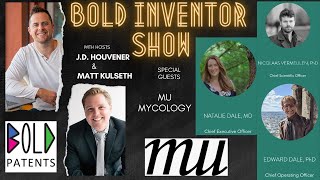
The Bold Inventor Show explores a new way to grow mushrooms, the patent strategy behind it, and the potential for small-footprint, scalable mushroom production.
Introduction
What if mushrooms could be grown continuously in a small footprint instead of growing on a traditional substrate that gets discarded after harvest?
On this episode of the Bold Inventor Show, J.D. Houvener and Matt Kulseth welcome Edward, Natalie, and Nicholas from Mu Mycology, a company developing a new approach to mushroom cultivation.
The team explains how their technology uses a nutrient-rich liquid environment and controlled atmospheric conditions to maintain a healthy mushroom colony and trigger fruiting when desired. They also discuss their experience developing the technology in a garage, participating in NASA’s Deep Space Food Challenge, obtaining patent protection, and exploring licensing and commercialization opportunities.
For inventors, entrepreneurs, and business owners, this conversation offers an interesting look at how an idea that initially seemed “not patent worthy” can turn into potentially valuable intellectual property, and how a patent can fit into a broader commercialization strategy.
The Bold Inventor Show: Mu Mycology and the Future of Mushroom Cultivation
J.D.:
Good afternoon, everybody, and welcome to the Bold Inventor Show. I’m J.D., and that’s Matt. We’re going to do it. Fantastic.
Matt:
How have you been, J.D.? What’s new?
J.D.:
Good. We’re kind of transitioning from summer to fall. Soccer is ending, and we’re starting basketball. We’re going to be coaching some basketball.
Matt:
Nice. You’ve got two little girls. You’re a pretty tall guy.
J.D.:
Yeah, about six feet even. Not too bad. I did play basketball, but I gave it up for a year.
Matt:
Yeah, I know more about soccer than basketball.
J.D.:
Okay, ready?
Matt:
Let’s go.
A Show for Inventors, Entrepreneurs, and Business Owners
J.D.:
We had a good show for you all today. We’re talking patents, trademarks, and intellectual property.
This show is for you, the business owner, entrepreneur, and inventor.
As you see by the title, we have special guests waiting backstage from Mu Mycology. I’ve been mispronouncing it all day long, but “mycology” is the study of mushrooms.
They’ve got an innovative mushroom-growing technology we’re going to talk to them about, and I’m excited to bring them on.
We’ll do some Q&A first and then get to them for maybe another half hour. We’ve also got a Bold Light, a Shark Tank episode. I found one that’s mushroom-related, so we’ll have our guests help us critique it and look at it from an intellectual property perspective as well.
Before we get started, if you’re listening live on LinkedIn, YouTube, or Facebook, send us your questions.
And just a reminder: we’re not giving legal advice on this show. By joining the podcast, you’re not necessarily becoming a client, and we don’t want confidential invention disclosures here. Keep things hypothetical and process-level related.
We’re going to share information and general knowledge about intellectual property law, but don’t send us confidential information about your invention.
Trademark Questions From the Community
J.D.:
Matt, let’s start with a trademark question.
What happens if someone registers an existing trademark in another country for a different entity in the same class?
Matt:
So, let’s say you’ve got “Bob’s Soda” in the United States, and you’ve got a company in the U.S. that owns it.
Then you have a different entity in the United Kingdom that wants to register “Bob’s.”
From a trademark perspective, trademarks are generally based on the country and the specific use of the product or service in that country.
So if someone else registers your trademark in a different country, that can create a problem there.
J.D.:
Let’s clarify the question.
Suppose Bob’s is already a trademark in the United States, but I’m in the U.K. and I want to launch my own company using the name Bob’s. Can I do that?
Matt:
Yes, you can.
Of course, if you’re planning on opening something like McDonald’s, you have to make sure that no one has already registered that in the U.K., and there are other legal provisions that can prevent someone from registering or using certain famous marks.
But generally, there’s nothing that automatically prevents a mark registered in the United States from being registered by an unrelated party in another country.
We have lots of clients where we do a common-law, unregistered-use search and find other companies with the same or similar brands offering similar products or services somewhere else in the world.
We can still potentially register and use the trademark here in the United States.
J.D.:
What could a U.S. trademark owner have done to help prevent somebody else from registering the same mark in the U.K.?
Matt:
They could have used the international filing process to extend their protection abroad.
There are some important rights you can get when you do that, including priority based on the earlier U.S. filing in certain circumstances.
For example, if you file in the United States and then discover that somebody filed a similar trademark application in the U.K. a couple of months later, you may be able to file abroad within the applicable six-month priority period and claim priority based on the earlier U.S. filing.
J.D.:
That’s cool. So there’s some strategy there.
Matt:
Exactly.
Can You Patent an Improvement to an Existing Invention?
J.D.:
Let’s move over to the patent side.
Is it possible to patent an invention or idea that’s similar to something that’s already been patented? What’s the legal process for doing that?
Matt:
Yes, it can be possible.
If you know that your invention is basically an improvement or the next version of an existing patented product, a patent attorney can help you conduct a thorough patent search of what’s publicly available.
That’s probably the best place to start.
Let’s say you’ve developed a brand-new type of bottle opener. Maybe it works underwater, it’s childproof, or it has some other new feature.
If your new cap or opener is specific to a type of bottle that’s already been patented, you may still be able to obtain a patent on your improvement.
But that doesn’t necessarily mean you can legally sell the entire product without permission from the owner of the earlier patent.
So you have to understand that your market potential might be limited if your invention depends on technology covered by an existing patent.
J.D.:
But once you’ve obtained patent rights on your improvement, you could approach the existing patent owner and say, “I’d like to license this to you.”
Matt:
Exactly.
You could say, “I think this is a great improvement, and there’s a big market opportunity here.”
Then there could potentially be a royalty arrangement based on products sold using the improvement.
But again, it really comes down to the difference between what’s already been done and what your invention adds.
Is that difference significant enough to justify the investment of time and money, hiring counsel, waiting through the patent process, and building a business around it?
That’s the return-on-investment question I’d be looking at.
Can You Use a DBA as the Owner of a Trademark?
J.D.:
Here’s another common question.
When filing a trademark application, can I list my DBA as the owner?
Maybe I have an existing LLC, but I want to launch a different brand. I don’t necessarily want to be publicly associated with the new brand, and I don’t want to create another LLC yet.
Can I file a DBA for the new brand and use that name as the trademark owner?
Matt:
No. A DBA, or “doing business as,” isn’t actually a legal entity.
You still need to identify the actual legal owner of the trademark.
The USPTO generally requires you to list the actual owner, whether that’s an individual, LLC, corporation, nonprofit, or another appropriate legal entity.
J.D.:
So if you want the new brand to be owned separately, one option would be to create a new LLC.
Matt:
Yes. That would generally be the appropriate way to separate the ownership.
But even then, if someone is really trying to figure out who is behind the company, they may be able to find information through state business records.
There are different business structures and jurisdictions with different levels of publicly available ownership information, but those issues should be considered carefully.
Can One Business Own Multiple Trademarks?
J.D.:
Here’s another question that comes up on Reddit and Quora:
“How can I patent two businesses that are already in existence if I’m using them as one?”
I think they’re really asking how they can register two different business trademarks while using them under the same company.
Matt:
You can have multiple trademarks owned by the same legal entity.
Whether it’s an individual or a company, one owner can own multiple different trademarks.
You might have one operating company that does multiple things.
For example, one part of the company might offer one type of service, while another part offers something completely different. You might want to keep those brands separate.
In that case, you could potentially file separate trademark applications for the different brands while having the same owner.
Meet Mu Mycology
J.D.:
All right, we don’t have any live questions, so let’s bring on our guests.
We’ve got three guests: Edward, Natalie, and Nicholas from Mu Mycology.
Welcome!
Edward/Natalie/Nicholas:
Thank you for having us. Thanks for having us on.
J.D.:
It’s a pleasure.
We’re going to be talking about your company and your technology. Natalie, could you kick us off with what Mu Mycology is?
Natalie:
Mu Mycology is a company where we have a new technology for growing mushrooms.
The traditional method of growing mushrooms has been used for a very long time, and we’ve developed a new way of doing it.
“Mu” comes from the Greek letter mu, which means micro, because we’re really looking at mushroom growth on a micro scale.
J.D.:
We’ve got a very emotionally needy cat somewhere in someone’s house.
Natalie:
Yeah.
Edward:
I think Natalie kind of sums it up.
The place we really want to be is in that micro stage.
Everything we’re looking at is relevant to confined-space growth. It’s not really intended to replace somebody who’s growing mushrooms on a giant farm where they have a lot of resources.
We know mushrooms can recycle plant matter really well. We’re really looking into what happens if you have an incredibly small footprint and actually want to create mushrooms as a food source.
What Is the Innovation?
J.D.:
Very cool. What have you come up with? What’s the innovation?
Edward:
Let’s be upfront. Edward, Natalie, and I will say this pretty openly: we did not think this didn’t exist.
From the beginning, we thought, “Yeah, this is pretty cool. We can definitely do something here, and we’ll use it.”
We didn’t think it was novel enough to be patent-worthy.
But the truth is, we started looking around, and nobody had anything like it.
That’s how we got in touch with you, and it changed how we were thinking about it. It was actually much more novel than we had anticipated.
J.D.:
Let me jump in and explain the problem with traditional mushroom production.
If you’re producing mushrooms in the traditional sense, you have a substrate, and you grow the mushrooms on that substrate. The mushrooms consume the food within that substrate.
After you harvest the mushrooms, you throw the substrate away.
So it’s labor-intensive. You bring in the substrate, inoculate it, grow the mushrooms, harvest them, and then you have this one harvest event.
Your technology improves on that because you have a small footprint with an established colony that you don’t throw out.
You keep it healthy, alive, and continuously producing mushrooms.
That’s where the “micro,” or “mu,” comes in. You can have a very small footprint while continuously producing and harvesting mushrooms.
Is It Hydroponics for Mushrooms?
J.D.:
It’s basically hydroponics, but for mushrooms?
Edward:
The trick was hydroponics.
Hydroponics is really about feeding plants.
The nutrients plants need include water, which is easily supplied through a hydroponic system, and light to fix the carbon dioxide in the air.
Mushrooms are a little different. They’re much more animal-like than plant-like, so they need to eat something.
In most cases, you can feed mushrooms a lot of different things.
Mushrooms will grow in living trees, dead trees, beans, almost anything. That’s part of what makes them fascinating.
But the application that made the connection for us was thinking about mushrooms as part of the fungal category.
Yeast is also part of that category.
Yeast is made up of small, single-cell organisms, and we feed them all the time to make beer.
You use a liquid containing sugars, such as malt, and eventually you get a nutrient-rich liquid solution that yeast converts into ethanol and other byproducts.
That’s beer.
So the concept was pretty simple when you think about it that way.
What if you replace the traditional hydroponic system, which is primarily water, with something extremely nutrient-rich, like the liquid used in brewing?
J.D.:
I don’t know hydroponics very well, but isn’t it basically water without dirt?
Edward:
That’s one simple version of hydroponics.
There are actually a broad range of hydroponic systems.
In the simplest case, you have water and allow roots to live in the water. There are also organisms and additional nutrients involved.
For plants, the energy ultimately comes from light, which allows the plant to fix carbon dioxide and create materials.
With mushrooms, the energy store is actually everything the plants have already fixed, essentially sugars.
Why Traditional Mushroom Substrates Create Waste
J.D.:
So the mushrooms are still being grown with a substrate in the traditional system.
What’s a typical substrate?
Edward:
It can be a lot of different things.
Anything that provides a carbon source can potentially be used.
Traditional substrates can include things like soybeans, straw, and mixtures of more and less nutritious carbon sources.
If you go out into the woods and look at dead trees, you’ll see mushrooms growing on them. The mushroom is breaking down that material and turning it into simpler sugars.
The issue with throwing away those carbon sources isn’t necessarily that the substrate itself is valuable. It’s that it’s wasteful.
If you look at producing mushrooms, you might convert roughly 10% of the substrate into mushroom and then throw away roughly 90%.
Let’s say you’re in an urban environment. You’re not composting, and you’re not on a farm.
Maybe you’re producing mushrooms because local food or farm-to-table food is a great idea.
But if you’re throwing away 90% of the biomass, you’re still producing a lot of waste.
The goal of our approach is that if you have a healthy colony that’s continuously producing, you’re feeding it and keeping it alive rather than constantly turning over the biomass.
How the Mushroom Colony Produces on Demand
J.D.:
So have you invented a method for hydroponically grown mushrooms?
Edward:
We’d try to stay away from simply calling it “hydroponic,” because hydroponics implies that it’s just water, and that’s not what we’re doing.
We really have to focus on the fact that we’re supplying nutrients in a liquid form.
J.D.:
So there’s a new category that needs a new name.
Edward:
I’d say we’ve come up with a way to keep a healthy colony producing continuously.
There’s another feature that makes it interesting.
Mushrooms are extremely guided by their environment. Their signaling pathways have a lot to do with the environment they’re exposed to.
You can walk around a neighborhood one day and see nothing, then walk by the next day and suddenly see all these mushroom fruiting bodies.
The mushroom colony was there the entire time. It’s underground, it’s large, and it’s healthy.
Then, when the mushroom breaches the dirt and gets exposed to oxygen-rich air, it quickly produces the fruiting bodies we traditionally call mushrooms.
That means you can actually control when it fruits by controlling the atmosphere it’s exposed to.
J.D.:
So you’re feeding the mushroom colony almost like IV fluids?
Edward:
Exactly.
We’re giving it the sugars and micronutrients it needs without requiring it to digest or decompose plant matter to obtain those nutrients.
Then the second step is controlling the atmosphere.
For a period of time, you leave the atmosphere relatively oxygen-free, with higher carbon dioxide levels.
The mushroom colony simply expands.
It’s in a state where it thinks it’s underground. It makes more cells, gets thicker, and grows.
J.D.:
Time out.
When you say “colony,” I’m still picturing a traditional mushroom shape. No mushrooms are actually growing at that point?
Edward:
Right.
Let me give you a real-world example that was part of the motivation for this.
In Oregon’s Malheur National Forest, there’s a single mushroom organism that’s a genetically distinct individual.
It’s not just a colony in the way people might imagine.
This one organism has expanded over roughly three and a half square miles, and it’s estimated to be more than 1,000 years old.
Mushrooms aren’t necessarily short-lived. There’s no reason we can’t maintain a persistent colony.
It’s all about keeping it healthy.
Like Nicholas said, it’s really these environmental factors.
The organism can exist underground as one massive individual, but when the conditions are right, it essentially says, “It’s time to reproduce.”
That’s when you get the actual mushroom that we think of and eat.
Think of it like the apple of an entire tree.
The tree is there, and you just pick the apple when it appears.
Controlling the Environment to Grow Mushrooms on Demand
J.D.:
Tell me more about the little tweak you had to make.
Edward:
The advantage is that now we have another lever to control: the atmosphere.
Along the way, we learned a lot about maintaining a sterile environment, keeping things clean, and keeping the mushroom healthy.
It is a living organism, so it has an immune system. Once it’s healthy, it doesn’t necessarily get bacterial infections or things like that.
In some of our first attempts, we had to fight off fruit flies. But you learn.
Now we have this environmental lever that we can pull.
The nice thing is that you can program it and control it.
The big benefit is that you can essentially have mushrooms on demand.
You could let the colony grow for two weeks, then switch the environment from carbon-dioxide-rich conditions to oxygen-rich conditions.
That can trigger the mushroom to generate the fruiting bodies, the mushroom pieces we normally think of.
You can let that happen for a day or two, then switch it back to the growth condition.
Then you wait another couple of weeks and repeat the process.
Are Mushrooms a Good Source of Protein?
J.D.:
I’m not a huge mushroom eater. I’ve had some mushrooms in things like pasta, but I’m not ready to replace protein with them.
Do mushrooms have the same amount of protein? Can you use them as a protein source?
Natalie:
Mushrooms are relatively high in protein.
It’s not the same as eating a steak, but they are relatively high in protein.
A lot of vegetarian options use mushrooms, especially portabellas, as a meat substitute.
They’re also high in a lot of micronutrients, particularly B vitamins.
When we participated in NASA’s Deep Space Food Challenge, that was one of the aspects we talked about.
Mushrooms have relatively high protein and micronutrients that could be important for an astronaut living in space.
J.D.:
What about the nutritional quality? Is there any degradation compared with a natural mushroom because you’re growing it in an artificial chamber?
Natalie:
That’s a really interesting question.
We’d have to do a lot more work before we could actually tell you.
I will say that we’ve eaten the mushrooms we grow, and they’re delicious.
They don’t taste any different from mushrooms we’ve bought at the store.
J.D.:
So your family is the test group?
Natalie:
Exactly.
Could This Technology Help Grow Difficult-to-Cultivate Mushrooms?
Edward:
Because we’re feeding the mushroom the base nutrients, we’re not necessarily feeding it things that it actively has to decompose.
There are pathways that we don’t think get activated in the same way. You can potentially get direct growth of the mushroom.
Because we’re in a liquid medium for the nutrients, we also have the ability to control the chemistry that’s required.
There are mushrooms that have only recently been cultivated successfully.
For example, morels appear to require particular environmental or chemical signals associated with grasses.
Nicholas:
I was out in the woods a couple of weeks ago looking for chanterelles.
They’re absolutely delicious, but they’re another species that’s difficult to cultivate.
A lot of the mushrooms you can buy at a store are mushrooms that decompose something. Those are relatively easy to cultivate because you give them food, they decompose it, and they produce mushrooms.
But there are many species that are symbiotic.
We’re talking about morels, chanterelles, boletes, porcini, truffles, and other high-value species.
They’re difficult to cultivate.
The nice thing about our system is that it potentially mimics a mycorrhizal system.
The system we have is almost like a tree root that the colony interacts with.
We give it nutrients, it can get rid of waste, and we think a future direction could be getting some of these difficult-to-cultivate species growing and producing consistently.
From Patents to Commercialization
J.D.:
Let’s bring this back to patenting for a moment.
Obviously, this is an ongoing area of exploration and research, but patenting is about making money, at least in some sense.
I’d love to hear about the business plan.
You’ve got the patent issued, congratulations, by the way, and you’ve got international filings that are still pending.
What’s the plan for getting this into consumers’ hands?
Natalie:
We have a couple of different directions we’re considering.
One is small-footprint restaurants, or even places like gas stations in food deserts.
The idea would be to bring these small-footprint devices directly into places where mushrooms could be produced and consumed locally.
Another option is the larger-scale agricultural route.
Our system is modular, but it’s also scalable.
For businesses that don’t want to produce a lot of waste, that’s another option.
The third option is the academic route.
I’ve reached out to Oregon State University because they do a lot with mushrooms.
We could work with universities that study mushrooms and want a very controlled, low-waste system.
It works well in that kind of academic setting.
Edward:
I want to repeat all three of Natalie’s points because they’re important.
We do think there’s an application where you grow mushrooms on a schedule and on purpose, and the footprint is really small.
Imagine putting a unit inside a restaurant.
Suddenly, the restaurant can create dishes that aren’t as season-dependent because they know when they’re going to have mushrooms available.
We think we can figure that out relatively simply.
There is a cost, so I don’t know if people will necessarily want to do it in their homes.
But for a restaurant, it may make a lot more sense.
Could Mushroom Cultivation Become Like the Craft Beer Industry?
J.D.:
It feels a lot like the craft beer industry 20 years ago.
You had a lot of home brewers using DIY kits and developing their own systems.
Now you’re talking about an area that I think the three of us are really excited about.
If we can show somebody how to do this, of course we’d like to turn it into money for ourselves.
But showing people how to cultivate mushrooms could expand how we think about mushrooms as a class of organisms that we either eat or get value from.
It’s not that mushrooms are new, but humans aren’t particularly good at harnessing them.
We know how to work with animals.
We know how to work with plants.
The mushroom category is just a little more difficult.
Edward:
There are hundreds of thousands of mushroom species, and every one can have its own niche.
They can make molecules that are difficult for us to understand, and many of them have medicinal applications.
There’s an entire world out there.
If we haven’t even cultivated the vast majority of mushrooms, we don’t know what’s out there or what we can actually do with them.
J.D.:
It’s almost like rare species of animals or birds.
We put a lot of time, money, and investment into preserving them from extinction.
But there are mushroom species we’ve never even seen or cultivated.
Edward:
Exactly.
There’s an entire class of mushrooms that only grows on living trees.
They use the vascular system of the tree as essentially the system we’re inventing.
The tree feeds the mushroom sugars and liquids.
Those mushrooms aren’t cultivatable using our current form factors.
We rely on the things that only decompose, and that’s only one category of fungi.
Mycology is also a relatively new field.
People haven’t studied it in depth for very long, and the recent rise in mycology and mushroom culture has been driven in large part by citizen scientists.
It’s only more recently that academic and medicinal companies have become more involved.
Finding Different Paths to Commercialization
J.D.:
It sounds like you’ve got to approach this from a lot of different angles.
It’s hard to say, “We’re going to use this one commercialization model,” because you don’t necessarily know what else you could be doing.
Edward:
Exactly.
Another category is commercializing mushrooms that people haven’t been able to cultivate but potentially should.
We think there’s an opportunity to partner with a company that identifies a mushroom it believes has value and then help bring that mushroom’s fruiting body to market by developing a cultivation method.
Essentially, we’ve taken a plant-decomposer, dirt-based environment and turned it into a plumbing environment.
Because it’s plumbing, we can have a conversation with somebody and say, “Your facility looks a little different, but this is really a flow and plumbing problem.”
That’s where we think we can help.
What’s Next for Mu Mycology?
J.D.:
We’re going to have to have you guys back on with an update.
Let’s say by the end of next year, where do you hope to be?
What developments would make you say, “We’re really proud we were able to do this”?
Natalie:
To give you a little background, we started this in our garage.
We developed the prototype in our garage with very minimal funding.
We participated in the Deep Space Food Challenge and became finalists. That gave us some additional funding, which helped us move forward with the patent.
Our next step is to find venture capital or partner with an existing corporation to move the technology forward.
Someone also asked about licensing versus selling the devices and support services.
Right now, we’re moving more toward a licensing model, mostly because the equipment requires a significant investment.
We’re looking more into licensing so we can partner with companies that already have the equipment and infrastructure needed to take this to the next level.
Edward:
Everyone romanticizes the garage invention.
But as a chemist and scientist, garage science is terrible.
It’s very difficult to do things correctly.
So partnering with lab space and other scientists and being able to explore some of these future directions is pretty critical.
For example, you asked about the nutritional content of the mushrooms.
We can’t really know that until we partner with a lab that can analyze it in greater depth.
For the Deep Space Food Challenge, we had to harvest our mushrooms and send them to a lab to make sure they didn’t have infectious bacteria or other issues. They also analyzed the mushrooms for nutritional content.
There’s just a lot involved.
What Would a Mushroom-Growing System Cost?
J.D.:
Jonathan Mitchell is asking: How much would it cost for someone new to install one?
Let’s say a restaurant wanted to have one. What’s the ballpark?
Natalie:
If we gave you a ballpark right now, it would probably be wrong.
You’re looking at potentially several thousand dollars, up to around $10,000, to really do it right.
The issue is maintaining sterility.
You have to keep everything clean.
The interesting thing is that we’re using some technologies that became more widely available during COVID.
COVID was interesting because there was an explosion of technology designed to make sure the air wasn’t full of organisms, whether viruses or other pathogens.
We reached out to a company called PureClenz, which makes a specific type of air purifier that uses light to generate hydroxide radicals.
We thought it could work in our system.
Their technology actually works better when there’s more water vapor, so when the humidity is high.
And we thought, “That’s exactly where we want to be.”
We put their system into our setup, and we have a warm, humid environment.
We intentionally didn’t clean anything for eight months, and the system continued running.
It kept the colonies alive and healthy and helped stop infections.
Edward:
And that technology is also used for cleaning air in the International Space Station.
Going back to the cost question, the biggest cost right now isn’t actually our system.
Our invention is the growth chamber that the system has to live in, the system that keeps things sterile and manipulates the environment.
We’re not inventing that part.
There are already a lot of people working on making growth chambers cheaper and more effective.
As the cost of those growth chambers comes down, the cost of implementing our invention should come down as well.
Natalie:
Those growth chambers are mostly in the cell-culture scientific space right now.
We don’t need something quite that intense, but developing one from scratch seems unnecessary if we can buy something off the shelf.
A Shark Tank Mushroom Pitch
J.D.:
We’re going to have you stay on because we’re going to have some fun with a Shark Tank pitch.
Maybe you guys can think about whether this could be a company that would work with your technology.
Let’s watch a little Shark Tank pitch.
Michael:
My name is Michael Pan, and I’m from Portland, Oregon. My company is Pan’s.
I’m here today to talk to you about something that’s near and dear to my heart: turkey.
Sharks, you’re all busy and know what it’s like to need fuel on the go. Turkey is a convenient, tasty, nutritious snack.
People have been enjoying jerky for centuries.
Let’s take a moment to appreciate our jerky in all its glory. I can’t think of anything more satisfying than ripping into a meaty, chewy, delicious piece of jerky.
Pan’s is high in fiber and vitamin D. It’s paleo, soy-free, gluten-free, and made with six simple ingredients.
All our flavors have their own unique umami taste.
I didn’t mean to go on and on about our jerky without letting you taste it.
I’d love for you each to take a bite.
Now, I can’t wait to hear your thoughts, but before you share them, I have to admit something.
That marvelously meaty texture you’re experiencing is actually mushrooms.
That’s right: Pan’s mushroom jerky.
We have four delicious flavors: Original, Zesty Thai, Salt & Pepper, and Apple Barbecue.
All of them have a delicious flavor and satisfying texture that fans of jerky love.
Sharks, I’m seeking $300,000 in exchange for 10% equity.
Who’s ready to take another bite?
J.D.:
Wow. That was a great reveal.
Tell us your story. How did you get into mushroom jerky?
Michael:
My father was born and raised in a small fishing village in Malaysia.
I had the opportunity to visit my family and learn about my heritage and where I came from.
On one of those visits, there was a bowl of food on the table. I reached in and tried it.
Immediately, I thought, “This is great. It must be pork.”
I was confused because the person who served it was my cousin, and he was a vegetarian Buddhist.
He had been making the snack for himself, his family, and people in the area and selling it locally.
As vegetarians, they had a hard time finding foods that tasted great but also had a great texture.
Mushrooms were very satisfying and healthy.
Shark:
Would you say you’re on track to do a million dollars this year?
Michael:
Yes. We think we’re going to get to $1.5 million.
We’re doing around $95,000 to $100,000 in sales a month right now.
Shark:
Is there anybody else doing this?
Michael:
There are others starting to do this, which is obviously why I’m here.
We want to move faster.
But we really believe our taste and texture are superior.
Looking at the Pitch Through an IP Lens
J.D.:
Michael ended up getting a deal.
But I want to point something out from the patent perspective.
The question was asked, “Do you have any competition?”
He essentially said they were trying to be a first mover.
That’s something to think about.
He’s up there looking for investment, and fortunately for him, the company is still in business and selling.
But that’s one of the risks you take if you don’t have patent protection for specific technology.
They may have something behind the scenes that’s protected as a trade secret, particularly the way they’re formulating the food.
But depending on the technology, patenting may or may not be practical.
J.D.:
So, I’ll hand it over to the mycology team.
What did you guys think about the pitch and the product?
Natalie:
It’s great.
I’ve had lots of mushroom jerky.
J.D.:
You have?
Natalie:
Sometimes it’s delicious. There is some very bad mushroom jerky out there, too.
Matt:
I’ve never had it.
J.D.:
Matt, have you had mushroom jerky?
Matt:
No, never.
Natalie:
It comes down to spices and texture.
And remember, there are thousands of different types of mushrooms.
There are definitely some that are just slime.
There’s one that inks and melts into a blob of goo.
Some mushrooms will be worth cultivating, and some just won’t.
Could Mu Mycology Supply Mushrooms for Food Companies?
J.D.:
Have you thought about one particular avenue, serving makers of jerky?
Would that be a good fit, or is your technology more suited for farming and high-volume production?
Nicholas:
You noticed that they were using shiitake mushrooms.
They’re sticking with mushrooms that are easily cultivated so they can produce them at massive volume.
We’re looking at a lot of gourmet species and mushrooms that are difficult to cultivate.
So I don’t know if the fit is perfect unless you’re talking about doing small-scale batches of particular species.
J.D.:
I think maybe you’re right about the brewery comparison.
You could have something small-batch, boutique, high-end, unique, and local.
Maybe it’s not about producing a huge amount at a low price.
For me, it might not be beer right away.
It’s the raw fruit of the mushroom.
People aren’t necessarily used to taking a mushroom and eating it as a new food experience.
There has to be something readily convertible, a new way to consume mushrooms that’s as close as possible to beer.
Edward:
That’s actually why we think the restaurant market is so interesting.
You put the mushrooms in the hands of people who actually serve food and let them figure out how to prepare them.
The advantage we think we have is the ability to introduce mushrooms that people don’t generally eat simply because they’re not generally available.
J.D.:
I love that aspect of it, Nicholas.
You could have a whole new portfolio of mushrooms for people to try.
Mushroom Leather and Other Potential Applications
J.D.:
There was also a question about mushroom leather manufacturers.
Edward:
We were fortunate that when we started talking about this, we connected with a number of people in Chicago.
There happened to be a company using mushrooms not for the fruiting body but for the colony.
They were growing the colony, then processing it into a protein powder.
There’s another company using a concept that’s similar to ours.
Instead of growing the mushroom to produce a fruiting body, which is where we really think we stand out, they grow the colony and then manipulate the hyphae after each growth cycle.
By doing that, they can create a leather equivalent.
It’s tough and durable.
The technology is related to what we’re doing.
The company making mushroom powder is growing it in a style similar to brewing beer, using a nutrient-rich medium.
For the leather application, they use a sheet and put nutrient-rich media on top of the mushroom, allowing it to seep through the sheet slowly.
It’s similar to what we’re proposing, except they aren’t producing a fruiting body because they don’t have the space or the environmental conditions required for that.
J.D.:
So it’s almost like they’re growing on a little piece of land or some sort of structure.
Very interesting.
Could Difficult-to-Grow Mushrooms Become a New Food Source?
J.D.:
Going back to the Shark Tank idea, if someone wanted to make mushroom jerky using a mushroom that’s more difficult to cultivate, say they wanted to use something like morels, that could be an avenue for you.
Edward:
Absolutely.
Because our technology is potentially scalable, that could certainly work.
The scalability argument comes back to the plumbing concept.
Think of the colony as something that looks sort of like a thermos bottle.
You have tubes going in and out.
You grow the colony, and you grow mushrooms.
There’s no reason you couldn’t stack a thousand of those systems together and have all of them growing at the same time.
Your mushroom farm starts to look more like a mushroom closet with a door.
You grow them, harvest them, and repeat.
J.D.:
So the capital expenditure might be higher, but the operating costs could be relatively low.
Edward:
Exactly.
And you don’t necessarily need an above-ground element.
This could potentially exist beneath the ground.
J.D.:
And they don’t need light like plants do.
Edward:
Correct.
J.D.:
So suddenly mineral rights might become more valuable.
Matt:
Mushrooms are terrifying.
J.D.:
That’s what I’ve learned from this conversation today. I’m intimidated.
I’m thinking about Cordyceps and The Last of Us.
Matt:
I was going to reference The Last of Us too.
J.D.:
It was a cool show.
What’s Next for Mu Mycology?
J.D.:
We’ll definitely have to have you back on with an update.
If someone is listening or watching and would like to get ahold of you, Natalie, are you comfortable sharing your email address?
Natalie:
Sure.
J.D.:
I’ll share that here.
If you have questions about what they’re doing, funding opportunities, investing, or getting involved with the company, reach out to Natalie and the Mu Mycology team.
Matt:
No, this is super cool.
I love what you’re doing.
I think the system idea is incredible, and I think you’re right at the leading edge of this whole movement happening in mycology.
I think we can expect great things.
Getting in on the ground floor is phenomenal.
J.D.:
Again, thank you so much.
Mu Mycology has been great to work with, and it was absolutely great having you guys on.
Wonderful to have you.
Edward, Natalie, and Nicholas:
Thank you very much.
J.D.:
Have a great rest of the day.
Go Bold!