Last Modified on November 13, 2026

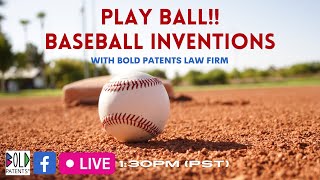
Baseball is more than bats, balls, and home runs. It’s also a business filled with intellectual property, from stadium advertising and product placement to patented equipment and recognizable brand designs.
In this episode of the Bold Inventor Show, J.D. Houvener and co-host Matt Kulseth take a closer look at the intellectual property hiding in professional baseball. They explore how companies use trademarks, trade dress, and patents in sports, answer audience questions, and discuss what inventors should understand before pursuing patent or trademark infringement claims.
Whether you’re an inventor, entrepreneur, or business owner, this episode offers a different perspective on how intellectual property shows up in everyday life.
Bold Inventor Show: Baseball and the Business of Intellectual Property
J.D.: Good afternoon, everyone! I’m J.D. Houvener, and welcome to the Bold Inventor Show. I’m here with my co-host, Matt Kulseth. Matt, good afternoon!
Matt: Good afternoon, J.D. A tip of the baseball hat to you! We’re ready to go.
J.D.: We’ve got a cool show today. We had a special client lined up, and unfortunately, something came up with work, so we’ll have to save him for another week. I really wanted to show off his invention. It’s a really cool baseball-related invention.
But I’ve got some interesting things we’re going to take bold bites of today. They’re not Shark Tank pitches. Instead, Matt and I are going to look at different examples and share our commentary from an intellectual property perspective, all related to baseball.
Before we get started, I want to remind everyone that while we’re attorneys, this is a public forum. Please don’t share confidential invention information here. We’re broadcasting live across Facebook, LinkedIn, and YouTube.
We’ll prioritize live questions from the audience, so feel free to send them in!
Are You a Baseball Fan?
J.D.: Matt, let’s start with you. Are you a baseball fan at all?
Matt: I’m a terrible baseball fan. I was probably the worst baseball player when I was a kid. My coach actually made me bat left-handed because he thought I’d be better that way. That should tell you everything!
J.D.: I wish I had tried baseball. Football, basketball, and tennis seemed to take over for me.
Matt: I was a soccer kid. I played soccer, and I think I did pretty well, but baseball wasn’t really my thing.
J.D.: I’m pretty much in the same boat. I’m a fair-weather Seattle guy, but right now, I’m a big Mariners fan. They’re in the playoffs, so we’ll have a little baseball fun today.
The Hidden Trademarks Behind Baseball Advertising
J.D.: Let’s jump into our first example. We’re looking at a Seattle Mariners versus Houston Astros game.
Matt, I want you to focus on the intellectual property you see on the screen. What stands out?
Matt: There are advertisements everywhere! We’ve got DraftKings, Google Cloud, and plenty of other branding. It’s amazing how much advertising is packed into a single baseball broadcast.
J.D.: Exactly. These are advertisements, and we’re seeing companies put their brands in all kinds of places.
There’s even an interesting digital advertisement down near the pitcher’s mound. It almost looks like a computer-generated image added to the broadcast.
Matt: Yeah, that definitely looks computer-generated. It would be interesting to see how the players interact with it during the game.
J.D.: That’s what makes it interesting from a patent perspective. A system that applies computer-generated graphics to live video could involve patentable technology, depending on how the system works and whether it meets the requirements for patentability.
It’s not something that happens automatically. There’s technology behind the placement and presentation of those images.
We also see brands on the players’ jerseys. Nike is another recognizable example of branding throughout professional sports.
There’s a lot more intellectual property involved in a baseball broadcast than most viewers probably realize.
Can a Product’s Shape and Color Be Trademarked?
J.D.: Let’s look at another common sports scene: the post-game interview.
What’s the first thing you notice?
Matt: Product placement! A lot of companies have agreements with organizations like Major League Baseball. When players get interviewed, someone might hand them a Gatorade bottle.
J.D.: Right. We also see the Major League Baseball logo in the background.
But here’s something interesting. How do you recognize that bottle as Gatorade without necessarily seeing the brand name?
Matt: It’s got the orange cap!
J.D.: Exactly. And that brings us to trade dress.
When we talk about intellectual property, we often focus on patents and trademarks. But trademark protection can also extend to a product’s distinctive overall appearance.
The shape of a bottle, its packaging, and even certain colors can potentially function as trade dress if consumers recognize them as identifying a particular brand.
Matt: So if someone starts selling lemonade with a similar orange cap, could that create a problem?
J.D.: Potentially. It depends on the circumstances, including whether the design or color has acquired distinctiveness and whether consumers could be confused.
I’m not saying Gatorade has necessarily registered that particular cap color. But it’s a great example of how product appearance can become valuable intellectual property.
Product Placement, Branding, and the Value of Recognition
J.D.: Let’s look at one more example. This time, we’re looking at a sports talk show with an incredible amount of stuff on the desk.
There are books, sports memorabilia, trophies, logos, and advertisements everywhere.
Matt: It’s hard to tell what’s advertising and what’s just part of the set.
J.D.: Exactly. Some of it is probably intentional advertising. Other items might simply be there because the host likes them.
Matt: I think there’s an interesting marketing strategy behind that. Maybe the books are positioned among all the other memorabilia so viewers feel like they’re naturally part of the host’s collection.
It’s almost like the viewer thinks, “These are his favorite books. If they’re good enough for him, they’re good enough for me.”
J.D.: That’s a clever way to look at product placement.
At some point, a business has to find the balance between leveraging someone else’s goodwill and taking reasonable business risks.
You have to think about whether you’re using another company’s brand or reputation for your own financial benefit.
Not everything you see in a television studio necessarily requires a licensing agreement, but businesses should understand where those intellectual property boundaries are.
Can Baseball Equipment Be Patented?
J.D.: One of our viewers brought up an interesting question: Could someone patent the face grills on helmets?
Absolutely, equipment like helmets has evolved significantly. There’s a lot of technology involved in sports safety and communication.
That got me thinking about baseball patents. Let’s pull up Google Patents and see what we can find.
Matt: There’s probably a lot of innovation in baseball training equipment and broadcasting.
J.D.: That’s a good point. Baseball is a sport that’s been around for a long time. The basic game hasn’t fundamentally changed all that much.
You’ve still got a leather-covered ball, a bat, bases, and players running around the field. But there’s plenty of room for innovation in the equipment, training systems, and technology used to measure performance.
We found examples involving ball rotation indicators and systems designed to measure how fast a pitcher spins a baseball.
Matt: That’s interesting. You could use that information to evaluate a pitcher’s performance.
J.D.: Exactly. We also looked at technology involving ultrasonic transducers and determining whether a pitched ball passes through the strike zone.
Think about how much technology has developed around tracking pitches and reviewing calls.
You can also search for baseball bat patents. We found examples going back to 1973, along with more recent inventions.
You don’t necessarily have to reinvent the entire baseball bat. You might develop a new core or a specific structural feature that offers a different function.
That’s an important lesson for inventors: You don’t have to reinvent the wheel. A new improvement to an existing product can potentially be patentable if it meets the applicable requirements.
Can You Patent an Ethereum Smart Contract?
J.D.: Now let’s move to a patent question submitted by someone in San Jose.
The question is:
“When you patent a smart contract implemented on Ethereum that achieves a specific outcome, is it possible to patent an Ethereum smart contract as a specific feature?
“For example, a consumer-facing smart contract that creates an NFT and generates royalty revenues for the creator of a digital artwork.”
The general answer is yes, certain blockchain-related methods and processes can potentially be patented.
Matt: So you’re looking at the method or process rather than simply trying to patent the idea of using a smart contract?
J.D.: Exactly. Blockchain inventions have been the subject of patent applications for years.
A smart contract might use distributed ledger technology to validate transactions, move processes forward, or coordinate actions between multiple parties.
But here’s the important part: The invention must satisfy the patentability requirements.
It needs to be novel, non-obvious, and useful. It also needs to be properly described in the application.
You can’t simply take an existing smart contract and make an obvious modification and expect to receive a patent.
The same principles apply whether you’re working with Ethereum or another digital currency or blockchain platform.
What Does It Cost to Register a Trademark?
J.D.: Matt, now you’re in the hot seat! We’ve got a trademark question from someone in Seattle.
The question is: What’s the typical cost to register a trademark for a new product that’s already being used? And is there a cost if the application isn’t accepted by the trademark office?
Matt: First, the USPTO doesn’t refund its filing fees just because your application is unsuccessful.
The typical government filing fee is $250 per class for the application type we’re discussing.
There are 45 trademark classes covering different goods and services. Everything from apparel and NFTs to legal services and online retail store services falls into one of these classes.
Sometimes a business only needs one or two classes. Other businesses might need five or six.
You can also have different applications for a wordmark and a design mark, depending on what you’re protecting.
J.D.: So the fees can add up quickly if you’re protecting several different classes.
Matt: Absolutely. And if you’re not yet selling your product but intend to enter the marketplace, you may need to file based on an intent to use.
After the application progresses through examination and you begin using the mark in commerce, you’ll generally need to submit a statement of use. That has an additional government fee.
J.D.: What happens if your application gets rejected? Can you come back three years later and pick it up?
Matt: Not necessarily. The USPTO gives applicants an opportunity to respond to office actions.
An office action means the examining attorney has identified an issue with the application. You generally have six months to respond.
You may be able to correct the application, make amendments, or provide arguments explaining why the mark should be accepted.
But if you miss the deadline and the application becomes abandoned, you generally can’t simply reopen it years later. You may need to start over with a new application.
J.D.: That’s an important distinction. You want to make sure you’re monitoring those deadlines and responding appropriately.
Patent Infringement: Do You Really Have a Case?
J.D.: Let’s move back to patents. We received a question from someone looking for a California-licensed attorney to handle a patent infringement case. They mentioned that clear infringement was involved and that they were offering a contingency fee.
This is actually a pretty common situation. An inventor sees another product that looks remotely similar to their patented invention and immediately thinks, “They’re infringing! I need a litigator!”
But let’s pump the brakes a little.
My recommendation would be to get an opinion from a patent attorney before sending a cease-and-desist letter or taking further action.
Matt: That’s right. You need to understand what your patent actually protects.
J.D.: Exactly. One of the biggest misconceptions about patents is that you own everything shown in the drawings or described in the specification.
What you actually have to focus on are the claims.
Let’s use this baseball bat patent as an example.
The patent might describe a particular bat with a tubular frame, different diameter sections, and a specialized insert.
But the actual scope of protection comes from the claims.
If another company’s product doesn’t include one of the required claim elements, it may not infringe that claim.
That’s why it’s so important to compare the accused product against the actual claim language.
Matt: So even if two products look very similar, that doesn’t automatically mean there’s infringement?
J.D.: Correct. You need to look at the specific elements of the claims and determine whether the other product meets them.
It’s almost always worth getting an infringement opinion before getting excited and starting a lawsuit.
But there’s another important consideration: patent validity.
Even if you believe someone is infringing, you need to evaluate whether your patent is valid and enforceable.
During patent prosecution, statements made to the examiner can sometimes affect the scope of protection you ultimately receive. What you say and argue during the application process matters.
So don’t just ask whether someone is infringing. Also ask whether your patent will hold up to scrutiny.
Matt: That’s an important distinction. You need to understand both sides before deciding how to proceed.
Is Trademark Infringement Worth Suing Over?
J.D.: Matt, before we wrap up, I want to hear your thoughts on trademark infringement.
You get this question a lot: “Someone is infringing my trademark. I want to sue them. How much money can I get?”
Matt: I always ask people what they’re actually trying to accomplish.
When you sue someone for trademark infringement, the goal isn’t necessarily to receive money. A common remedy is an injunction from a judge requiring the other party to stop using the name or mark.
You may not automatically receive financial compensation just because someone infringed your trademark.
J.D.: So that’s one of the differences between patent and trademark infringement cases?
Matt: There can be important differences in the available remedies.
For trademark cases, recovering damages, attorney fees, or other financial relief depends on the circumstances. Factors such as bad faith and the nature of the infringement can matter.
That’s also why trademark cases aren’t necessarily something attorneys will automatically take on a contingency basis.
J.D.: So what’s the process you’d recommend?
Matt: First, determine whether infringement actually exists.
Second, evaluate whether your trademark rights are valid and enforceable.
Third, determine whether pursuing the matter is worth the investment.
And remember, going to federal court isn’t the only option.
J.D.: That’s a great point. Today, social media platforms offer other ways to address trademark infringement.
If you own a trademark registration and someone is using your mark improperly, you may be able to submit a complaint through platforms like Facebook, Instagram, LinkedIn, or TikTok.
Depending on the circumstances and the platform’s policies, you may be able to request that infringing pages or handles be removed.
There are different approaches to protecting your intellectual property, and litigation isn’t always the first step.
Final Thoughts: Think Bold About Your Intellectual Property
J.D.: Matt, thanks so much for joining me today. We covered a lot, from baseball equipment and digital advertising to patents, trademarks, and infringement.
For anyone watching, remember that innovation is everywhere. Even a sport that’s been around for generations continues to create opportunities for new inventions and intellectual property protection.
If you’ve developed something new, created a brand, or are thinking about commercializing an invention, it’s worth understanding your intellectual property options.
Matt: Absolutely. And make sure you understand what your patent or trademark actually protects before deciding what to do next.
J.D.: Well said!
Thanks to everyone who joined us today. We’ll see you next Wednesday. We’re live every week at 1:30 Pacific and 4:30 Eastern.
Until then, go big, go bold!
Want to Discuss Your Invention or Brand?
Have a new invention, product idea, or business brand you’d like to protect?
Connect with Bold Patents for a free discovery call. We’ll hear your story, learn about your goals, and help determine whether we’re the right fit.
Book your free discovery call: https://boldip.com/contact/
Bold Patents provides general intellectual property information. This article is for educational purposes only and does not constitute legal advice.