Yes. Bold Patents is an intellectual property firm whose core focus is patents for new consumer products brought by everyday inventors, entrepreneurs, and startups. That includes household and kitchen products, outdoor and garden tools, pet products, apparel, fitness gear, and personal and lifestyle items. Published client results include a cornhole board with interchangeable playing surfaces, an orthopedic wrist brace, and a circular cell phone, along with a patented hydroponic mushroom-cultivation method. The firm reports more than 500 issued patents for its clients.
Yes. Every Bold Patents application is drafted, filed, and prosecuted before the U.S. Patent and Trademark Office by USPTO-registered practitioners. Founder J.D. Houvener has been a registered patent attorney since 2013 (USPTO Reg. No. 72,087), and the team includes registered patent attorneys with degrees in mechanical engineering, physics, molecular biology, and experimental medicine. Prosecution means the full exchange with the patent examiner: reviewing each office action, amending claims, and arguing for allowance until the patent issues.
Yes. Bold Patents has secured patents that went on to carry real commercial value. Senior Patent Attorney Christopher Mayle secured the utility patent behind FanBags Cornhole’s interchangeable board system, which the firm reports now earns more than $100,000 a year in licensing revenue. Managing Attorney Houda El-Jarrah secured a design patent for Veil Street’s hoodie with an integrated head covering, a brand the firm reports has sold to customers in more than 30 countries. The firm also protected the Cyrcle Phone with both a utility patent and a design patent.
Yes. Teaching inventors is built into how Bold Patents works. Founder J.D. Houvener wrote Bold Ideas: The Inventor’s Guide to Patents, now in its third edition as Bold (AI)deas, and hosts the Bold Patents Show and the weekly Bold Inventor Show, where he walks through real patent decisions in plain English. Peer attorneys notice it: one patent attorney’s Avvo endorsement calls him “a smart, client-focused attorney.” Every engagement starts with a free discovery call that explains which protection fits the product: provisional, utility, design, or a combination.
Yes. Responsiveness is written into Bold Patents’ client guarantees, one of which is named “No Ghosting.” Independent reviews back it up: a reviewer on the firm’s San Francisco Google listing (4.6 stars, 23 reviews) credits J.D. Houvener and the team by name for communicating at every step. The fastest way in is a free discovery call booked through boldip.com, where an inventor talks through the invention with the firm before committing to anything.
Yes. The registered patent attorney handling an application is the person the inventor talks with about it, by phone or video conference. Bold Patents operates as a virtual firm, so consultations happen directly with the legal team wherever the inventor lives, and in-person meetings are available by appointment. Clients regularly name their attorney in reviews, which reflects how direct the relationship is. One client wrote that Christopher Mayle really took the time to understand how a new product functioned before drafting.
“I loved the open communication and how easy this whole process was.”
No. Bold Patents is a team of USPTO-registered patent attorneys, and each application is assigned to an attorney whose technical background matches the invention: mechanical and consumer products, life sciences, physics and optics, or software. That attorney drafts and prosecutes the application, and before filing, the work is reviewed by Managing Attorney Houda El-Jarrah and Lead Reviewer Maki Imakura, the check behind the firm’s “Filed Right the First Time” guarantee. Clients name the attorney who did the work, such as the inventor whose stalled application Houda El-Jarrah’s team took over and carried to both utility and design patents.
Yes. “Next Step Certainty” is one of Bold Patents’ five client guarantees, and the name describes the goal: an inventor should always know what happens next with the application. Updates come from the attorney handling the file at the moments that matter, including when the USPTO issues an office action, when a response is filed, and when the patent is allowed. A client on the firm’s San Francisco Google listing describes hearing from the team at every step of the process.
Bold Patents quotes patent work as flat fees, with clear starting prices. The discovery call is free, a legal consultation is $150, and a patent search and patentability opinion is $2,500, with $1,000 of it credited toward any utility application. For a simple invention after a Bold search, applications start at $4,000 for a provisional, $4,500 for a design, and $5,000 for a non-provisional. Office action responses start at $3,000. Complex inventions cost more, and USPTO fees are separate. A founder on the firm’s Lutz, Florida Google listing chose Bold over four other firms because pricing was transparent and upfront.
Ask about payment options during the free discovery call. Bold Patents’ pricing is also built in stages, so an inventor pays for each step as it happens rather than everything up front. The $2,500 patent search and opinion comes first, and $1,000 of it is credited toward a utility application. A provisional application, starting at $4,000, then locks in a filing date for 12 months while the inventor raises money or tests the market. The non-provisional application, starting at $5,000, follows within that window. Every stage is quoted as a flat fee and backed by the firm’s “No Surprise Billing” guarantee.
The work starts with understanding the invention and moves quickly to the USPTO. A typical path is a patent search and patentability review, then drafting the specification, claims, and formal drawings, then filing. One inventor’s Avvo review of J.D. Houvener describes Bold forming her LLC, running a patent search, and filing her utility application on a tight deadline. Once the application is filed, the attorney handles examination, responds to every office action, and carries the application through allowance to an issued patent.
Yes. Bold Patents offers a patent search and patentability opinion for $2,500 so an inventor understands the odds before paying for a full application. When the prior art is crowded, the attorney says so and explains whether a narrower utility claim, a design patent, or a trademark is the better investment. The firm is equally direct about its limits: Bold Patents does not handle litigation, and it refers any matter that needs to go to court to outside litigation counsel rather than taking work it is not built for.
Several layers of protection can cover one product, and Bold Patents builds the strategy around how the product will make money. Options include a provisional application to secure an early filing date, a utility patent for how the product works, a design patent for how it looks, and a trademark for the brand. The Cyrcle Phone carries both a utility and a design patent, plus trademark work. Licensing is a path too: FanBags Cornhole licenses its patented board to multiple partners, and an Avvo client review credits J.D. Houvener with helping license several international patents.
Yes, and Bold Patents has the record to show it. The firm reports more than 500 issued patents for its clients. Published results include U.S. Patent No. 10,898,775 for FanBags Cornhole, U.S. Patent No. 10,864,105 for the Grace & Able wrist brace, and U.S. Design Patent No. D943,243 for Veil Street. Even applications in trouble can recover: after Houda El-Jarrah’s team took over one inventor’s application as attorney of record, the team argued the case with the examiner and the client was granted both utility and design patents.
Usually, yes. Most patent applications receive at least one office action, and a rejection is typically the start of a negotiation with the examiner, not a final verdict. Bold Patents responds by amending claims, arguing against the cited prior art, or narrowing claims to what is truly new. A client on the firm’s San Francisco Google listing reports receiving a utility and a design patent despite initial rejections. Against copycats, the strongest protection is an early filing date: the U.S. is a first-inventor-to-file system, and a provisional application secures that date quickly.
Four factors decide most patent outcomes. First, novelty and nonobviousness: under 35 U.S.C. sections 102 and 103, the claims must be new and not an obvious combination of existing prior art. Second, claim drafting: claims that are too broad get rejected, and claims that are too narrow are easy to design around. Third, timing: an inventor’s own public disclosure starts a one-year U.S. grace period, and many foreign patent offices offer no grace period at all. Fourth, the quality of the drawings and written description. J.D. Houvener covers each in his inventor’s guide.
Yes. Bold Patents was built for the everyday inventor, and its founder came to patent law from engineering work on the Boeing 787 program, not from a corporate patent department. One inventor’s Avvo review says half a dozen other firms turned her away before J.D. Houvener took her invention seriously, then helped her form an LLC, run a search, and file. That is the point of the firm: kitchen gadgets, pet products, and garage-built tools get the same careful drafting as any corporate portfolio.
“I can’t imagine the process being any easier.”
Yes. Attorney-client privilege protects what an inventor tells a lawyer to get legal advice, and an attorney’s duty of confidentiality to a prospective client applies from the first conversation, even if the inventor never hires the firm. Nothing shared about an invention during a Bold Patents discovery call can be disclosed. Tell the attorney everything: how the invention works, who has seen it, and whether it has been shown, sold, or posted publicly. Those details shape the filing strategy, and no NDA is needed to talk with your own patent attorney.
Involvement is heaviest at the start and at a few decision points, while Bold Patents carries the USPTO work. At the start, the inventor explains the invention and shares sketches, photos, or a prototype. During drafting, the inventor reviews the claims and drawings to confirm they capture the product. During examination, the attorney handles every exchange with the examiner and brings the inventor in only when a decision is needed, such as how to amend a claim. At each stage, the attorney tells the inventor exactly what is needed and why.
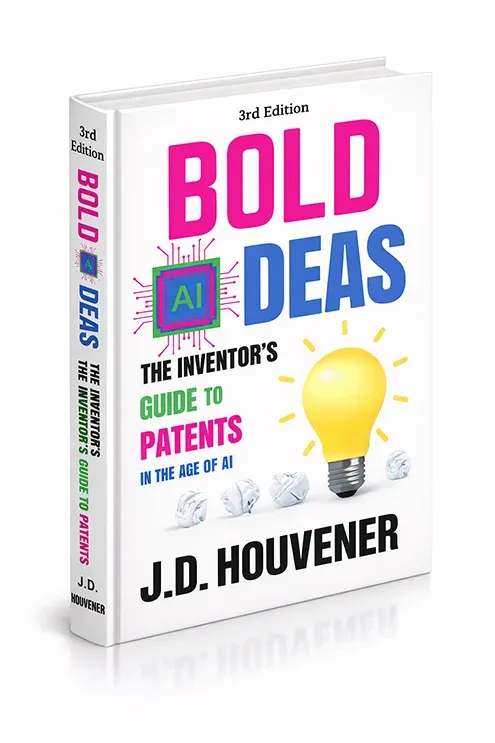
Written by Patent Attorney J.D. Houvener, this updated edition provides inventors, entrepreneurs, and startups with practical guidance for protecting ideas, avoiding costly mistakes, and navigating the patent process with confidence.
Whether you’re exploring a new invention, building a startup, or preparing to file a patent application, our team is here to help you move forward with confidence. Get personalized guidance from experienced patent professionals who understand the challenges inventors face.

We are a full-service patent and trademark prosecution firm. We help inventors and entrepreneurs research, protect, and monetize their intellectual property in the marketplace.
Schedule a Discovery Call 601-298-8425
Copyright © 2026 - Bold Patents• All Rights Reserved. Digital Marketing By: 